
Florida Mechanical Contractor CE Requirements: The 2026 Compliance Guide

What if the August 31st deadline didn’t have to be a source of last-minute panic? For many professionals, staying current with Florida mechanical contractor CE requirements feels like a race against the clock. You’re busy in the field, and the last thing you need is the stress of wondering if you’ve met the exact CILB mandates or if your credits will actually show up in the DBPR system. It’s a common frustration to feel buried under regulatory fine print when you just want to keep your license active and your business moving forward.
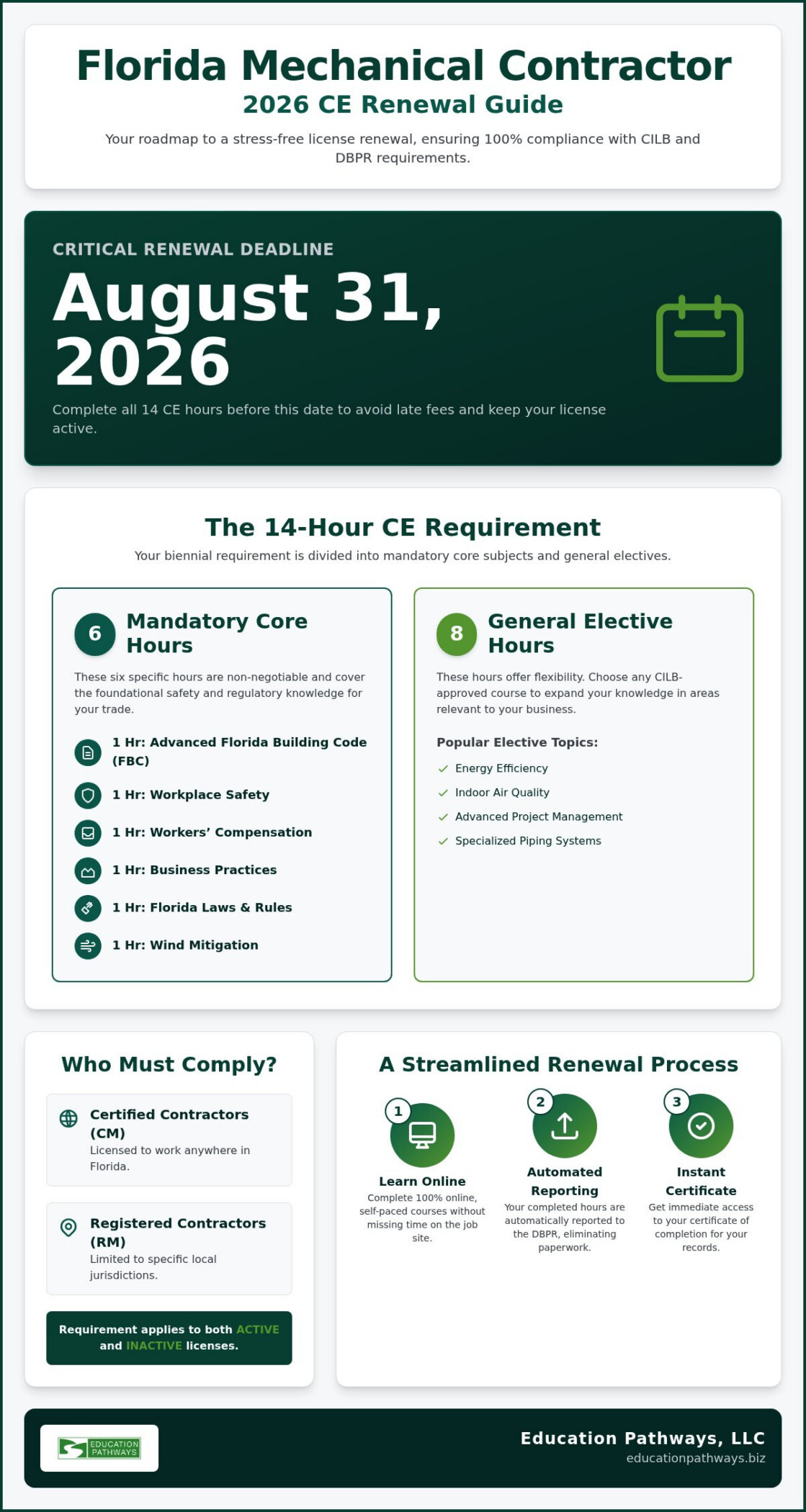
We understand that your time is your most valuable asset. This guide is designed to help you master the mandatory 14-hour continuing education requirements for your 2026 renewal with total confidence. You’ll learn exactly how to balance mandatory topics like the Florida Building Code and Workers’ Compensation with your elective hours. We’ll show you how to achieve 100% compliance through a streamlined process that includes automated state reporting and instant access to your completion certificates. By the end of this article, you’ll have a clear, step-by-step roadmap to navigate the 2026 deadline without the usual administrative friction.
Key Takeaways
- Identify the critical August 31, 2026, deadline for Certified Mechanical Contractors to ensure your license remains in good standing and avoid late fees.
- Master the 14-hour Florida mechanical contractor CE requirements by understanding the specific balance between mandatory core subjects and general elective credits.
- Discover the efficiency of 100% online, self-paced courses that allow you to fulfill your educational obligations without missing time on the job site.
- Learn how automated reporting to the DBPR and instant certificate issuance can eliminate the stress of manual paperwork and compliance tracking.
Understanding the Florida Mechanical Contractor License Cycle
The Construction Industry Licensing Board (CILB) operates under the Department of Business and Professional Regulation (DBPR). It sets the standard for every Florida mechanical contractor CE requirements cycle. Whether you hold a Certified (CM) or Registered (RM) license, the board ensures you stay current with evolving building codes and safety standards. This oversight is similar to how the state regulates a general contractor license, maintaining high professional standards across the industry. Keeping your credentials active requires a clear understanding of when and how to report your hours.
Licensees typically fall into two categories. Certified Mechanical Contractors (CM) have the authority to work anywhere in the state. Registered Mechanical Contractors (RM) are limited to specific local jurisdictions where they’ve provided evidence of competency. Regardless of your designation or whether your license is currently active or inactive, you must meet the 14-hour CE mandate every two years. If your license is inactive, you still need to complete these hours to maintain your standing and simplify the process when you decide to return to active status.
The August 31, 2026 Deadline
The calendar is ticking toward August 31, 2026. This date is the hard cutoff for all Certified Mechanical Contractors in Florida. Missing this deadline isn’t just a minor oversight; it can lead to hefty late fees or even the expiration of your professional credentials. You must complete your CE hours before you submit your renewal application. Waiting until the final week creates unnecessary risk, especially if there’s a delay in reporting your credits to the DBPR. It’s best to finish your courses early to ensure your Florida contractor license renewal goes through without a hitch.
Scope of Work: Mechanical vs. HVAC Contractors
Mechanical Contractors handle a broader scope than standard HVAC technicians. Your work includes unrestricted heating, air conditioning, refrigeration, and specialized piping systems. Because you often deal with high-pressure boilers and complex commercial systems, safety and workers’ compensation training is vital. While Class A and Class B Air Conditioning contractors focus on specific cooling systems, your mechanical license requires a more comprehensive understanding of industrial applications. Staying compliant with Florida mechanical contractor CE requirements ensures you’re legally cleared for this expanded scope of work while protecting your business from liability.
The 14-Hour Credit Breakdown: Mandatory vs. General
Meeting the 14-hour total for Florida mechanical contractor CE requirements doesn’t have to be complicated. Florida Statute mandates this total every two years to ensure professional competence across the board. While the total number is fixed, the way you spend those hours is split between specific core subjects and general electives. Most professionals find that choosing a pre-built package is the most efficient way to ensure no mandatory topic is accidentally overlooked.
The 6 Mandatory Core Hours
The CILB requires six specific hours that cover the regulatory and safety foundations of the trade. These are non-negotiable and must be reported to the state before your license can be renewed. One of the most critical components is the 1 Hour Advanced Florida Building Code (FBC) module. This isn’t a general code review; it’s a specialized course focused on the most recent updates to the Florida Building Code. Many contractors get caught up here because they take a general code course that doesn’t meet the “Advanced” designation required by the board.
Along with the code module, you must complete 1 Hour of Workplace Safety and 1 Hour of Workers’ Compensation. These subjects are vital for mechanical trades where heavy equipment and high-pressure systems are standard. You’ll also need 1 Hour of Business Practices, 1 Hour of Florida Laws and Rules, and 1 Hour of Wind Mitigation. This last hour is especially important in our state. It focuses on protecting structures and mechanical systems from hurricane-force winds, which is a key priority for any licensed contractor working in Florida.
Maximizing Value in the 8 General Hours
The remaining eight hours offer you the freedom to choose topics that actually help your business grow. You aren’t restricted to a single subject. Any CILB-approved course will count toward this total. This is your opportunity to explore energy efficiency, indoor air quality, or advanced project management. Organizations like the Mechanical Contractors Association often highlight these areas as key drivers for modern industry success. Using these credits to sharpen your competitive edge makes the renewal process feel like a strategic investment rather than a biennial chore. You can select courses that align with your specific niche, whether that’s commercial refrigeration or industrial piping.
If you’re looking for a way to manage these credits without the headache, you can find everything you need in a comprehensive Florida contractor CE hub. This approach ensures you meet all 14 hours in one streamlined process, allowing you to get back to the job site faster.
Online vs. In-Person CE: Choosing the Efficient Path
The days of sitting in a crowded hotel conference room for two full days are largely over. Most professionals now choose digital platforms to meet their Florida mechanical contractor CE requirements. This shift isn’t just about convenience; it’s about business survival. When you’re managing complex mechanical installations across multiple job sites, you can’t afford to lose sixteen or twenty hours of billable time to travel and classroom sessions. Online education allows you to keep your crew moving while you handle your compliance in the gaps of your schedule.
Digital courses eliminate the hidden costs that often come with traditional training. You won’t spend money on fuel, hotel stays, or expensive meals. More importantly, you won’t lose the revenue from missed service calls or delayed project milestones. By choosing an online path, you turn downtime into productive compliance time. You can finish a module during a lunch break or while waiting for a permit approval. This flexibility is the primary reason why Florida contractors have embraced the digital transition. Modern platforms offer several key advantages:
- Zero Travel Time: Complete your hours from your office, home, or truck.
- Reduced Opportunity Cost: Stay available for emergency calls and client consultations.
- 24/7 Accessibility: Learn whenever it fits your workflow, day or night.
- Cost Efficiency: Avoid the overhead of physical seminars and printed materials.
The Benefits of Self-Paced Learning
Modern platforms are built for the reality of a contractor’s life. You don’t have to finish all 14 hours in one sitting. You can start a course on your laptop in the office and finish it on your tablet at home. This “start and stop” functionality ensures you never lose progress if a client calls or an emergency arises on-site. Accessibility on mobile devices means your education goes where you go. Once you complete the final module, you receive an instant certificate. This provides immediate proof of completion for your own records before the state reporting process is finalized.
Quality and Approval: Ensuring Your Credits Count
Speed doesn’t matter if your credits aren’t accepted. You must verify that your education provider is officially approved by the DBPR and the CILB. You can check a provider’s credentials directly on the MyFloridaLicense portal by searching their name or license number. Using an unapproved source is a waste of time and money that could lead to a rejected renewal application. To ensure your hours are valid, you should only enroll in DBPR-approved online classes that offer automated reporting. This direct connection between the provider and the state board is the final piece of the puzzle for a stress-free 2026 renewal.
Step-by-Step: How to Renew Your Mechanical License in 2026
Renewing your professional credentials shouldn’t be a mystery. Once you’ve mastered the Florida mechanical contractor CE requirements, the actual renewal process follows a logical sequence. It begins with your education and ends with a confirmation from the state. By following a structured approach, you can avoid the common pitfalls that lead to delays or rejected applications. Efficiency is key when the August 31, 2026, deadline approaches.
The Automated Reporting Process
The most stressful part of renewal is often wondering if the state actually knows you finished your hours. When you complete your courses through Education Pathways, we report your credits to the DBPR automatically. This eliminates the need for you to manually upload certificates or mail in paper forms. Typically, your hours will appear on your state profile within 24 to 48 hours. We handle the heavy lifting of data transmission so you can stay focused on your projects.
If you don’t see your credits reflected after a few business days, don’t panic. The first step is to verify that your license number was entered correctly during enrollment. A single digit error is the most common cause of reporting delays. You should also ensure that you haven’t accidentally taken the same course twice in the same cycle, as the DBPR system will only count unique course numbers toward your 14-hour total. Our system is designed to prevent these errors, giving you peace of mind that your data is accurate.
Finalizing the DBPR Application
After your credits are visible in the system, you must log in to your DBPR Online Services account to finish the job. This is a separate step from completing your education. You’ll navigate to the renewal section and complete the “Affirmation” step. This is where you legally confirm that you’ve met all Florida mechanical contractor CE requirements for the current cycle. You don’t need to mail in physical proof unless you’re specifically audited, but the affirmation is a mandatory part of the digital application.
The final move is paying the state renewal fee. The portal accepts major credit cards, making the transaction fast and secure. Once the payment is processed and your CE is verified, your license status will update to “Active” for the new cycle. Even though the process is digital, Florida law requires you to maintain copies of your completion certificates for seven years. Keep digital backups in a secure cloud folder or print physical copies for your office files. This ensures you’re prepared if the board requests a records review in the future.
Ready to get started on your path to compliance? You can follow these license renewal steps to ensure your business stays active and legal without the administrative headache.
Streamlining Your Compliance with Education Pathways
Managing your professional development shouldn’t feel like a second job. Education Pathways has been a dedicated partner for Florida tradespeople since 2002. We’ve spent over two decades refining our platform to meet the exact needs of licensed professionals. When you’re facing the 2026 deadline, you need a provider that understands the nuances of Florida mechanical contractor CE requirements. Our 100% online, self-paced courses are designed to fit into your busy schedule without causing unnecessary friction. We’ve removed the hurdles of traditional learning to give you a direct path to renewal.
The Florida Contractor CE Hub
Our platform centers on the Florida Contractor CE Hub. This user-friendly dashboard allows you to manage all 14 hours of your required training from one central location. You can track your progress in real-time and jump between modules whenever you have a few free minutes between job sites. The most valuable feature for many is our automated reporting. As soon as you finish a course, our system begins the process of notifying the state. This significantly reduces renewal anxiety and ensures your record is updated well before the August 31st cutoff.
You don’t have to worry about lost paperwork or forgotten deadlines. The dashboard keeps everything organized, showing you exactly which credits you’ve completed and what’s left to do. If you’re managing multiple licenses or have a team of contractors, this centralized view is a massive time-saver. It’s built for speed and clarity, allowing you to get in, get your hours, and get back to work. There’s no waiting for a manual review; the system works as fast as you do.
Why Thousands of Florida Contractors Trust Us
Reliability is our hallmark. We don’t just offer mechanical courses; our catalog spans multiple industries, including CAM, Real Estate, and Architecture. This breadth of expertise ensures our material is always professional, efficient, and up to date with the latest CILB standards. We avoid the fluff and jargon found in other programs. Instead, we provide direct, actionable information that helps you run a better business. If you’re looking for a comprehensive resource, check out our DBPR-approved online classes to see how we simplify the path to compliance.
Choosing Education Pathways means choosing peace of mind. You get instant certificates for your records and the confidence that comes with working with a seasoned veteran in the education field. We’ve helped thousands of contractors navigate their renewal cycles since 2002 by providing a reliable bridge between complex state rules and simple execution. Our team understands the time constraints you face every day. We’ve done the heavy lifting of vetting the information so you don’t have to. Let us handle the administrative burden of reporting so you can focus on keeping Florida’s mechanical systems running smoothly.
Secure Your Mechanical License for the 2026 Cycle
Navigating the biennial renewal cycle doesn’t have to be a burden on your business. By understanding the specific breakdown of the 14-hour total and the critical importance of the August 31, 2026, deadline, you can plan your compliance with precision. Meeting Florida mechanical contractor CE requirements is about more than just checking a box; it’s about staying current with the Advanced Florida Building Code and safety standards that protect your projects.
Education Pathways is here to simplify every step of this process. As a DBPR Approved Provider, we offer a streamlined platform built for the way you work. You’ll benefit from instant certificates upon completion and automated daily reporting to the state board, ensuring your credits are verified without delay. Don’t let the administrative pressure of renewal distract you from your work in the field.
Complete Your Florida Mechanical Contractor CE Now and enjoy the peace of mind that comes with professional, reliable compliance. You’ve worked hard to build your career; we’ll help you keep it moving forward.
Frequently Asked Questions
Do Florida Mechanical Contractors need 14 hours of CE for 2026?
Yes, all licensed mechanical contractors must complete 14 hours of continuing education every biennial cycle. This applies to both active and inactive license holders. The total consists of six mandatory core hours and eight general elective hours. Meeting the Florida mechanical contractor CE requirements ensures your business remains compliant with the Construction Industry Licensing Board. Failing to meet this total will prevent you from successfully renewing your license through the DBPR portal.
When is the next deadline for Florida contractor license renewal?
The next critical deadline for Certified Mechanical Contractors (CM) is August 31, 2026. Certified licenses renew in even-numbered years, while Registered Mechanical Contractors (RM) typically renew on August 31 of odd-numbered years. You must finish all 14 hours of education before submitting your renewal application and paying the state fee. Early completion is highly recommended to avoid technical delays or last-minute reporting issues as the state-wide cutoff approaches.
Does Education Pathways report my credits to the DBPR automatically?
Yes, Education Pathways provides automated daily reporting to the state board for all completed credits. Once you finish a course, our system transmits the data directly to the Department of Business and Professional Regulation. This process usually updates your state profile within 24 to 48 hours. You won’t need to manually upload documents or mail in paper certificates. This reliable synchronization gives you peace of mind that your compliance status is officially recognized.
Can I complete my 14-hour Florida CE course on a mobile phone?
Yes, you can complete your entire 14-hour course on a smartphone, tablet, or laptop. Our platform is fully mobile-responsive and designed for busy professionals who need to learn between job sites. The self-paced format allows you to start a module on one device and finish it on another without losing your progress. This flexibility makes it easy to fulfill your education requirements during lunch breaks or while waiting for project inspections.
What happens if I miss the August 31, 2026 renewal deadline?
Missing the August 31, 2026, deadline results in immediate late fees and your license status changing to “Delinquent.” If you don’t renew within the following cycle, your license may expire entirely, requiring a much more complex reinstatement process. You’ll be legally unable to pull permits or sign contracts for new mechanical work until the license is active again. Completing your education early protects your business from these costly professional and legal interruptions.
Do I need a separate certificate for each of the 14 hours?
You don’t need to track 14 separate documents if you enroll in a comprehensive 14-hour package. While our system generates individual certificates for every hour completed, a full package summary is also provided for your records. Florida law requires you to maintain these digital or physical copies for seven years in case of a board audit. We provide instant access to these files as soon as you finish each module for your convenience.
Are the Florida Mechanical Contractor CE requirements different for registered vs. certified licenses?
The 14-hour requirement is identical for both registered and certified mechanical contractors, but the renewal schedule differs. Certified contractors (CM) must renew by August 31 of even-numbered years, such as 2026. Registered contractors (RM) follow an odd-numbered year cycle. Both groups must still cover the same mandatory core topics, including Workers’ Compensation and the Advanced Florida Building Code. Understanding these Florida mechanical contractor CE requirements ensures you follow the correct biennial timeline.
What is the “Advanced Building Code” requirement for 2026?
The Advanced Building Code requirement is a mandatory one-hour module focused on the latest updates to the Florida Building Code. It is not the same as a general code review course. The CILB requires this specific “Advanced” designation to ensure contractors stay current with specialized state standards. Our 2026 compliance packages include this approved module, so you don’t have to search for it separately or worry about missing a vital core credit.