
Texas Real Estate Legal Update Courses: The 2026 License Renewal Guide

Your Texas real estate license is more than a professional credential; it’s a shield that requires constant maintenance to stay effective. With the 89th Texas Legislature introducing significant shifts like mandatory written buyer representation agreements and new foreign investment restrictions, the stakes for your 2026 renewal are high. Staying compliant shouldn’t feel like a second job, yet it’s common to feel frustrated by curriculum changes or the fear of missing a deadline. Accessing high-quality Texas real estate legal update courses is the most efficient way to protect your career and meet TREC requirements without the stress.
We know your time is valuable and you need a direct path to license renewal. This guide ensures you master the mandatory 2026-2027 TREC Legal Update requirements while keeping your business running smoothly. You’ll find clear details on the new legislative updates, current renewal fees, and the fastest way to secure an instant certificate of completion. We’ll show you how to finish your 8 hours of mandatory CE quickly and ensure your credits are reported automatically to the state board. By the end of this guide, you’ll have a clear roadmap to a successful and compliant renewal.
Key Takeaways
- Master the mandatory 8-hour requirement for Legal Update I and II to ensure your license remains active for the 2026 cycle.
- Identify the critical shifts from the 89th Texas Legislature that affect property management and landlord-tenant disclosures.
- Choose the right Texas real estate legal update courses to gain the flexibility of 100% online, self-paced learning.
- Understand the core differences between Legal Update I and II, including new contract forms and practical fair housing applications.
- Learn how to eliminate administrative stress through automated reporting to TREC and instant certificate issuance.
Understanding the TREC Mandatory Legal Update Requirements for 2026
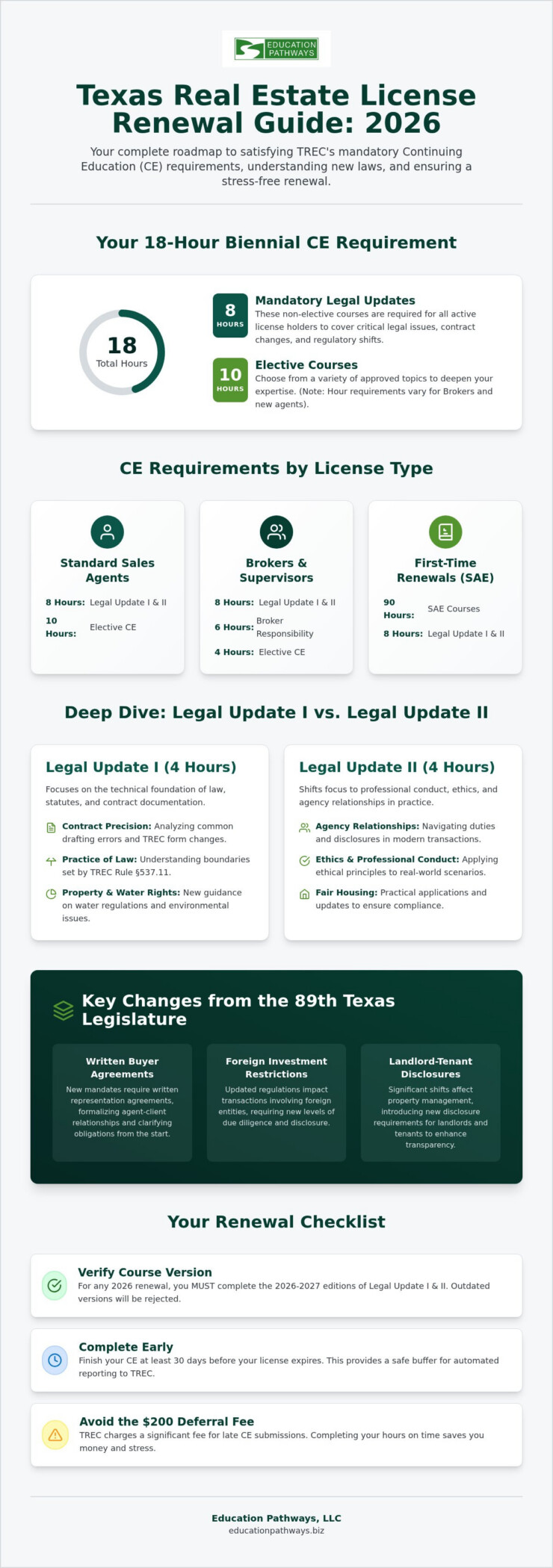
The Texas Real Estate Commission (TREC) mandates specific education to maintain high professional standards across the state. Every two years, active license holders must complete 18 hours of approved continuing education (CE). Unlike elective courses where you choose the topic, Legal Update I and Legal Update II are non-elective. These courses are designed by TREC to address emerging legal issues, contract changes, and regulatory shifts. TREC Rule §535.92 explicitly governs these mandatory education hours, ensuring every agent operates with the same foundational knowledge of current laws.
2026 represents a critical transition year for your license. The curriculum updates reflect the significant changes passed during the 89th Texas Legislature. These aren’t just refresher courses; they are essential briefings on new property rights, fraud prevention standards, and representation requirements. Failing to complete the correct version of these Texas real estate legal update courses can lead to an inactive license or unexpected deferral fees.
Total Hours Required for Sales Agents vs. Brokers
The 18-hour biennial requirement is structured to balance core legal knowledge with specialized electives. For most sales agents, the breakdown includes 4 hours of Legal Update I, 4 hours of Legal Update II, and 10 hours of elective CE. However, the path changes depending on your license type and experience level.
- Standard Sales Agents: 8 hours of mandatory legal updates plus 10 hours of electives.
- Brokers and Supervisors: If you sponsor agents or are a designated supervisor, you must also complete the 6-hour Broker Responsibility course. This leaves only 4 hours for electives.
- First-Time Renewals (SAE): New agents don’t follow the standard 18-hour CE cycle yet. They must complete 90 hours of Sales Agent Apprentice Education (SAE) in addition to Legal Update I and II.
Understanding these Texas real estate CE requirements ensures you don’t waste time on credits that don’t count toward your specific renewal needs.
The 2026-2027 Course Cycle Timeline
TREC updates the mandatory curriculum every two years. The 2024-2025 course versions generally expire at the end of 2025. If your license renewal date falls in 2026, you must complete the 2026-2027 editions of the Texas real estate legal update courses. Always verify the course version on the provider’s site before starting. Taking an outdated version won’t satisfy TREC’s requirements for a 2026 renewal. We recommend completing your hours at least 30 days before your license expires. This buffer allows for automated reporting and avoids the $200 CE deferral fee that TREC charges for late submissions.
Breaking Down Legal Update I and Legal Update II: Course Content
TREC divides the mandatory curriculum into two distinct four-hour segments. Legal Update I serves as the technical foundation, focusing on the mechanics of the law and contract documentation. Legal Update II shifts toward the professional’s conduct, emphasizing ethics and agency relationships. Completing both Texas real estate legal update courses from an approved provider is non-negotiable for an active license. High-quality Texas real estate legal update courses bridge the gap between complex legislation and everyday practice, ensuring you possess both the technical knowledge and the ethical framework required for modern real estate transactions.
Key Topics in Legal Update I (2026-2027)
The 2026-2027 version of Legal Update I places a heavy emphasis on contract precision. TREC continues to refine its forms to reduce disputes and clarify obligations between parties. You’ll analyze common drafting errors that often lead to disciplinary action or failed closings. A major focus is TREC Rule §537.11, which outlines the strict boundaries regarding the unauthorized practice of law. Agents must understand how to navigate these forms without crossing into legal advice, especially as addenda and specialty disclosures grow more complex.
Legislative updates from the 89th Texas Legislature have introduced new complexities regarding property rights and tax exemptions. Additionally, the 2026 curriculum includes expanded guidance on water regulation and environmental concerns. In a state where water rights are increasingly contested, understanding how these issues impact land use is vital. This section of the course provides the tools to identify potential red flags before they derail a transaction.
Essential Ethics and Agency in Legal Update II
While the first course covers the “what” of real estate law, Legal Update II covers the “how” of professional behavior. This course centers on fiduciary duties, which remain the cornerstone of the agent-client relationship. You’ll examine modern agency disclosure requirements to ensure clients fully understand who represents their interests. Clear communication is your best defense against claims of misrepresentation or breach of duty.
Fair housing remains a top priority for TREC in the current cycle. The 2026 curriculum provides practical applications for recognizing and preventing steering or discriminatory practices in digital and physical spaces. Through real-world case studies, you’ll learn to identify subtle biases that can lead to significant legal liability. This course is designed to protect both the consumer and your professional reputation. If you need to complete these requirements quickly, you can find the latest Texas real estate CE classes available in a flexible, self-paced format.
Key Legislative Changes from the 89th Texas Legislature
The 89th Texas Legislature introduced a wave of regulatory shifts that fundamentally alter the Texas Real Estate License Act (TRELA). These changes are central to the 2026-2027 Texas real estate legal update courses. One of the most significant updates involves property management and landlord-tenant disclosures. New rules now require clearer standards for identifying and refusing fraudulent documents, as seen in SB 647. Additionally, HB 4063 requires property owner signatures on unilateral memorandums of contract. This move prevents the clouding of titles, a common tactic used in predatory real estate practices. SB 17 also prohibits the acquisition of real property by individuals from specific countries identified as security threats, creating a new layer of due diligence for agents during the intake process.
Disclosures for properties in special districts have also been tightened. Agents must ensure buyers are fully informed about local taxing authorities and utility districts before closing. Marketing and advertising rules for Texas Realtors have evolved to keep pace with digital trends. Transparency is no longer just a best practice; it’s a legal mandate. All digital advertisements must clearly identify the broker’s name and the licensed status of the individual agent to avoid consumer confusion. These legislative tweaks ensure that the public remains protected in an increasingly complex market.
TREC Rule Changes and Advisory Committee Updates
The Texas Real Estate Commission (TREC) relies heavily on the Broker-Lawyer Committee to vet contract revisions. In 2026, this committee focused on clarifying language in residential sales contracts to reflect new legislative mandates. Another major shift involves virtual office providers. TREC has established stricter standards for physical office requirements to ensure every brokerage maintains a verifiable base of operations. Enforcement protocols for license holder misconduct have also been strengthened. The commission now has more direct tools to address ethical breaches, ensuring higher accountability across the industry.
Practical Application for 2026 Transactions
Legislative changes directly impact your listing and buyer agreements. SB 1968 now requires written agreements for buyer representation, ending the era of informal handshake deals. This change protects your commission and clarifies the agency relationship from the start. Compliance requires a proactive approach to documentation. For example, the 2026 regulatory framework demands a higher standard of transparency in water rights disclosures to protect buyers from unforeseen land-use restrictions. Avoiding compliance pitfalls starts with understanding these nuances. Enrolling in Texas real estate legal update courses ensures you have the practical knowledge to navigate these new rules while meeting your Texas real estate CE requirements.
Choosing the Best Texas Real Estate CE Courses Online
Selecting the right provider for your Texas real estate legal update courses is a decision that directly impacts your productivity. You need a partner that prioritizes speed, reliability, and ease of use. TREC-approved providers vary significantly in their delivery methods. While some legacy schools still rely on “online correspondence” that can involve slow manual grading, modern professionals require 100% digital, interactive modules. These platforms offer immediate feedback and allow you to move through the material without waiting for a proctor or instructor. If you’re facing a looming renewal deadline, instant certificates are non-negotiable. They provide the immediate verification you need to ensure your license remains active.
You also have the choice between individual legal update modules and comprehensive 18-hour packages. For many agents, a full bundle is the most efficient choice. It covers the mandatory 8 hours of legal updates and the 10 hours of electives in one streamlined experience. This approach keeps all your records in one place and simplifies the tracking of your progress. You can access TREC-approved Texas real estate CE packages that are specifically designed to meet every requirement for the 2026 cycle.
The Advantage of Self-Paced Learning
Flexibility is the greatest benefit of a truly digital platform. You don’t have to clear your calendar for a six-hour block. You can pause a module after a listing appointment and resume it on your mobile device while waiting for a client. This compatibility with modern technology means you can learn on the go, whether you’re at your desk or between showings. It completely eliminates the need for travel to a physical campus, saving you hours of commuting time and allowing you to focus on closing deals.
Automatic Reporting: The “Hidden” Feature to Look For
The reporting process between the provider and the state board is a critical link in your renewal chain. When a provider offers automatic reporting, they transmit your completion data directly to the commission. This removes the administrative burden from your shoulders. Manual certificate uploading is a common source of frustration; it’s prone to errors and often leads to significant renewal delays. Before you enroll, verify that your provider handles this step. You should also review the Texas real estate CE requirements to confirm that your chosen credits will be valid for your specific license type. Choosing a provider that prioritizes these automated features ensures a frictionless path to compliance.
Streamlining Your License Renewal with Education Pathways
Education Pathways, LLC provides a streamlined solution for agents who value their time. Since 2002, we’ve focused on creating a reliable path for licensed professionals to meet their regulatory obligations. Our Texas real estate legal update courses are specifically updated for the 2026-2027 cycle, ensuring you remain compliant with the latest TREC rules. We believe in a no-nonsense approach; our courses are 100% online, interactive, and completely self-paced. You won’t find unnecessary fluff here. Instead, you’ll find the precise information you need to protect your career. Our platform is built for speed, ensuring your Legal Update I and II credits reach TREC instantly so you can focus on your next closing.
Our Texas Real Estate CE Hub
Accessing our Texas Real Estate CE Hub allows you to manage your entire 18-hour renewal in one location. We’ve simplified the enrollment process for Legal Update I (2026-2027) and Legal Update II, making it easier than ever to get started. This hub acts as your personal command center, where you can track progress and access your instant certificates. If you need a deeper dive into the specific rules governing this year, refer to our Texas Real Estate Continuing Education: 2026 Compliance Guide for a broader overview of the current standards.
Getting Started with Your 2026 Renewal
The path to a compliant license is a logical process designed for busy professionals. First, enroll in your chosen modules through our secure portal. Second, complete the interactive content at your own speed. Third, renew your license through the TREC portal once our automated reporting system verifies your credits. There’s no need to travel to a physical classroom or wait for manual credit reporting. We’ve optimized every step to ensure your data is secure and your education is valid. Our state-approved curriculum gives you the peace of mind that comes with knowing you’re fully compliant. Experience the satisfaction of a requirement completed without complication. Enroll in your Texas Real Estate Legal Update courses today and stay ahead of the 2026 renewal cycle.
Secure Your 2026 License Renewal Today
Staying compliant with the latest TREC mandates doesn’t have to disrupt your business. You’ve seen how the 89th Texas Legislature has reshaped property rights and agency disclosures, making the 2026-2027 curriculum more critical than ever. By choosing 100% online, self-paced Texas real estate legal update courses, you can master these changes on your own schedule. Our platform takes the administrative burden off your plate with automated reporting to TREC and instant certificates of completion. As a TREC-approved provider serving professionals since 2002, we ensure your credits are valid and your renewal is seamless.
Don’t let a deadline create unnecessary stress in your career. Take the final step toward a worry-free renewal and protect your professional standing. Complete your mandatory 2026 Texas Legal Update courses online and stay focused on your clients. You’re ready to tackle the new year with confidence and a fully compliant license.
Frequently Asked Questions
Can I take Legal Update I and II in the same day?
Yes, you can complete both courses in a single day. Each course is four hours long, totaling eight hours of study. Since TREC allows license holders to earn up to 12 hours of continuing education credit in any 24-hour period, finishing both legal updates fits well within the daily limit. This is a highly efficient way to knock out nearly half of your 18-hour biennial requirement in one focused session.
How long do I have to complete my Texas real estate CE courses after enrolling?
You can work through your courses at your own speed after enrollment. Our 100% online, self-paced modules allow you to pause and resume whenever your schedule permits. While there isn’t a strict completion deadline from our side, you must finish all 18 hours before your license expiration date. Completing your Texas real estate legal update courses early ensures you avoid the $200 CE deferral fee charged by TREC for late submissions.
Does Education Pathways report my credits directly to TREC?
Yes, we handle the reporting process for you. Once you successfully complete a course, our system automatically transmits your credits to the Texas Real Estate Commission. This automated feature eliminates the need for manual uploads and reduces the risk of administrative errors. We’ve prioritized this workflow since 2002 to ensure our students experience a frictionless renewal process, allowing you to focus entirely on your real estate transactions and client relationships.
What happens if I miss my renewal deadline but have completed my CE?
If you miss the deadline but have finished your CE, you’ll need to pay a late renewal fee. For sales agents, the fee is $143 if you’re less than 90 days late, increasing to $176 if you’re between 90 days and six months late. Brokers also face increased costs for late submissions. It’s critical to submit your renewal application through the TREC portal immediately to move your license back to active status and avoid further penalties.
Is the Broker Responsibility course required for all Texas brokers in 2026?
No, the 6-hour Broker Responsibility course is only mandatory for specific individuals. You must take it if you’re a broker who sponsors one or more sales agents, a designated supervisor of a business entity, or a delegated supervisor for six months or more. If you don’t fall into these categories, you only need to complete the standard 8 hours of Texas real estate legal update courses plus 10 elective hours for your renewal.
How quickly will I receive my certificate of completion?
You’ll receive your certificate of completion instantly. As soon as you finish the final module of your course, the system generates a verified digital certificate that you can download immediately. This instant access provides the peace of mind you need, especially during last-minute renewals. You won’t have to wait for manual grading or email delivery; your proof of compliance is available the moment you’re done with the curriculum.
Can I use Legal Update courses from the 2024-2025 cycle for a 2026 renewal?
No, you must use the 2026-2027 versions of the legal update courses for any renewal occurring in 2026. TREC updates the mandatory curriculum every two years to reflect new laws from the 89th Texas Legislature. Taking an outdated course won’t satisfy your renewal requirements and could lead to your license becoming inactive. Always verify that you’re enrolled in the current cycle’s editions before starting your study modules to ensure full compliance.