
2026 Texas Real Estate CE Changes: Compliance Guide

Starting January 1, 2026, showing a residential property without a signed written agreement isn’t just a bad habit; it’s a direct violation of the updated Texas Real Estate License Act. Many agents are currently scrambling to understand what change in realtor course in texas 2026 texas requires for their upcoming license renewal. This shift toward mandatory transparency under Section 1101.563 means the days of informal buyer relationships are officially over.
It’s understandable to feel some pressure regarding these legislative shifts, especially when you’re already balancing a full closing schedule. We’re here to help you navigate the new 2026-2027 Legal Update curriculum and ensure you meet your 18-hour CE requirement without the headache. This guide provides a clear roadmap for the new buyer representation rules, the updated mandatory Broker Responsibility Course, and the most efficient way to secure your credits through TREC-approved online learning. We will break down exactly which courses you need to stay compliant and how to complete them quickly on your own schedule.
Key Takeaways
- Identify the new mandatory requirements for written buyer representation agreements under Section 1101.563 to avoid licensing violations.
- Discover what change in realtor course in texas 2026 texas specifically affects the 2026-2027 Legal Update curriculum and mandatory contract-related hours.
- Master the protocols for showing residential property without representation, including the 14-day limit on non-exclusive agreements.
- Confirm the exact 18-hour CE breakdown for sales agents and brokers, including the mandatory 6-hour Broker Responsibility course for all renewing brokers.
- Streamline your renewal process with TREC-approved, 100% online courses that offer instant certificates and automated state reporting.
The 2026 Legislative Shift: New Rules for Texas Realtors
The 89th Texas Legislative Session significantly reshaped the landscape for residential real estate. Most agents are familiar with the gradual evolution of state laws, but the changes taking effect on January 1, 2026, represent a decisive shift toward consumer protection. The Texas Real Estate Commission (TREC) is now overseeing a transition from voluntary practices to strictly mandated written buyer representation. This move aims to eliminate ambiguity regarding agent duties and compensation, ensuring every consumer knows exactly who represents their interests before a single door is unlocked.
Major Updates to the Real Estate License Act (TRELA)
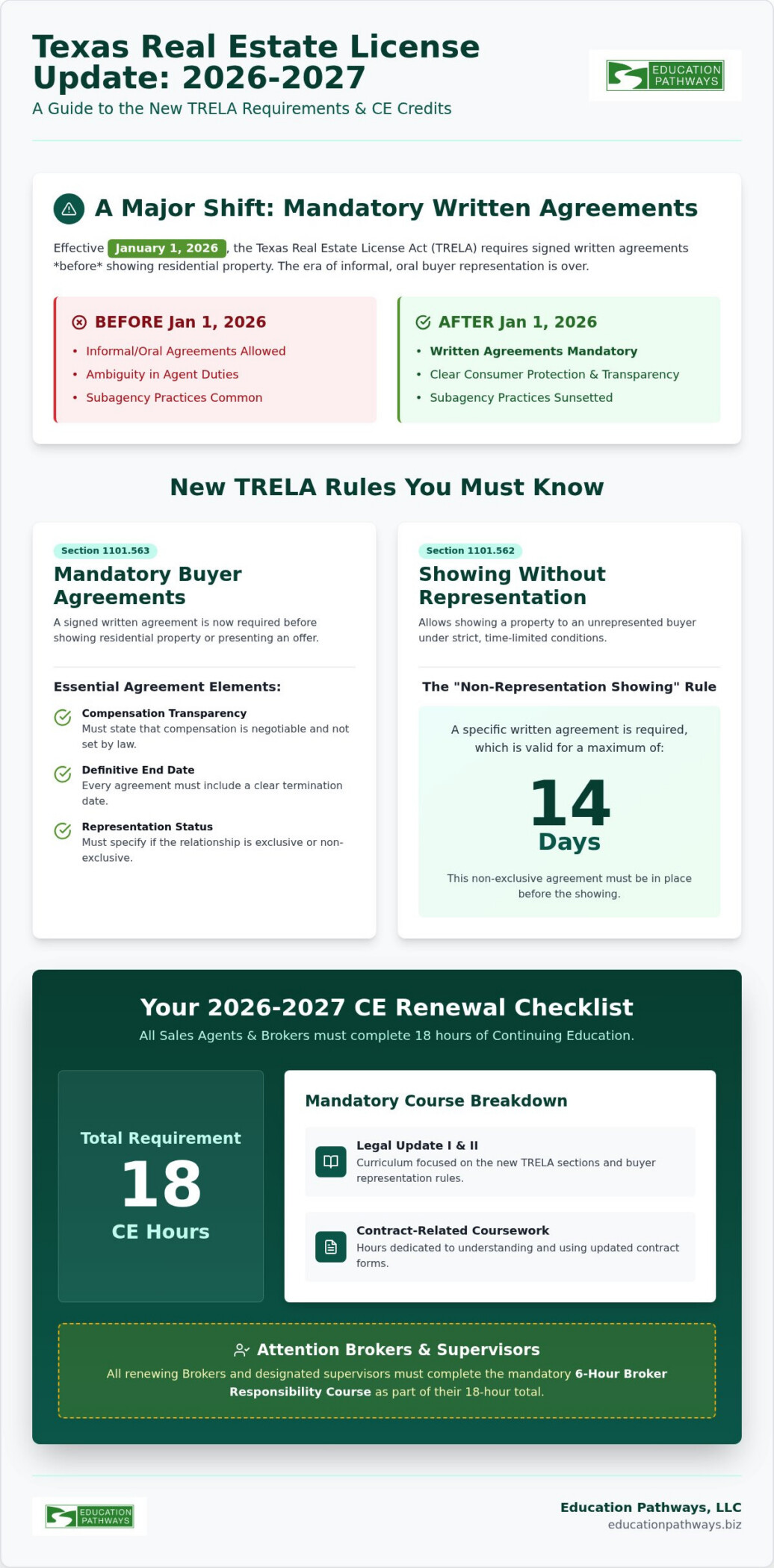
The core of this legislative overhaul resides in two new sections added to TRELA. Section 1101.563 now requires license holders to enter into a written agreement with a prospective buyer before showing any residential property. This essentially ends the era of oral representation in Texas. Additionally, Section 1101.562 introduces the concept of a “Non-Representation Showing.” This allows agents to show property without representing the buyer, provided a specific written agreement is in place for a maximum of 14 days. These updates also effectively sunset traditional subagency practices. By removing references to subagency from the Act, the state has limited the legal scenarios where one broker can represent another broker’s client without a direct contractual link.
Key regulatory changes include:
- Mandatory Signatures: Agreements must be signed prior to showing residential property or presenting an offer.
- Compensation Transparency: All agreements must state that broker compensation is negotiable and not set by law.
- Termination Dates: Every agreement must include a definitive end date and specify whether the relationship is exclusive.
Why Your 2026 Renewal is Different
If you’re asking yourself what change in realtor course in texas 2026 texas has introduced, the answer lies in the direct connection between these laws and your continuing education. The Commission has shifted its enforcement priorities to focus heavily on the Information About Brokerage Services (IABS) form and the timing of written disclosures. Compliance isn’t just about checking a box anymore; it’s about proving you’ve established a clear agency relationship before performing any licensed activities.
Because these laws are so impactful, the 2026-2027 Legal Update curriculum is built almost entirely around these new sections of TRELA. To stay active, you’ll need to master these nuances through Texas real estate CE requirements that reflect the current legislative environment. This renewal cycle requires a proactive approach to avoid the risks of non-compliance during showings and contract negotiations. Understanding the “why” behind these rules is the first step toward a smooth, penalty-free renewal process.
Mandatory Written Buyer Representation Agreements (Section 1101.563)
The transition from oral to written representation is the most significant procedural shift Texas real estate has seen in decades. Effective January 1, 2026, the handshake deal is officially a thing of the past. Under Texas Occupations Code Sec. 1101.563, license holders must secure a signed written agreement before showing any residential property or presenting an offer. This isn’t just a recommendation for better business; it’s a statutory requirement designed to protect both the consumer and the broker. While this primarily impacts residential transactions, agents working in commercial or farm and ranch sectors should note that the standard of care is shifting across the industry. Understanding what change in realtor course in texas 2026 texas covers is essential because these new rules leave very little room for error.
Essential Elements of the New Written Agreements
A compliant agreement must do more than just identify the parties. It needs to clearly define the broker’s duties and the specific services provided to the buyer. One of the most critical additions is the explicit compensation section. You must state the amount or rate of compensation, the source of payment, and include a mandatory disclosure that broker compensation is negotiable. Every agreement requires a definitive termination date and must clarify whether the representation is exclusive or non-exclusive. These details ensure that the buyer isn’t surprised by a bill or a long-term commitment they didn’t fully understand.
Handling Open Houses and Initial Inquiries
The new law creates unique challenges for open houses and spontaneous showing requests. If a prospective buyer refuses to sign an agreement, you cannot show them a residential property as their representative. In these cases, the listing agent can still show the property, but they must clearly explain they represent the seller. If you’re acting as a buyer’s agent, you’ll need to develop a quick, professional “elevator pitch” to explain why the law now requires a signature before the tour begins. It’s helpful to frame this as a consumer protection benefit that ensures they receive the full fiduciary duties they deserve.
Adapting to these requirements doesn’t have to be stressful if you have the right resources. You can find detailed breakdowns of these forms in our Texas real estate CE classes, which are updated for the 2026-2027 cycle. These courses provide the practical scripts and form-filling guides you need to keep your business moving without interruption. By mastering these agreements now, you’ll position yourself as a transparent, law-abiding professional in a market that increasingly values clarity.
Showing Property Without Representation: Section 1101.562
While Section 1101.563 mandates written representation, Section 1101.562 provides a specific, narrow path for license holders to show property without representing the buyer. This “Non-Representation Showing” status is a crucial tool for listing agents and those hosting open houses. It allows you to perform the physical act of showing a home without triggering fiduciary duties to the prospective buyer. However, this isn’t a loophole to avoid paperwork. If you’re wondering what change in realtor course in texas 2026 texas requires you to master, this technical distinction is at the top of the list. You must have a signed non-representation agreement in place before the showing begins.
The limitations of this status are strict. As a non-representative, you’re strictly prohibited from providing advice or opinions to the buyer. You can provide factual data about the property, but you cannot suggest an offer price, critique the home’s condition, or offer negotiation strategies. This differs fundamentally from traditional intermediary status. In an intermediary relationship, the broker represents both parties. In a non-representation scenario, you represent the seller or act as a neutral facilitator. Crossing the line into “advice” can lead to accidental implied agency, which carries significant legal risk under the new 2026 standards.
The Removal of Subagency from TRELA
One of the most profound changes in this legislative cycle is the official removal of “subagency” from the Texas Real Estate License Act. For decades, subagency allowed a cooperating broker to represent the seller through the listing broker. This often led to buyer confusion regarding who was actually looking out for their interests. By removing these references, the 89th Legislature has simplified the professional landscape. You’re either the buyer’s agent through a written agreement, or you’re a non-representative. This change forces a cleaner, more transparent business model that aligns with Texas real estate CE requirements focusing on consumer clarity.
Best Practices for Non-Representation Agreements
To stay compliant, you must use the correct written non-representation forms. These agreements are not open-ended. They must be non-exclusive and have a termination date of no more than 14 days. If a buyer wants to see more properties with you after that window, you’ll need a new form or a full representation agreement. Always ensure the IABS form is delivered and acknowledged before signing the non-representation document. Documenting every interaction is the best way to prove you stayed within the bounds of a facilitator and didn’t inadvertently provide the “advice and opinions” reserved for represented clients.
Navigating the 2026-2027 Texas Legal Update I & II Curriculum
Every two years, TREC refreshes the mandatory core curriculum to reflect the most pressing issues in the industry. For the 2026-2027 cycle, these courses are the primary vehicle for teaching the new buyer representation laws discussed earlier. If you’re wondering what change in realtor course in texas 2026 texas has made these eight hours so critical, it’s the direct integration of Senate Bill 1968. Completion of both Legal Update I and Legal Update II is non-negotiable for all active licensees. These courses provide the legal foundation required to operate under the new transparency standards. Stay compliant today.
Breakdown of Legal Update I Topics
Legal Update I serves as the technical manual for the 89th Legislative Session updates. Beyond the mandatory buyer agreements, this course dives deep into revised TREC rules regarding advertising. The Commission has tightened regulations for team naming conventions. They want to ensure team names don’t mislead the public into thinking a team is its own independent brokerage. You’ll also find updated guidance on handling escrow and earnest money. With the shift toward digital transactions, the 2026 curriculum provides clear protocols for electronic fund transfers. It covers the specific timing of deposits to keep you within state guidelines.
Breakdown of Legal Update II Topics
While the first course handles the technical rules, Legal Update II focuses on ethics and agency. This section covers TREC’s current enforcement priorities. It highlights common complaints that lead to disciplinary action. Fair housing remains a major pillar. You will see new modules on emerging litigation trends and the proper use of technology in marketing. Texas-specific property issues also get significant attention. Expect to review the latest tax law changes and complex water rights issues; these are increasingly vital in rural and suburban transactions across the state.
Mastering these updates doesn’t have to be a burden on your schedule. Our streamlined, TREC-approved courses allow you to learn these updates at your own pace. You can easily complete your Texas real estate license renewal online with instant certificates and automated reporting to the state. It is that simple.
Fulfilling Your 18-Hour CE Requirement with Education Pathways, LLC
Keeping your license active shouldn’t be a source of stress. The standard 18-hour continuing education requirement remains the benchmark for Texas sales agents and brokers during this cycle. This total must include 4 hours for Legal Update I, 4 hours for Legal Update II, and 3 hours of contract-related coursework. The remaining 7 hours are dedicated to electives of your choice. If you’re a broker, remember that the 6-hour Broker Responsibility course is a mandatory part of your 18-hour total for renewals on or after January 1, 2026. Understanding what change in realtor course in texas 2026 texas has implemented ensures you don’t accidentally skip a mandatory module or fall short on credits.
Education Pathways, LLC has been a TREC-approved provider since 2002. We understand that your time is your most valuable asset. Our 100% online, self-paced platform allows you to chip away at your requirements between showings or late at night. Once you finish a course, we provide instant certificates for your records and report your credits directly to the state board. This automated process removes the friction of manual reporting and gives you peace of mind that your records are accurate and official.
Choosing the Right Texas CE Package
Efficiency is key when selecting your curriculum. We recommend bundling Legal Update I and II with your mandatory contract hours to ensure all core requirements are met in one go. You can then tailor your remaining seven hours with electives that actually benefit your specific niche, whether that is property management, luxury residential sales, or commercial leasing. When comparing your options, reviewing a comprehensive guide to the best Texas real estate CE courses online for 2026 can help you identify the right TREC approved CE courses for your renewal goals. You can also browse Texas real estate CE classes to find the combination that best suits your professional goals for the 2026 cycle.
The Renewal Timeline: Avoiding Late Fees
Timing is everything in real estate, and your renewal is no different. TREC recommends submitting your completed CE hours at least 10 days before your license expiration date. This buffer allows for processing time and ensures you aren’t hit with late fees or an inactive license status. It’s easy to get overwhelmed by the technical updates, but a clear checklist makes the process manageable. If you have waited until the last minute, our instant certificates are a lifesaver. They provide immediate proof of completion while our system handles the official reporting. For a step-by-step walkthrough of exactly how to organize and complete your Texas realtor license renewal courses before the deadline, check out our dedicated guide on the topic. For a more detailed look at the 2026 schedule, check out our companion piece, Texas real estate agent CE credits: the 2026 license renewal guide. Staying ahead of the deadline is the simplest way to keep your business running without interruption.
Secure Your Professional Future for the 2026 Texas Shift
The landscape of Texas real estate is shifting toward total transparency. You now have the tools to handle mandatory buyer agreements and navigate the technical nuances of the new TRELA sections with confidence. By mastering the 2026-2027 Legal Update curriculum, you protect your professional reputation from the risks of accidental implied agency. It’s about more than just checking a box; it’s about staying compliant in a market that demands clarity. Knowing exactly what change in realtor course in texas 2026 texas requires keeps you ahead of the curve and ready for your next showing.
Don’t let the new regulations slow your momentum. Enroll in TREC-Approved Texas Real Estate CE Courses Today to secure your license. As a TREC-approved online provider, we provide instant certificates of completion and automated state board reporting to make your renewal effortless. You can focus on your clients while we handle the technical side of your compliance. Stay confident, stay compliant, and keep your business moving forward into 2026.
Frequently Asked Questions
Is a written buyer representation agreement mandatory in Texas in 2026?
Yes, a written buyer representation agreement is mandatory as of January 1, 2026. This change comes from Section 1101.563 of the Real Estate License Act. You must have the agreement signed before you show any residential property or present an offer. This ensures that the buyer understands your duties and compensation from the very start of the professional relationship. It’s a significant move toward consumer protection in Texas.
Can I still show a house to a buyer without a signed agreement?
You can only show a house without representation if the buyer signs a specific non-representation agreement. This document must state that you don’t represent the buyer and it cannot last longer than 14 days. During these showings, you’re strictly prohibited from providing advice or opinions. If you want to offer professional guidance, you must transition to a full written representation agreement first. This protects you from accidental implied agency.
What are the new Legal Update I & II courses for the 2026-2027 cycle?
The new courses focus heavily on the legislative shifts from the 89th Texas Legislature. If you’re looking for what change in realtor course in texas 2026 texas requires, it’s these updated Legal Update I and II modules. They cover mandatory written agreements, the removal of subagency, and updated TREC advertising rules. These eight hours are essential for understanding your new legal obligations in the 2026 cycle and staying fully compliant with the law.
Did subagency get removed from the Texas Real Estate License Act?
Yes, the 89th Legislature officially removed references to subagency from the Texas Real Estate License Act. This change simplifies agency relationships by ensuring agents are either representing a buyer through a written agreement or acting as a non-representative. It eliminates the confusion caused when a cooperating broker represented the seller by default. This move aligns with the state’s broader goal of consumer transparency and professional accountability across the entire Texas real estate market.
How many hours of CE do I need to renew my Texas real estate license in 2026?
Active sales agents need 18 hours of approved continuing education every two years. This total must include 4 hours of Legal Update I, 4 hours of Legal Update II, and 3 hours of contract-related coursework. If you’re a broker who sponsors agents, you must also complete the 6-hour Broker Responsibility course. These requirements apply to all renewals occurring on or after January 1, 2026, to keep your license in active status.
What happens if I don’t complete my Texas CE by the renewal deadline?
Your license will immediately become inactive if you miss the CE deadline. You can’t perform any licensed activities or receive commissions until you’re back in good standing. TREC typically requires a $200 deferral fee if you renew without the credits or a late fee if you miss the expiration date entirely. Completing your hours early is the best way to avoid these unnecessary costs and keep your business running smoothly.
Does Education Pathways report my CE credits to TREC automatically?
We report your credits directly to the state board once you finish your course. You don’t need to mail certificates or notify the commission manually. Our system is designed for speed and accuracy, ensuring your TREC record reflects your hard work within a few business days. This automated reporting is a standard feature of our 100% online, self-paced Texas real estate CE packages, giving you one less thing to worry about.
Are the 2026 Texas realtor course changes applicable to commercial agents?
Yes, the updated Legal Update curriculum is mandatory for all active Texas real estate license holders. While the new written agreement laws specifically target residential property, the broader changes in realtor course in texas 2026 texas apply across the board. Commercial agents must still master the new advertising rules and agency updates to maintain an active license and stay compliant with current TREC enforcement priorities during their next two-year renewal cycle.