
AIA-Approved HSW Courses Online: Choose and Complete CE in 2026

An online course can fit your schedule and still miss the credit requirement you need to meet. Before enrolling in AIA approved HSW courses online, check the course’s HSW designation, how credits are recognized or reported, and whether the content fits your learning needs.
AIA learning credits and state license requirements are separate. A course that counts toward one may not satisfy the other, so review the credit details before enrolling and keep clear completion records.
This guide explains how to assess HSW eligibility, distinguish AIA credit from state requirements, and organize your documentation. It also shows how to compare course objectives, format, assessments, certificates, and reporting details so you can choose online coursework that fits your professional goals and schedule.
Key Takeaways
- Learn what HSW means and why a course’s designation matters when choosing AIA approved HSW courses online.
- Compare learning objectives, format, assessment, certificates, and credit reporting before you enroll.
- Use a practical process to match coursework to your credential’s requirements and keep clear completion records.
- See how self-paced online learning, automated assessments, and instant certificates can make architecture CE easier to manage.
What Are AIA-Approved HSW Courses Online, and Which Credits Do They Count Toward?
Quick definition: An online course describes how you learn; an HSW designation identifies qualifying Health, Safety, and Welfare content; and the credit pathway determines where completed learning can be counted. These terms are related, but they are not interchangeable.
HSW education focuses on protecting the public’s health, safety, and welfare through architecture. For Architect and International Associate members, the AIA’s annual continuing education requirement is 18 Learning Units (LUs), including at least 12 HSW LUs. One hour of continuing education equals one LU. The American Institute of Architects administers the AIA Continuing Education System (AIA CES), which tracks member learning units.
Course terminology matters. AIA CES-registered providers report eligible course completions through the AIA CES system, but provider participation alone doesn’t make every course HSW-eligible. Look for a course-specific HSW designation and clear information about its credit type. If you’re tracking Florida requirements, review the Florida architecture continuing education options alongside your AIA learning needs.
What makes an online course HSW-eligible?
Eligibility depends on course content and designation, not the screen or device you use. Under AIA’s HSW criteria, at least 75% of a course’s content and instructional time must address HSW topics. A course may be online and still offer only elective learning units, so check the specific course listing rather than relying on its subject area or delivery format.
For example, a course about accessibility, life safety, or building performance may relate to HSW, but the topic alone doesn’t establish eligibility. Confirm that the course carries the HSW designation and note how its credits are classified before enrolling. When choosing AIA approved HSW courses online, verify the credit status rather than relying on the title.
Do AIA credits automatically satisfy state license requirements?
No single credit label guarantees that a course will satisfy every state’s license-renewal rules. AIA CES membership requirements and state licensing requirements are separate systems. A state may set its own credit totals, approved subject areas, reporting process, or other conditions.
Check the current rules from the licensing authority for each credential and jurisdiction you hold. Confirm the required topics, renewal period, and accepted documentation before counting a course toward state renewal. Track AIA LUs and state-required continuing education separately, even when one course may be relevant to both.
How AIA CES and HSW Course Credits Work from Enrollment to Completion
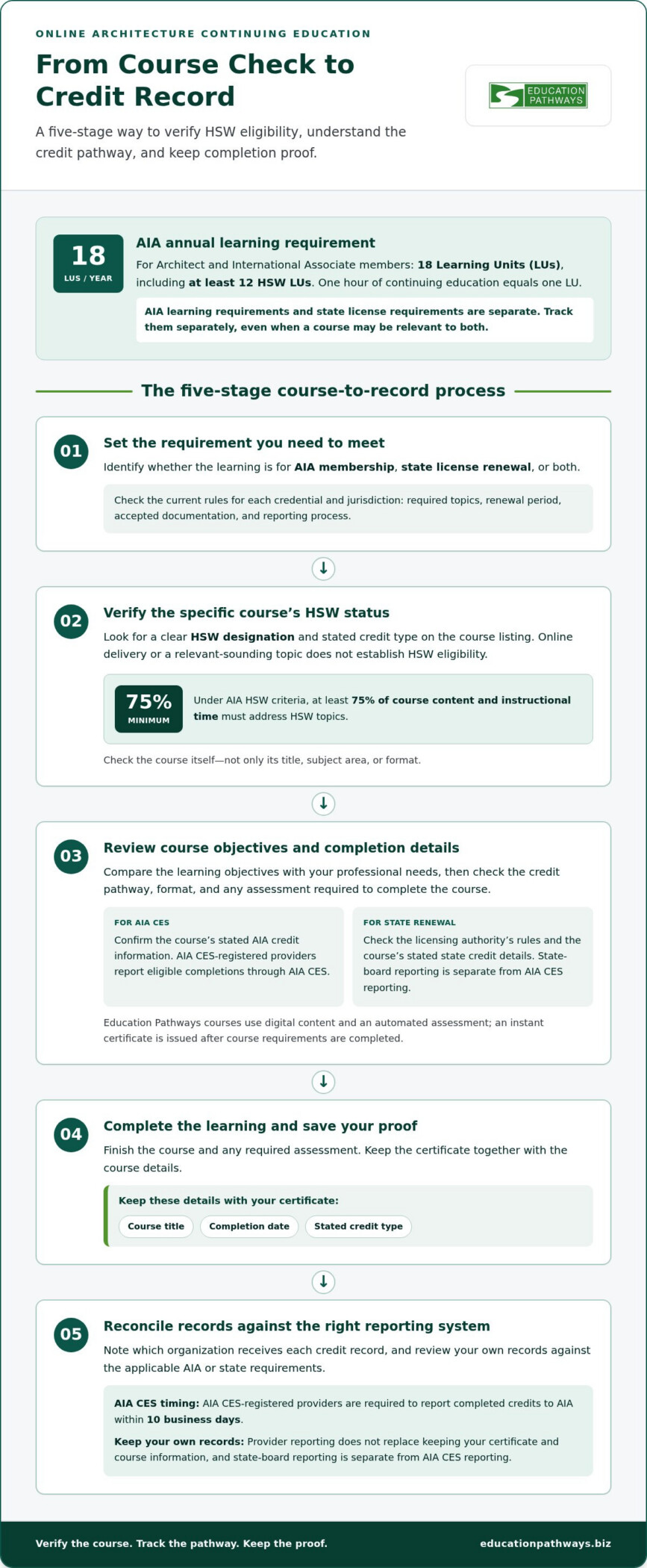
Getting credit starts before enrollment. First, identify whether you’re completing learning for AIA membership, state license renewal, or both. Then review the course title, learning objectives, HSW designation, and stated credit information. The format or topic alone doesn’t determine how credits will count.
Which course details should learners review before enrolling?
Check that the course’s credit type and intended pathway match your goal. AIA CES learning units, HSW units, and state-required continuing education may follow different rules. Read the course details, including any assessment required for completion.
Education Pathways courses use digital content and an automated assessment. After completing the course requirements, learners receive an instant certificate. Course completions are reported to appropriate licensing boards. State-board reporting is separate from AIA CES reporting, so use the course’s stated credit information to determine whether it fits an AIA learning requirement. AIA CES registered providers are required to report completed credits to AIA within 10 business days.
What records should architects keep after completing HSW education?
Keep the completion certificate and course details together, including the title, completion date, and stated credit type. These records help you track learning across renewal periods and provide documentation if requested. Reporting and retention rules can differ between AIA CES and state licensing authorities, so keep your own records even when a provider reports completion.
Oregon’s state licensing board requirements offer one official example of a jurisdiction setting continuing education rules for architect registration. Check the current requirements for each credential and jurisdiction you hold, and note which organization receives each credit record.
A practical completion sequence is simple:
- Match the course to your AIA or state requirement.
- Review its designation, credit details, and completion steps.
- Complete the learning and any required assessment.
- Save the certificate and course information.
- Review your records against the applicable reporting system.
For self-paced online architecture CE, explore Florida architecture continuing education and keep the course’s specific credit pathway in view as you plan your next steps.
How to Compare AIA-Approved HSW Courses Online Before You Enroll
Compare the details that determine whether a course fits your learning goals and credit requirement. A convenient format or relevant-sounding topic is not enough. For AIA approved HSW courses online, verify the specific HSW designation and credit pathway rather than assuming every online course qualifies.
Use this checklist to assess each course listing. Approval, credit, and reporting details should be specific to the course.
| Course detail | What to look for | Why it matters |
|---|---|---|
| HSW designation | A clear HSW designation for the specific course | Online delivery alone doesn’t establish HSW eligibility. |
| Learning objectives | Objectives that explain the subject and intended learning | They help you judge relevance to your professional needs. |
| Format | Whether learning is self-paced or follows another structure | Choose a format that fits your schedule and learning preferences. |
| Assessment | Whether an assessment is part of course completion | Know what you must finish to earn documentation. |
| Certificate | Whether a certificate is provided and what course details it records | You’ll want clear proof of completion for your records. |
| Reporting | Which organization receives reported completions, if applicable | AIA CES reporting and state licensing reporting are separate pathways. |
Which course features matter most to busy architects?
Look for clearly presented course materials, a manageable format, and a straightforward completion process. Check whether the course includes an assessment and certificate, and whether the listing explains how completion is recorded. Education Pathways offers self-paced online learning with digital content, an automated assessment, and an instant certificate. These features describe the learning process; the course’s credit designation and pathway are separate details.
How can you confirm the course fits your credit goal?
Start with the requirement you need to meet. Then compare the course’s stated designation and credit pathway with that requirement. For AIA learning, use AIA CES information as your reference point. For license renewal, consult the licensing authority for your jurisdiction. Keep the two checks distinct, even if a course appears relevant to both.
For example, imagine two listings with similar architecture topics. Listing A explains its learning objectives, identifies its HSW status, and describes its certificate and reporting process. Listing B emphasizes online access but gives little credit detail. Listing A gives you more information to assess, but you should still compare its stated details with the requirement you’re targeting.
For state-specific context, review Florida architecture continuing education online alongside your AIA learning goals.
A Practical Checklist for Completing Online HSW Courses and Keeping Proof
A little preparation can prevent a completed course from becoming a recordkeeping headache. Before starting AIA approved HSW courses online, identify the credit requirement you’re working toward, note the deadline, and decide where you’ll save your completion records. Check current rules for your specific credential and jurisdiction, since requirements and reporting processes can differ.
What should you do before starting an online course?
Use this sequence to get organized before you begin:
- Identify the requirement. Decide whether you’re tracking AIA CES learning, state license continuing education, or both. Keep the pathways separate in your notes.
- Select a course that fits. Review the learning objectives, course-specific HSW designation, stated credit information, assessment details, and completion documentation. Match those details to the requirement you need to meet.
- Plan your study time. Set aside time to work through the materials. Keep enrollment details and login information where you can find them again.
- Complete the learning and assessment. Follow the course’s stated steps so your completion can be documented.
- Save proof and review your records. File the certificate and course details, then check the applicable reporting system or licensing record.
For busy professionals, a self-paced course can make it easier to fit learning around work. Education Pathways courses include digital content, an automated assessment, and an instant certificate. The certificate documents your completion for your personal records. It does not, by itself, establish that credits were reported to AIA CES or satisfy a particular state requirement.
What should you do after the final assessment?
Save the certificate with the course title, completion date, and stated credit type. Use a dedicated digital folder or another consistent recordkeeping system, and note which requirement you intended the course to address. Review the course’s stated reporting process, then check the relevant system or licensing record rather than assuming the certificate means every organization has received the information.
If a completion or credit record doesn’t appear as expected, compare your saved documentation with the reporting instructions. Follow the applicable course or licensing-board process to resolve the discrepancy, and keep your certificate while it’s being addressed.
Save-this checklist: requirement identified, course details reviewed, assessment completed, certificate filed, reporting pathway checked, deadline noted.
Ready to organize your architecture CE? Review Florida architecture continuing education options as you plan your next course.
Complete Architecture CE Online with Education Pathways
Once you know what credit you need and how you’ll document it, choose a course that fits your schedule and professional goals. Education Pathways, LLC provides self-paced, fully online continuing education for architects and engineers. Courses include digital learning content, an automated assessment, and an instant certificate of completion.
What to expect from an online architecture CE course
Access the course materials online, work through the content at a pace that suits your schedule, and complete the assessment. After completion, you receive an instant certificate to save with your continuing education records. Course completions are reported to appropriate licensing boards. State-board reporting and AIA CES reporting are separate processes, so use the stated credit details to identify the pathway relevant to your requirement.
Course format and credit designation are separate considerations. If you’re looking for AIA approved HSW courses online, rely on a course-specific HSW designation and AIA CES credit information. Don’t infer approval or HSW eligibility from online access, a relevant-sounding topic, or a certificate alone.
For Florida-focused options, browse Florida architecture CE courses. If you’re planning around a renewal deadline, review the separate Florida architecture license renewal information as well. State license rules and AIA CES learning requirements are distinct, so keep each credit goal clear as you choose coursework.
Choose your next step with confidence
Before enrolling, check four details: the course’s designation, the credit purpose, the learning format, and the documentation you’ll receive. Compare those details with your AIA or state requirement. Keep the certificate and course information in your records, and track reporting through the relevant system.
Education Pathways, LLC has provided continuing education since 2002. Its self-paced online format, automated assessment, and instant certificates offer a straightforward way to complete coursework and maintain proof of completion. Choose a course based on the requirement you need to meet, not on format alone.
Ready to plan your next course? Explore Florida architecture CE courses and review the course details that align with your continuing education goals.
Choose Your Next Architecture CE Course with Confidence
The right course starts with the right credit goal. Check the course-specific HSW designation and credit pathway, then compare the learning format, assessment, and completion records. AIA learning credits and state license requirements are separate, so track each against its own current rules.
Education Pathways has provided continuing education since 2002. Its architecture and engineer courses are self-paced and fully online, with digital content, an automated assessment, and an instant certificate of completion. Completions are reported to appropriate licensing boards. That reporting should not be assumed to mean AIA CES reporting, so review the course’s credit details and keep your certificate for your records.
Ready to plan your next step? Explore online continuing education courses and choose coursework that fits your professional learning needs. With a clear credit goal and organized records, you can make steady progress with confidence.
Frequently Asked Questions
What is an AIA-approved HSW course?
An AIA-approved HSW course is continuing education designated for Health, Safety, and Welfare credit within the AIA Continuing Education System (AIA CES). HSW learning addresses the protection of public health, safety, and welfare through the built environment. Check the individual course’s designation and credit details, as well as its provider’s AIA CES status. A course’s online format or architecture-related subject alone doesn’t establish that it qualifies for HSW credit.
Are all online AIA continuing education courses HSW-approved?
No. Online delivery describes how you take a course, not how its credits are classified. An online course may offer HSW learning units, elective learning units, or another type of credit. Review the course listing for its specific HSW designation and credit pathway before enrolling. Don’t assume that every course from an AIA CES provider is HSW-eligible, or that an HSW-related topic automatically earns HSW credit.
How can I tell whether an online architecture course counts as HSW?
Look for a course-specific HSW designation and clear credit information in the course details. Under AIA HSW criteria, at least 75% of a course’s content and instructional time must address HSW topics. The title alone isn’t enough to establish eligibility. Review the learning objectives and designation, then verify the course’s credit information through the relevant AIA CES source before counting it toward an HSW requirement.
Do AIA CES credits count toward state architect license renewal?
Not automatically. AIA membership education requirements and state license-renewal rules are separate systems. A course’s AIA CES credit may also be relevant to a state requirement, but acceptance depends on that jurisdiction’s current rules, including any required topics or documentation. Check the licensing authority for each credential you hold. Track AIA learning units separately from state continuing education so you can confirm each requirement is met.
How are AIA HSW course credits reported after completion?
AIA CES registered providers report completed credits to the AIA, generally within 10 business days. Reporting to a state licensing board is a separate process, and a certificate or state-board report doesn’t by itself confirm AIA CES reporting. Review the course’s stated reporting pathway and check the appropriate record system after completion. Keep your certificate and course details in case you need to resolve a missing or incorrect entry.
Can architects complete HSW continuing education entirely online?
Architects can complete HSW education online when the course is offered in that format and meets the relevant credit criteria. Online access alone doesn’t establish HSW eligibility, and acceptance for license renewal depends on the rules of the state where you’re licensed. Some jurisdictions may set requirements for live or structured study. Check the current licensing authority rules and the course’s designation before relying on online learning for a renewal requirement.
What proof should I keep after completing an online HSW course?
Keep the completion certificate and course information together in a dedicated professional education record. Save the course title, completion date, stated credit type, and any available completion or reporting confirmation. An instant certificate can document your completion, but it doesn’t necessarily show that AIA CES or a state licensing board received a report. Retain your own records and follow the documentation rules for each organization or jurisdiction.
How do I choose an online HSW course that fits my learning goals?
Start by identifying whether you need AIA CES HSW learning, state license continuing education, or both. Then compare the course-specific HSW designation, learning objectives, format, assessment, certificate, and reporting details. Choose content that supports your professional interests while meeting the credit purpose you’ve identified. Education Pathways offers self-paced online continuing education for architects and engineers, with digital content, an automated assessment, and an instant certificate.