
Florida CAM Financial Management CE: The 2026 Compliance Guide

Financial management CE isn’t just a renewal hurdle; it’s a strategic defense against association liability and fraud. You’re managing more than just physical properties; you’re overseeing millions in assets while navigating a landscape of shifting 2026 regulations and DBPR reporting deadlines. Finding the time to complete your mandatory Florida CAM financial management CE during a busy management season is a challenge every professional understands. With Florida’s community association landscape evolving rapidly after recent legislative reforms, compliance is the only way to protect your career and your communities.
This guide simplifies your path to compliance. You’ll master the latest insurance and financial requirements for your Florida CAM license renewal while learning how to fulfill your 3-hour requirement quickly and effectively. We’ll break down the 2026 DBPR standards, show you how to get an instant certificate of completion, and explain the automated reporting process that keeps your license in good standing. By the end of this article, you’ll have a clear, no-nonsense roadmap to securing your 2026 renewal before the September 30 deadline.
Key Takeaways
- Confirm the exact credit hour breakdown for the September 30, 2026 renewal cycle, including specialized requirements for HOA managers.
- Master the latest insurance and risk management principles to safeguard association assets and reduce your professional fiduciary liability.
- Fulfill your Florida CAM financial management CE requirement efficiently through state-approved online courses that fit into a busy management schedule.
- Streamline your compliance process with instant certificates of completion and automated credit reporting directly to the DBPR.
- Understand how recent legislative reforms impact reserve studies and financial transparency for the communities you manage.
Florida CAM Financial Management CE Requirements for 2026
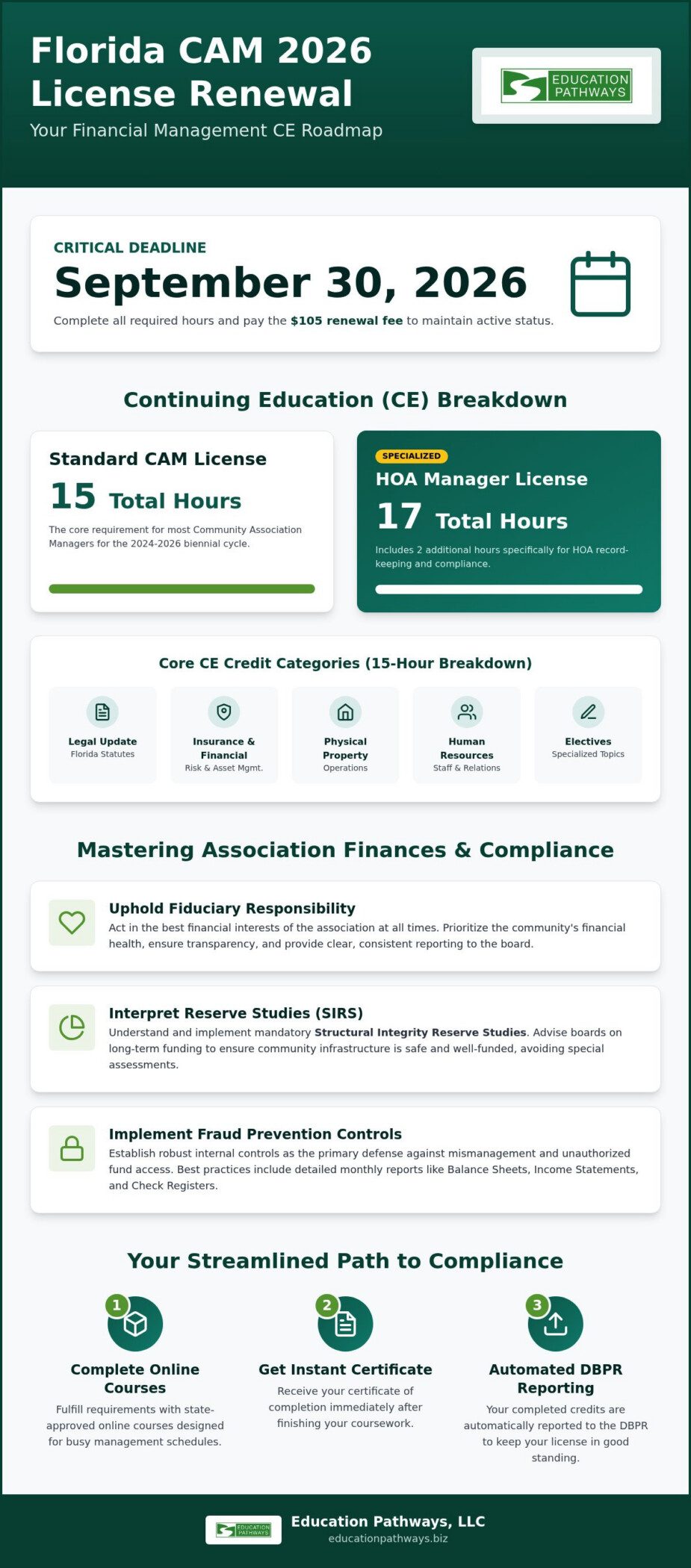
The Florida Department of Business and Professional Regulation (DBPR) requires all licensed managers to complete a biennial renewal cycle. This process ensures every Community Association Manager (CAM) maintains a high standard of professional competency. For the 2024 to 2026 cycle, the state emphasizes financial oversight and insurance accuracy. Association managers handle millions of dollars in community assets, making financial transparency a top priority for state regulators. Completing your Florida CAM financial management CE isn’t just about checking a box; it’s about protecting the communities you serve from liability and fraud.
Most managers must complete 15 hours of approved education. However, if you manage a Homeowners Association (HOA), your requirement increases to 17 hours. This includes specific credits for HOA recordkeeping. The state breaks down the standard 15 hours into five key areas: Legal Update, Insurance and Financial Management, Operation of Physical Property, Human Resources, and Electives. Fulfilling your Florida CAM financial management CE ensures you can navigate these complex fiscal requirements with confidence. Each category targets a specific risk area in community governance.
The Core Components of CAM Continuing Education
Legal Update seminars provide the foundation for regulatory compliance, keeping you informed on new Florida statutes. The Insurance and Financial Management category specifically focuses on protecting association assets through reserve planning and risk mitigation. Finally, credits in the Operation of the Association’s Physical Property ensure you can effectively manage maintenance schedules and vendor contracts. These core components work together to reduce operational risks for both the manager and the board.
Deadlines and Compliance Windows in 2026
The hard deadline for the current cycle is September 30, 2026. You must complete all required hours and pay the $105 renewal fee by this date to maintain an active status. Don’t wait. Missing this window leads to an involuntary inactive license, which prevents you from legally managing associations. It’s vital to verify your status early. You can review the full breakdown of Florida CAM CE requirements to ensure your specific portfolio meets all state mandates. Waiting until the final weeks of September often leads to unnecessary stress during the busiest management season. Staying ahead of the deadline guarantees a seamless transition into the next licensing period.
Mastering Association Finances: Beyond the CE Credit
Mastering your Florida CAM financial management CE is the first step toward professional excellence. However, true mastery requires translating those credits into daily operational transparency. As a manager, you serve as the bridge between complex financial data and the board’s decision-making process. You don’t just report numbers; you provide the context that keeps associations solvent. Clear communication ensures board members understand their financial position before they vote on major expenditures. It’s about the math.
Your role carries a significant fiduciary responsibility. This means you must act in the best interests of the association at all times, prioritizing their financial health over vendor relationships or personal convenience. Organizations like the Community Associations Institute (CAI) emphasize that ethical financial management is the cornerstone of professional property management. Best practices for monthly reporting include providing a comprehensive balance sheet, an income statement with budget-to-actual variances, and a detailed check register. Delivering these reports consistently builds trust and allows for early detection of budget overruns.
Robust internal controls act as the primary barrier against financial mismanagement and unauthorized fund access in 2026.
Reserve Studies and Long-Term Capital Planning
Modern Florida legislation has fundamentally changed how we look at reserves. The 2022 reforms introduced mandatory Structural Integrity Reserve Studies (SIRS) for many condominium associations. You must know how to interpret these technical reports to advise boards on long-term funding strategies. Effective planning helps associations avoid the need for sudden, high-cost special assessments that can financially strain residents. By aligning reserve contributions with the SIRS findings, you ensure the community’s infrastructure remains safe and well-funded for decades.
Fraud Prevention and Internal Controls
Fraud prevention starts with identifying common red flags, such as unexplained vendor payments, missing bank reconciliations, or frequent “miscellaneous” expenses. Implementing a strict segregation of duties is essential; the person who approves invoices shouldn’t be the same person who signs the checks or reconciles the bank statements. While digital payment systems increase efficiency and speed, they also require updated security protocols to prevent sophisticated cyber-fraud. If you want to dive deeper into these protection strategies while fulfilling your Florida CAM financial management CE requirements, you can explore our Florida CAM CE online bundles to stay ahead of the curve.
Navigating Insurance and Risk Management in Florida
Understanding insurance principles is a core requirement of your Florida CAM financial management CE. You aren’t just renewing policies; you’re protecting the association’s long-term solvency. Evaluating policy limits and deductibles requires a delicate balance between adequate protection and community budget constraints. While high deductibles might lower annual premiums, they can also lead to massive, unplanned special assessments if a major loss occurs. Your job is to ensure the board understands these trade-offs before they sign a renewal agreement.
Proactive risk management is your best strategy for controlling costs. Insurance carriers in 2026 look closely at roof ages and the results of structural integrity studies. By documenting regular maintenance and repairs, you demonstrate a lower risk profile to underwriters. This methodical approach can lead to more favorable terms during policy renewals. Staying informed through your Florida CAM CE Requirements ensures you can navigate these evolving market conditions with confidence.
Types of Essential Coverage for Florida Associations
Directors and Officers (D&O) liability coverage is non-negotiable for any community. It protects board members from personal liability related to their official decisions. Fidelity bonds and crime insurance are also state-mandated to protect association funds from internal theft or mismanagement. In the Florida market, flood and windstorm coverage nuances are critical. Standard property policies often exclude these perils, requiring separate riders or specialized policies. You must verify that these coverages align with current replacement cost valuations to avoid being underinsured after a storm.
Effective Insurance Claim Procedures
When a loss occurs, your role as a facilitator is vital for a successful recovery. Claims depend on precise documentation. You should maintain updated asset inventories and high-resolution photos of all common areas before the start of hurricane season. Working with adjusters and legal counsel requires a highly organized approach. You act as the primary point of contact, ensuring all requested data is provided promptly to avoid claim denials or delays. Post-claim financial adjustments are equally important. A major loss often triggers a need for immediate budget revisions to cover deductibles or emergency repairs. For more information on managing these complex fiscal cycles, you can review the full Florida CAM CE requirements to find courses that focus on insurance claim management.
How to Complete Your Florida CAM CE Online Efficiently
Professional property management doesn’t pause for licensing deadlines. For busy managers, self-paced online education is the most practical way to meet state mandates without disrupting daily operations. Online courses allow you to study during quiet office hours or between property inspections, providing a flexibility that traditional classrooms cannot match. When selecting a provider, DBPR approval is your first priority. You need a partner with a long history of compliance, such as a provider operating since 2002, to ensure your credits are valid and recognized by the state board.
Verifying that a course fulfills the specific Florida CAM financial management CE hour is essential. Not all bundles are created equal. You must check the course syllabus to confirm it explicitly covers the required 3-hour financial and insurance category. An instant certificate of completion acts as your immediate professional safeguard, providing definitive proof of compliance the moment you finish your final module. This allows you to verify your status with employers or the board without waiting for manual processing.
The Step-by-Step Online Enrollment Process
The enrollment process is designed for speed and clarity. First, you should identify whether you need the standard 15-hour package or the 17-hour HOA-specific bundle. Once you select the correct Florida CAM CE classes online, you can access the material immediately. Modern learning platforms are optimized for both desktop and mobile devices. This means you can start a module on your office computer and finish it on a tablet later in the evening. The system saves your progress automatically, allowing you to tackle the Florida CAM financial management CE requirements in manageable segments.
Ensuring Your Credits Reach the DBPR
Once you complete your course, the reporting process should be hands-off. Approved providers utilize an automated system to transmit your credit data directly to the state. This eliminates the risk of manual entry errors and ensures your records are updated quickly. It’s a good practice to log into the DBPR website 24 to 48 hours after completion to verify that your credits appear in your official transcript. Staying proactive ensures there are no surprises as the September 30 deadline approaches. For a deeper look at the process, you can review the Florida CAM license renewal guidelines to confirm your status is secure. If you are ready to secure your 2026 renewal, start your Florida CAM CE online today and gain instant peace of mind.
Why Choose Education Pathways for Your CAM Renewal?
Education Pathways stands as a seasoned veteran in the field of professional compliance. Since 2002, we’ve helped thousands of managers navigate the complexities of state mandates with ease. Our commitment to providing a 100% online, user-friendly experience means you can complete your Florida CAM financial management CE without the friction of rigid classroom schedules. We understand the unique time constraints of your industry. That’s why our system prioritizes speed, official verification, and convenience for every user.
Beyond CAM licensing, we support a wide range of Florida professional licenses, including contractors, real estate agents, and architects. This breadth of experience ensures we stay at the forefront of DBPR regulatory changes. When you choose us, you gain the peace of mind that comes with instant certificates and automated reporting. We do the heavy lifting of vetting information so you can proceed with absolute confidence in your active license status. It’s a professional partnership built on reliability.
The Education Pathways Difference
Our curriculum isn’t just about theory; it’s developed by industry experts for real-world application. This ensures you can apply your Florida CAM financial management CE insights directly to your association’s budget and insurance evaluations. The streamlined user interface is designed for clarity and speed. You won’t find unnecessary narrative fluff here. Instead, you’ll find a logical, methodical flow that respects your time and professional experience. For a deeper dive into the specific steps for your next cycle, consult our Florida CAM license renewal guide.
Ready to Renew Your License?
As the September 30, 2026, deadline approaches, having a final checklist is vital for every manager. Ensure you have accounted for all 15 required hours, or 17 if you manage an HOA portfolio. Bundling your financial management credits with other mandatory hours like Legal Update or Physical Property is the most efficient way to stay compliant. Our platform makes tracking these requirements simple and predictable, acting as a bridge between complex state rules and your successful renewal.
Follow this final checklist for a stress-free renewal:
- Verify your current credit status on the official DBPR portal.
- Select a course bundle that includes the mandatory 3-hour financial and insurance category.
- Complete your modules at your own pace on any mobile or desktop device.
- Download your instant certificate for your personal records.
- Confirm that your credits have been automatically transmitted to the state.
Don’t let the busy management season interfere with your professional standing. You can Browse Florida CAM CE Courses Today to secure your 2026 renewal with an approved, trusted partner.
Secure Your 2026 Florida CAM License Renewal Today
Mastering association finances is about more than just meeting state mandates; it’s about safeguarding your community’s assets and your professional reputation. You’ve learned how to navigate complex insurance requirements and reserve studies to protect your residents. By prioritizing efficient, online learning, you can fulfill these obligations without losing focus on your daily property management responsibilities. Completing your Florida CAM financial management CE through a trusted provider ensures that every credit is accurately tracked, verified, and reported.
Since 2002, Education Pathways has provided state-approved solutions that respect your time and professional standing. Our platform offers instant digital certificates upon completion and handles all automated reporting to the Florida DBPR for you. This streamlined process removes the stress from the biennial renewal cycle. Enroll in DBPR-Approved Florida CAM Financial Management CE Now and take the final step toward securing your license. You have worked hard to build your career; let us help you protect it with ease and reliability.
Frequently Asked Questions
How many hours of financial management CE do Florida CAMs need?
Standard community association managers must complete 3 hours of Insurance and Financial Management as part of their total 15-hour biennial requirement. Managers who oversee Homeowners Associations need 17 total hours, but the 3-hour financial block remains a core component for everyone. This specific Florida CAM financial management CE ensures you understand reserve funding, fiduciary duties, and annual budget preparation.
Is the Florida CAM financial management course offered online?
Yes, you can complete the course entirely online through our platform. Education Pathways provides 100% online, self-paced modules designed specifically for busy professionals who can’t attend in-person seminars. You don’t need to visit a physical classroom or schedule a livestream. You can log in from any mobile or desktop device and finish your credits whenever your schedule allows.
How do I know if my CE credits were reported to the DBPR?
We report your credits automatically to the Florida DBPR through a secure data link. Once you finish your course, our system transmits the completion data without any extra steps from you. You should log into your official MyFloridaLicense account 24 to 48 hours after completion to verify the update. This automated process removes the risk of manual filing errors and ensures your license status stays active.
Can I take all 15 hours of my Florida CAM CE online?
Yes, the state of Florida allows you to fulfill your entire 15-hour or 17-hour requirement through approved online distance learning. You can bundle your Florida CAM financial management CE with other mandatory topics like Legal Update, Human Resources, and Physical Property. This is the most efficient way to secure your renewal before the September 30, 2026, deadline without disrupting your workday.
What happens if I complete my CE credits after the renewal deadline?
If you fail to complete your credits by the September 30 deadline, your license status changes to involuntary inactive. You cannot legally perform the duties of a community association manager while your license is inactive. You’ll have to complete the required hours and pay additional delinquency fees to reactivate your status. It’s best to finish your hours early to avoid these professional complications.
Do I get a certificate immediately after finishing the CAM financial course?
You will receive a digital certificate of completion the moment you finish the final module of the course. This certificate serves as your immediate proof of compliance for your employer, board members, or personal records. While we handle the automated reporting to the state board, having an instant copy provides peace of mind that your legal requirements are fully met.
What is the difference between CAM pre-licensure and continuing education?
Pre-licensure training is the initial 16-hour course required to sit for the state exam and earn a new license. Continuing education (CE) is the training required every two years to maintain and renew an existing license. Education Pathways focuses exclusively on high-quality CE for licensed professionals. We don’t offer initial pre-license training, in-person classroom sessions, or job placement services.
Does the financial management course cover insurance requirements too?
Yes, the state-mandated category specifically combines insurance and financial management into a single 3-hour block. The course covers property and liability insurance principles, policy limits, and deductibles. It also explores fidelity bonds and the manager’s role in the claims process. This ensures you can effectively manage association risks alongside the community’s annual budget and mandatory reserve funds.