
Florida CAM Law Update Course: Master the 2026 Legislative Changes

Missing the September 30, 2026, renewal deadline isn’t just a paperwork error. It’s a direct threat to your license and your livelihood. You’re already juggling board meetings and maintenance schedules, so the last thing you need is a confusing pile of new bills to decipher. Finding a reliable Florida CAM law update course shouldn’t be another chore on your to-do list. We know that the shift from managerial discretion to mandatory disclosure feels like a heavy lift. It’s frustrating to navigate complex DBPR reporting deadlines while trying to translate legislative jargon into daily action.
You deserve a straightforward path to compliance that respects your time. This guide breaks down exactly how to master the latest 2026 legislative changes, including the critical shifts in HB 1203 and HB 913. We’ll show you how to complete your mandatory 3-hour legal update requirement quickly and earn an instant certificate of completion. From new HOA website mandates to updated structural integrity rules, you’ll gain the clarity needed to protect your associations and your professional reputation. Let’s get your credits reported so you can focus on what matters most.
Key Takeaways
- Understand the mandatory 3-hour legal update requirement and how it fits into your total 15-hour biennial renewal cycle.
- Learn how legislative changes like HB 1203 and HB 913 impact daily operations, specifically regarding HOA transparency and meeting attendance.
- Discover how to select a state-approved Florida CAM law update course that provides instant certificates and automated DBPR reporting.
- Identify the exact steps to verify your current credits and fulfill all requirements before the September 30, 2026, license renewal deadline.
Understanding the 2026 Florida CAM Legal Update Requirement
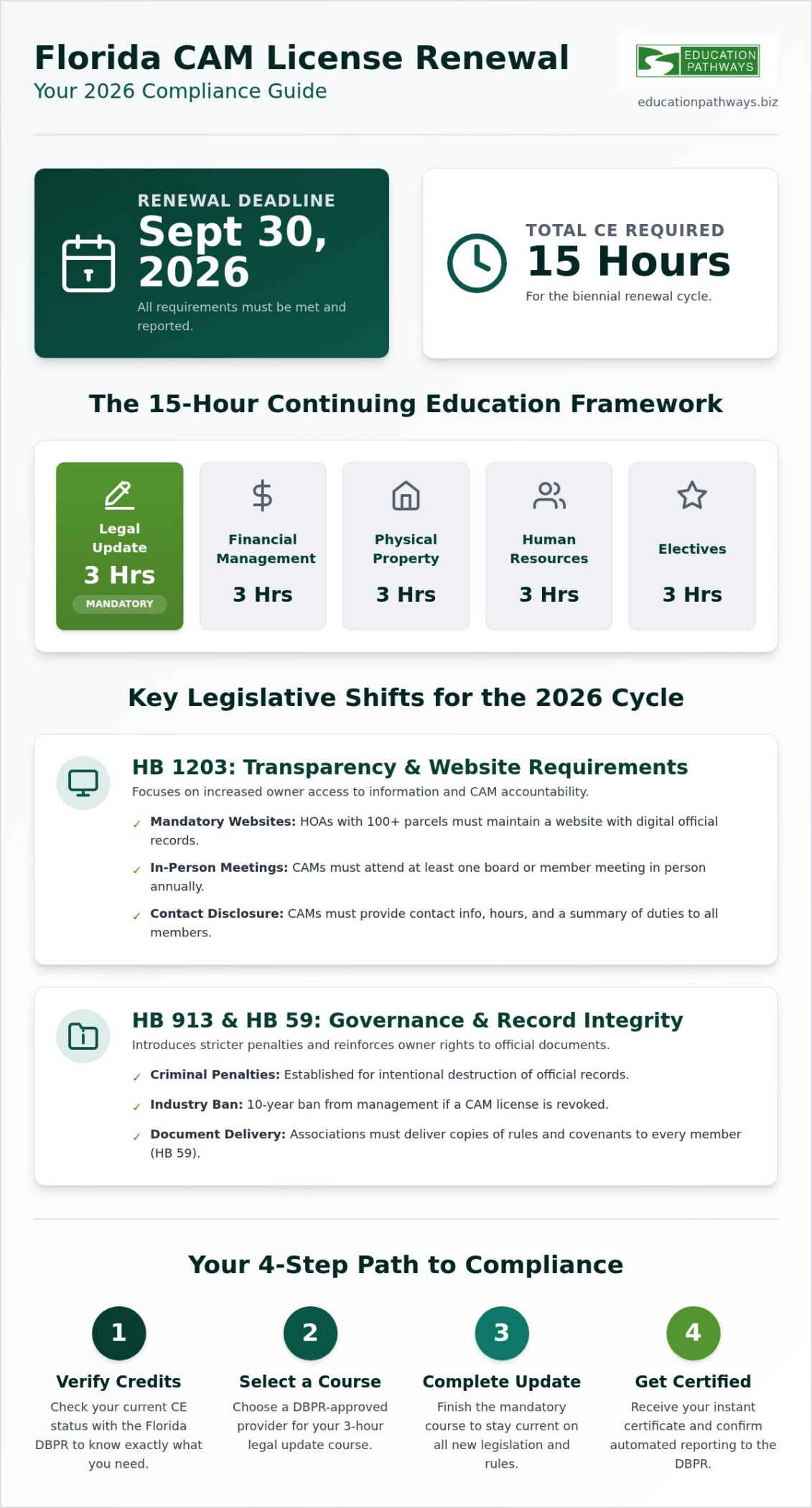
September 30, 2026, marks the hard deadline for your license renewal. To stay active, the Florida Department of Business and Professional Regulation (DBPR) requires all managers to complete 15 hours of continuing education. Within this framework, the 3-hour legal update is the most critical component. It isn’t just another elective; it’s a mandatory deep dive into the shifting regulatory landscape. Enrolling in a state-approved Florida CAM law update course ensures you meet these strict requirements without risking your professional standing.
The Community Association Manager profession requires constant vigilance. The DBPR mandates this specific course every cycle because Florida’s statutes are rarely static. By focusing on the legal update, the state ensures every manager operates with the same baseline knowledge of new bills and court rulings. If your course isn’t DBPR-approved, your hours won’t count. This could lead to a lapsed license and unnecessary administrative hurdles.
The 15-Hour CE Framework for CAMs
The 15-hour requirement is divided into specific categories to ensure a well-rounded skillset. You’ll typically need three hours in each of the following areas:
- Legal Update: The mandatory 3-hour core of your education.
- Financial Management: Budgeting, reserves, and financial reporting.
- Operation of Physical Property: Maintenance and structural safety.
- Human Resources: Personnel management and fair housing.
- Electives: Additional topics relevant to your specific management role.
The Legal Update is the only non-negotiable category. While you might enjoy certain electives more, the state prioritizes legal literacy above all else. Keep in mind that extra legal hours don’t usually roll over to the next cycle. You must complete a fresh 3-hour Florida CAM law update course every two years to remain compliant.
Why 2026 is a Landmark Year for Law Updates
The 2024 and 2025 legislative sessions were exceptionally busy. Lawmakers responded to growing concerns about building safety and association transparency with a wave of new requirements. Owners now have expanded rights regarding records access, and managers face stricter accountability for meeting attendance. This surge in activity makes your 2026 update more than a formality; it’s a vital survival guide. The Legal Update serves as the primary mechanism for state-mandated professional alignment, ensuring you don’t fall behind as these new standards take effect.
Key Legislative Shifts: HB 1203, HB 913, and SB 948
The 2026 renewal cycle focuses heavily on transparency. Legislators are moving away from manager discretion and toward mandatory disclosures. This shift requires you to adjust how you handle documents and communicate with owners. Understanding these specific bills is the cornerstone of any quality Florida CAM law update course. Managers must now provide their contact information, hours of availability, and a summary of duties to all members to ensure clear lines of communication.
HB 1203: Transparency and Website Requirements
Homeowners’ Associations (HOAs) with 100 or more parcels faced a major deadline on January 1, 2025. These associations must now maintain a website containing digital copies of official records. As a manager, you’re responsible for ensuring these portals stay updated. Non-compliance can lead to significant fines and DBPR investigations. You should audit your management workflow to ensure new rules, budgets, and contracts are uploaded immediately. HB 1203 also requires CAMs to attend at least one board or member meeting in person annually. This physical presence requirement aims to increase engagement and accountability within the community.
Condominium and Cooperative Governance (HB 913)
As you navigate the increased requirement for physical presence at community meetings, prioritizing your personal safety is a wise professional move. Many managers find that training with Performance Krav Maga provides the practical self-defense skills and confidence needed when working directly with the public in diverse environments.
HB 913 introduces stricter accountability across the board. If a CAM license is revoked, that individual is barred from owning or working for a management company for 10 years. The bill also clarifies board eligibility and term limits to prevent entrenched leadership. Perhaps most significantly, it establishes criminal penalties for the intentional destruction of official records. This change protects the association by ensuring a clear paper trail for financial and structural decisions. Managers must now be even more diligent about record retention and inspection protocols. The deadline for Structural Integrity Reserve Studies (SIRS) was also extended to December 31, 2025, giving associations a final window to achieve compliance.
HB 59 requires associations to deliver copies of rules and covenants to every member. You can’t simply point to a binder in the office anymore. Along with this, Florida Senate Bill 948 mandates detailed flood risk disclosures for prospective purchasers and tenants. This applies to developers and landlords within condominiums and cooperatives. Property managers must ensure these disclosures are part of the standard application or sales package. Staying on top of these moving parts is easier when you use a Florida CAM law update course that simplifies the legal jargon into actionable steps.
Choosing Your Course: Self-Paced Online vs. Live Webinars
Busy managers often face a choice when selecting a Florida CAM law update course. You can either log into a live webinar at a specific time or complete the work on your own schedule. Live webinars often feel interactive, but they come with a significant “attendance risk.” If your internet connection drops or an emergency call from a board member pulls you away, you might lose credit for the entire session. Many providers enforce strict rules where missing even the first few minutes disqualifies your attendance. This rigidity doesn’t always fit the unpredictable life of a community association manager.
In contrast, modern online platforms offer high accessibility across all devices. You can start a module on your office desktop and finish it on your phone while waiting for a vendor. This flexibility ensures that your compliance doesn’t stall because of a meeting that ran late. You don’t have to worry about missing a specific start time or being penalized for a technical glitch on the provider’s end. It’s about making the requirement work for you, not the other way around.
The Freedom of Self-Paced Learning
Choosing Florida CAM CE online gives you total control over your learning environment. You can pause the lecture to take a call and resume exactly where you left off. This is especially helpful for the 3-hour legal update, which often contains complex jargon and dense legislative details. You have the ability to review specific modules multiple times until you’re confident in the material. Perhaps the best part is the instant gratification. The second you finish the course, your certificate of completion is available for download. There’s no waiting for an instructor to verify a roster or mail a physical copy.
Comparing Costs and Value
When you evaluate different providers, look beyond the initial sticker price. While most legal update courses range between $39 and $50, the real value lies in the administrative support. Check if the provider offers automated reporting to the DBPR. Manually entering credits is a recipe for errors and missed deadlines. A high-quality Florida CAM law update course handles this for you, sending your data directly to the state within 24 hours. You can review a full breakdown of what’s required on our Florida CAM CE requirements page. Prioritizing a partner that has been in the industry for decades reduces the friction of license renewal, giving you much-needed peace of mind.
Step-by-Step Guide to Completing Your Legal Update
Navigating the renewal process doesn’t have to be overwhelming. You’ve already learned about the legislative shifts and the flexibility of online learning. Now, it’s time to execute. The first step is verifying your current standing on the DBPR portal. Logging in early prevents last-minute surprises. Once you know exactly which hours you lack, you can enroll in a state-approved Florida CAM law update course to fill the mandatory legal requirement.
After enrollment, you’ll work through specific modules covering the 2026 changes. Most courses conclude with a brief assessment to ensure you’ve grasped the key points of HB 1203 and HB 913. Passing this assessment triggers the generation of your completion certificate. You should download this immediately for your personal records. While the provider handles the heavy lifting of reporting, having your own proof of completion provides an essential safety net during the busy renewal season.
Verification and Reporting Protocols
Consistency is key when dealing with state records. Your CE credits are reported to the licensing board automatically by the provider. You don’t need to mail certificates or call the DBPR. However, you should check your online account 48 hours after finishing the course. Look specifically at the “Legal” credit bucket to ensure it shows as “Satisfied.” If your credits don’t appear within two business days, contact your education provider immediately to verify that your license number was entered correctly.
2026 Renewal Readiness Checklist
Completing your education is only half the battle. You must also submit your formal renewal application and pay the $105 biennial fee. Use this checklist to ensure you’re prepared for the September 30, 2026, deadline:
- DBPR Login: Ensure you can access your account and that your email address is current.
- Credit Audit: Confirm all 15 hours (or 17 for HOA managers) are visible in the system.
- Application Fee: Have a valid credit card ready for the $105 renewal fee.
- Contact Update: Verify that your mailing address and employer information are accurate.
Don’t wait until the final week of September. We recommend starting this process at least 60 days before your license expires. This gives you ample time to resolve any reporting discrepancies or technical issues. Ready to check the legal requirement off your list? Enroll in our Florida CAM law update course today and get your credits reported instantly.
Education Pathways: Your Partner for 2026 CAM Compliance
Since 2002, Education Pathways has served as a cornerstone for licensed professionals across the state. We understand that your time is your most valuable asset. That’s why our Florida CAM license renewal pathway is designed to be as efficient as possible. We don’t just provide credits; we provide a streamlined experience that removes the stress of mandatory reporting. Our specialized focus on Florida regulations ensures that every module is accurate and relevant to your daily operations. You aren’t just checking a box. You are gaining the practical knowledge needed to guide your associations through the complexities of the 2026 cycle.
Our 100% online, self-paced advantage means you never have to sacrifice your schedule for a rigid classroom session. You can master the 2026 legislative changes from your home, office, or even between site inspections. This flexibility is what makes our Florida CAM law update course the preferred choice for active managers who need results without the wait. We’ve built our platform to support your professional growth on your own terms. It allows you to focus on managing your communities while we manage your compliance details.
Why Thousands of Florida CAMs Trust Us
Reliability is built through years of consistent performance. Our automated systems ensure high reporting accuracy, sending your completed credits directly to the DBPR within 24 hours. You won’t have to spend your weekend wondering if your hours were logged correctly or if a manual entry error will trigger a license suspension. The user-friendly interface works seamlessly on any device, allowing you to switch from desktop to mobile without losing your progress. This creates a sense of order and predictability for your renewal season. If you ever run into a question, our dedicated customer support team is ready to help. They aren’t just tech support; they deeply understand the specific nuances of Florida’s community association laws and reporting deadlines.
Enroll in Your 2026 Law Update Today
The September deadline will arrive faster than you think. Take control of your compliance now by browsing our full selection of Florida CAM CE classes. While the 3-hour legal update is mandatory, many managers choose to bundle it with their other required hours. This approach provides maximum savings and ensures your entire 15-hour or 17-hour requirement is handled in one place. We’ve already performed the heavy lifting of vetting information so you can proceed with confidence. Our courses are structured to help you move quickly from a professional requirement to a functional resolution. Compliance shouldn’t be a hurdle; let us make it a milestone.
Secure Your Professional Future for 2026 and Beyond
Mastering the 2026 legislative changes is essential for any manager aiming to protect their communities and their professional license. You’ve seen how HB 1203 and HB 913 reshape transparency and recordkeeping standards across Florida. Staying ahead of these shifts isn’t just about simple compliance; it’s about leading your associations with confidence and clarity. By choosing a state-approved Florida CAM law update course, you turn a mandatory requirement into a powerful professional advantage. You don’t have to navigate these complex bills alone.
Education Pathways has been a trusted DBPR Approved Provider since 2002. We’ve streamlined the entire renewal process to respect your busy schedule and reduce administrative friction. You’ll receive an instant certificate of completion the moment you finish; our system handles the automatic reporting to the state board for you. This ensures your “Legal” credit bucket is satisfied well before the September 30 deadline. Enroll in the Florida CAM Law Update Course Now to secure your peace of mind. You’ve worked hard to build your career, and we’re here to help you protect it.
Frequently Asked Questions
Is the 3-hour Florida CAM law update course mandatory for every renewal?
The 3-hour legal update is a mandatory requirement for every biennial renewal cycle. While the total requirement is 15 hours of continuing education, the DBPR specifically mandates that 3 of those hours must come from an approved Florida CAM law update course. This ensures all managers stay current with the latest legislative changes and court rulings that impact community associations. You cannot substitute these hours with electives or other categories.
Does HB 1203 apply to both Condominiums and Homeowners Associations?
HB 1203 specifically targets Homeowners’ Associations rather than Condominiums. This bill introduced several transparency standards, including the requirement for HOAs with 100 or more parcels to maintain a website with digital copies of official records. It also mandates that CAMs attend at least one board or member meeting in person annually. While Condominiums have similar website requirements under different statutes, HB 1203 is the primary driver for new HOA operational standards in 2026.
How long does it take for my CAM CE credits to show up on the DBPR website?
Credits typically appear on the DBPR website within 24 to 48 hours after you finish your course. At Education Pathways, we utilize automated reporting systems to send your data to the state board as quickly as possible. We recommend checking your online account two business days after completion to verify that the “Legal” credit bucket is satisfied. If your hours don’t appear in that timeframe, it’s often due to an incorrect license number provided during enrollment.
Can I take the Florida CAM legal update course on my phone?
Yes, you can complete the Florida CAM law update course on any mobile device, including smartphones and tablets. Our platform is 100% online and optimized for mobile browsers, allowing you to learn from the office, home, or while on-site at an association. The self-paced format means your progress is saved automatically across devices. You can start a module on your desktop and finish it on your phone without losing any work.
What happens if I miss the CAM license renewal deadline in 2026?
If you miss the September 30, 2026, deadline, your license will immediately become inactive. You cannot legally manage community associations or collect a salary for CAM services with an inactive license. If you remain inactive for more than two years, your license may become null and void, requiring you to start the initial licensing process from scratch. It’s critical to complete your Florida CAM law update course early to avoid these severe professional penalties.
Are these courses approved by the Florida Department of Business and Professional Regulation (DBPR)?
Our courses are fully approved by the Florida Department of Business and Professional Regulation (DBPR). Education Pathways has been a state-approved provider since 2002, ensuring that every hour you complete counts toward your 15-hour biennial requirement. We stay in close contact with regulatory boards to ensure our curriculum reflects the most recent legislative changes, including HB 1203 and HB 913. You can trust that our content meets all official state standards.
Do I get a physical certificate or a digital one after completing the course?
You receive an instant digital certificate of completion immediately after passing the final assessment. There’s no need to wait for a physical copy to arrive in the mail. You can download and save this PDF for your personal records or print it for your employer. While we report your credits to the DBPR automatically, keeping your digital certificate provides a vital safety net and serves as official proof of compliance for the 2026 renewal cycle.
What are the specific changes for HOA website requirements in 2026?
HOAs with 100 or more parcels are now required to maintain a website containing digital copies of official records. This includes governing documents, budgets, meeting notices, and contracts. This mandate, established by HB 1203, aims to increase transparency for homeowners. Managers must ensure these portals are kept current and that members have secure access to the required documents. Failure to maintain this digital infrastructure can result in significant fines from the state during the 2026 cycle.