
Florida General Contractor CE Requirements: 2026 Compliance Guide

Your license is the foundation of your business, yet the biennial renewal process often feels like a race against a ticking clock. If you haven’t started tracking your hours for the August 31, 2026 deadline, you’re risking more than just a late fee. Understanding the specific Florida general contractor CE requirements is essential to keeping your operations legal and your projects moving. It’s frustrating to pause your work for mandatory classes, especially when the breakdown of general versus mandatory credits seems designed to confuse.
We understand that your time is best spent on the job site, not in a classroom. This guide provides everything you need to know about the 14-hour CILB requirement, including the specific mandates for wind mitigation and the advanced building code module. We’ll walk through the exact credits you need to secure your 2026 renewal. You’ll discover how to complete the entire process online, obtain instant proof of completion, and ensure your credits are reported to the state without any administrative headaches. By the end of this article, you’ll have a clear, stress-free path to maintaining your professional standing.
Key Takeaways
- All certified contractors must complete their 14-hour requirement before the August 31, 2026 deadline to maintain an active license.
- Master the breakdown of the Florida general contractor CE requirements, including the specific mandatory hours for safety, workers’ compensation, and wind mitigation.
- Compare the efficiency of 100% online, self-paced courses against traditional classroom sessions to save time on the job site.
- Verify the automated reporting process to ensure your completed credits are properly logged with the DBPR for a seamless renewal.
- Gain peace of mind with instant certificates that provide immediate proof of your professional compliance.
Understanding the Florida General Contractor CE Deadline for 2026
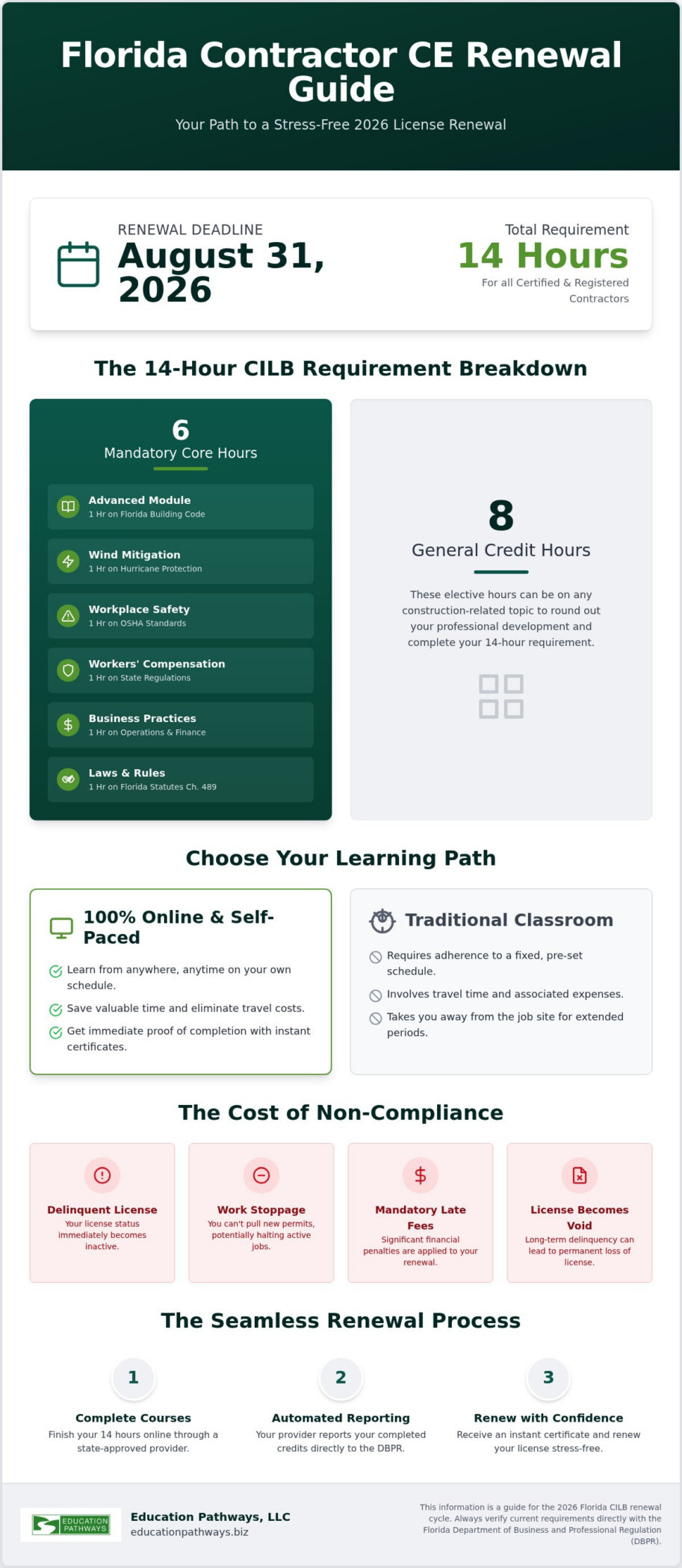
The Florida Construction Industry Licensing Board (CILB) sets a strict timeline for all license holders to ensure they remain current with building codes and safety standards. For the current cycle, the 2026 renewal period for CILB licensees concludes on August 31, 2026. All Certified and Registered General Contractors must complete 14 hours of continuing education before this date to maintain their professional standing. Managing your Florida general contractor CE requirements early ensures your business stays operational without the stress of a last-minute rush. Waiting until the final weeks often leads to technical bottlenecks on state portals or delays in credit reporting that can put your livelihood at risk.
The Two-Year CILB Renewal Cycle
The CILB operates on a biennial cycle that finishes in even-numbered years for certified licenses. This means every 24 months, you’re required to demonstrate a commitment to professional growth and regulatory compliance. While General Contractor Licensing follows broad industry standards, Florida’s specific mandates are managed by the Department of Business and Professional Regulation (DBPR). It’s important to distinguish between Certified and Registered licenses. Certified Contractors hold a state-wide license (starting with “C”), while Registered Contractors (starting with “R”) are typically limited to local jurisdictions. Although the research indicates registered contractors often renew in odd years, many local jurisdictions and specific CILB categories align with the 2026 deadline. Starting your courses well before the August cutoff prevents the risk of reporting delays that occur when thousands of contractors hit the state portal simultaneously.
Consequences of Non-Compliance
Missing the August 31 deadline carries immediate and heavy penalties for your business. Your license status will change to delinquent the moment the deadline passes. This administrative shift stops you from pulling new permits and can even halt progress on active job sites if an inspector checks your credentials. The state also applies mandatory late fees that significantly increase the cost of your Florida contractor license renewal. Beyond the initial fines, the long-term risks are even more severe. If a license remains delinquent for more than one full cycle, it may become null and void. Reinstating a voided license is a much harder and more expensive process than simply completing your Florida general contractor CE requirements on time. You can avoid these pitfalls by regularly checking your credit status on the MyFloridaLicense.com portal. Seeing exactly which hours you still need helps you plan your training efficiently and gives you the peace of mind that your business foundation is secure.
Breaking Down the 14-Hour Continuing Education Requirement
Every two years, Florida contractors must navigate a specific set of 14 hours to stay compliant with state regulations. The Florida Construction Industry Licensing Board (CILB) mandates that these hours be completed through a state-approved provider. If you hold multiple CILB licenses, such as a General Contractor and a Roofing license, a single 14-hour package typically satisfies the requirements for both. This streamlines the administrative burden for professionals managing several certifications at once. It’s essential to ensure your chosen provider handles the heavy lifting of reporting so you can focus on your projects.
The 6 Mandatory Core Hours
The core of the Florida general contractor CE requirements consists of six specific topics. These are non-negotiable and must be included in your curriculum to successfully renew. Each of these hours addresses a critical pillar of safe and legal construction operations in Florida.
- Specialized or Advanced Module: 1 hour focused on the latest updates to the Florida Building Code.
- Workplace Safety: 1 hour covering OSHA standards and essential site safety protocols.
- Workers’ Compensation: 1 hour regarding state regulations, insurance requirements, and employer obligations.
- Business Practices: 1 hour on managing the financial, legal, and operational aspects of a construction firm.
- Laws and Rules: 1 hour detailing Chapter 489 of the Florida Statutes and board rules.
- Wind Mitigation: 1 hour required for General, Building, Residential, Roofing, and Specialty Structure contractors to address Florida’s unique climate challenges.
The Pool Electrical Requirement
There is often confusion regarding the pool electrical module. While the DBPR specifically mandates this for pool and spa contractors, it frequently appears in general contractor packages to ensure the curriculum is CILB-compliant for all license holders. If you are a General Contractor, this hour typically satisfies one of your eight general elective requirements. It provides essential knowledge for job sites where pools are integrated into larger residential or commercial builds. Including it in a bundle ensures the course meets the needs of various license types without leaving gaps in your transcript.
The 8 General Elective Hours
After completing the core modules, you have 8 hours of general credits to fulfill. These hours offer more flexibility than the mandatory core. You can choose topics that align with your specific business goals, such as green building, advanced project management, or contract negotiation. Our goal is to make these hours as useful as they are mandatory. Education Pathways simplifies this by bundling everything into a single, cohesive course. You can view our 14-hour CE bundles to see how we’ve curated these topics for maximum efficiency. This approach ensures you don’t have to piece together individual classes from different sources, saving you hours of research as the August 31, 2026, deadline approaches.
Choosing Between Online and Classroom CE Courses
Deciding how to fulfill your Florida general contractor CE requirements often comes down to a choice between traditional classroom seminars and modern digital platforms. While some prefer the face-to-face interaction of a physical location, the logistical hurdles can be significant. Classroom sessions usually require you to block out two full days of work. For an active job site manager, this isn’t just a time commitment. It’s a loss of billable hours and direct oversight on the project. Online learning removes these barriers by allowing you to work around your existing schedule.
Efficiency of 100% Online CE
The primary advantage of digital learning is the ability to maintain your workflow. You don’t have to lose two days of work for a classroom seminar held in a distant city. Instead, you can review modules on your mobile device or desktop during site breaks or after hours. Because the courses are self-paced, you can save your progress and resume exactly where you left off. This eliminates the stress of rushing to a scheduled event. Once you finish, you receive an instant digital certificate of completion. This is a major benefit over classroom sessions that might take days or weeks to mail out paper copies. Meeting the state Continuing Education Requirements has never been faster or more convenient.
A cost-benefit analysis favors the online route when you consider hidden expenses. Travel time, fuel, and hotel stays for in-person classes quickly add up. Online enrollment is an immediate process that saves these resources for your business. You get the same high-quality instruction without the overhead of a traditional seminar environment.
Verifying DBPR-Approved Providers
Not all education providers are equal. It’s vital to verify that your chosen company is a DBPR-approved provider before you spend time or money on a course. You can check a provider’s license number directly on the MyFloridaLicense portal. Taking a non-approved course from a national aggregator can lead to a rejected renewal application. These aggregators often sell generic courses that don’t meet the specific Florida general contractor CE requirements set by the CILB. Since 2002, Education Pathways has focused on Florida-specific compliance to ensure our students are always protected. Choosing Florida Contractor CE Classes Online through an established, local expert guarantees that your hours will count toward the August 31, 2026, deadline. We handle the technical verification so you can proceed with confidence.
How to Successfully Complete and Report Your CE Credits
Completing your 14 hours is a major milestone, but your work isn’t done until the state recognizes those credits. The bridge between finishing a course and having an active license for 2026 is the reporting process. While the provider handles the data entry, you remain the primary stakeholder in your license status. Most providers, including Education Pathways, LLC, report credits within 24 to 48 business hours. You cannot technically finalize your renewal on the state portal until these hours appear in your official transcript. Understanding this sequence is key to meeting the Florida general contractor CE requirements without unnecessary stress.
The Automated Reporting Process
We take the administrative burden off your plate by reporting your hours directly to the CILB. This process is automated, but it relies on the accuracy of the information you provide during enrollment. Ensure your license number is exactly as it appears on your state-issued card, including prefixes like CGC or CBC. A single typo can lead to a reporting mismatch that delays your renewal. We’ve been the reporting expert for Florida professionals since 2002, ensuring that data flows seamlessly to the DBPR. If your credits don’t appear on the state’s site within three business days, contact your provider immediately to verify the submission. We recommend checking your status early so there’s plenty of time to resolve technical glitches before the August 31 deadline.
Finalizing Your License Renewal
Once your transcript is updated, you must complete the final submission through the state’s official website. Logging into the DBPR Online Services portal is the only way to officially renew. First, verify that your CE hours are listed as “satisfied” in your account profile. Next, navigate to the renewal section and follow the prompts to submit your application. You’ll be required to pay the state renewal fee, which is a separate cost from your CE courses. This is also the best time to verify that all personal and business contact information is current. After you pay the fee and receive your new license, your responsibilities shift to record keeping. You’re required to maintain your CE records for four years. This documentation is your primary defense in the event of a state audit, providing proof that you’ve met all Florida general contractor CE requirements for the cycle.
Streamline Your 2026 Renewal with Education Pathways
Since 2002, Education Pathways has focused on providing a direct route to professional compliance. We understand that managing Florida general contractor CE requirements shouldn’t be a second full-time job. Our platform is built specifically for busy industry professionals who need a reliable, no-nonsense solution. We’ve spent over 20 years refining our process to ensure your credits are reported accurately and your time is respected. Visit our Florida Contractor License Renewal Hub to see how we simplify the biennial cycle for thousands of contractors across the state.
Why Contractors Trust Education Pathways
We focus on “no-fluff” content that prioritizes your time. This means you get the essential information needed for the 2026 renewal without unnecessary filler or academic jargon. Our courses are designed for contractors, not tech experts, making the navigation simple and intuitive on any device. If you encounter any technical hurdles, our reliable customer support team is available to provide fast resolutions for busy professionals. You can learn more about Fulfilling Your Florida Contractor 14 Hour CE Requirement through our specialized guides. We act as your reporting expert, reducing the administrative anxiety that often comes with state audits and manual data entry.
Enroll in Your 14-Hour Package Today
Our comprehensive 14-hour package includes every mandatory module required by the CILB. This includes the essential hour of Wind Mitigation, the Advanced Building Code updates, and the necessary safety credits. For a single fee, you gain instant access to our 2026 CILB-approved curriculum. There are no hidden costs for reporting or certificate generation. Everything you need to meet the Florida general contractor CE requirements is contained in one place, allowing you to finish your hours at your own pace and get back to the job site. Explore our Florida Contractor CE Hub today to secure your license for the next cycle with confidence. You’ll receive instant proof of completion and the peace of mind that your professional standing is protected by a DBPR-approved provider.
Secure Your Professional Standing for 2026
Staying compliant with the August 31, 2026, deadline is the most effective way to protect your business and prevent costly delinquency fees. You now have a clear roadmap for navigating the 14-hour Florida general contractor CE requirements, from mandatory wind mitigation modules to the flexibility of online learning. Remember that your provider handles the reporting, but verifying your status on the MyFloridaLicense portal ensures a seamless renewal. By choosing a self-paced digital platform, you can fulfill these obligations during your downtime without ever leaving the job site.
Education Pathways has been a trusted, DBPR-approved provider since 2002. We specialize in 100% online courses that provide instant certificates and automated reporting to the state. This means you can focus on building your business while we manage the administrative details. Don’t wait for the last-minute rush to secure your license status. Get Your 14-Hour Florida Contractor CE Package Now and gain the peace of mind that comes with professional compliance. Your next project is waiting, and we’re here to help you stay ready for it.
Frequently Asked Questions
How many continuing education hours does a Florida general contractor need?
Florida general contractors must complete 14 hours of continuing education for each biennial renewal period. This total includes 6 mandatory hours covering specific topics like safety and laws, followed by 8 general elective hours. Meeting the Florida general contractor CE requirements ensures your license remains active and in good standing. It’s a straightforward process when you use a bundle that covers all required categories.
When is the next Florida contractor license renewal deadline?
The next renewal deadline for certified contractors is August 31, 2026. Certified licenses end in even-numbered years, while registered contractors typically renew in odd-numbered years. It’s best to complete your hours at least 30 days before the deadline. This allows plenty of time for the state to process your credits and update your license status on the official portal without any last-minute stress.
Does the 14-hour CE requirement include Wind Mitigation?
Yes, one hour of Wind Mitigation is a mandatory part of the 14-hour requirement for most CILB license holders. This specific module focuses on methodology for reducing property damage during windstorms and is essential for general, building, and roofing contractors. Our 14-hour packages include this credit to ensure you meet all the necessary Florida general contractor CE requirements in one convenient online location.
Are CE credits reported automatically to the Florida DBPR?
Credits are reported automatically by DBPR-approved providers such as Education Pathways. Once you complete a course, the provider submits your data to the state within 24 to 48 business hours. You don’t need to mail paper certificates to the board, but you should keep digital copies for your personal business records for at least four years in case of a state audit.
Can I complete my Florida contractor CE courses entirely online?
You can complete all 14 hours of continuing education entirely online through a self-paced platform. This format allows you to log in and out as your schedule permits, which is ideal for busy contractors on active job sites. Digital courses provide the same official credit as classroom seminars without the need for travel, hotel costs, or taking unnecessary time away from your work.
What happens if I don’t finish my CE hours by August 31, 2026?
Your license will immediately move to a delinquent status if you miss the August 31, 2026, deadline. This status prevents you from pulling new permits or performing work that requires an active license. You’ll also face mandatory state late fees. If the license remains delinquent for more than two years, it may become null and void, requiring a much more difficult reinstatement process.
Do I need a separate CE course for my electrical specialty license?
A single 14-hour CILB-approved course usually satisfies the requirements for all contractor licenses held by one individual. However, certain licenses like Pool or Electrical may have specific hour requirements that are often integrated into comprehensive bundles. Always verify that your chosen package covers the specific mandatory topics for every license you intend to renew to ensure you are fully compliant with board rules.
How can I check how many CE credits I already have?
You can verify your current credit total by logging into the MyFloridaLicense.com portal. Navigate to your license profile and view the continuing education transcript section. This official record shows exactly which mandatory and general hours have been successfully reported by your education provider. It’s the most reliable way to confirm you’ve met all requirements before attempting to finalize your renewal and pay your state fees.