
Florida General Contractor CE Requirements: The 2026 Renewal Guide

Would you rather spend your weekend in a crowded hotel seminar or finish your licensing requirements from your own home? For many professionals, the looming August 31, 2026, deadline feels like a countdown to unnecessary stress. Staying compliant with Florida general contractor CE requirements shouldn’t mean wasting hours in a boring classroom or guessing which credits actually count toward your 14-hour total.
We understand that your time is your most valuable asset. It’s frustrating to navigate the split between mandatory and general hours while managing a full project schedule. You need a straightforward way to protect your license and get back to work. This guide provides a clear roadmap to master the 14-hour mandate efficiently. You’ll learn exactly which topics are required, how to access a self-paced online solution, and how to ensure your credits are reported automatically to the state. We’ll walk through a complete 2026 renewal checklist and show you how to handle everything from workplace safety to the Florida Building Code without the headache.
Key Takeaways
- Mark your calendar for August 31, 2026. This is the firm deadline for completing your 14 hours of board-approved continuing education.
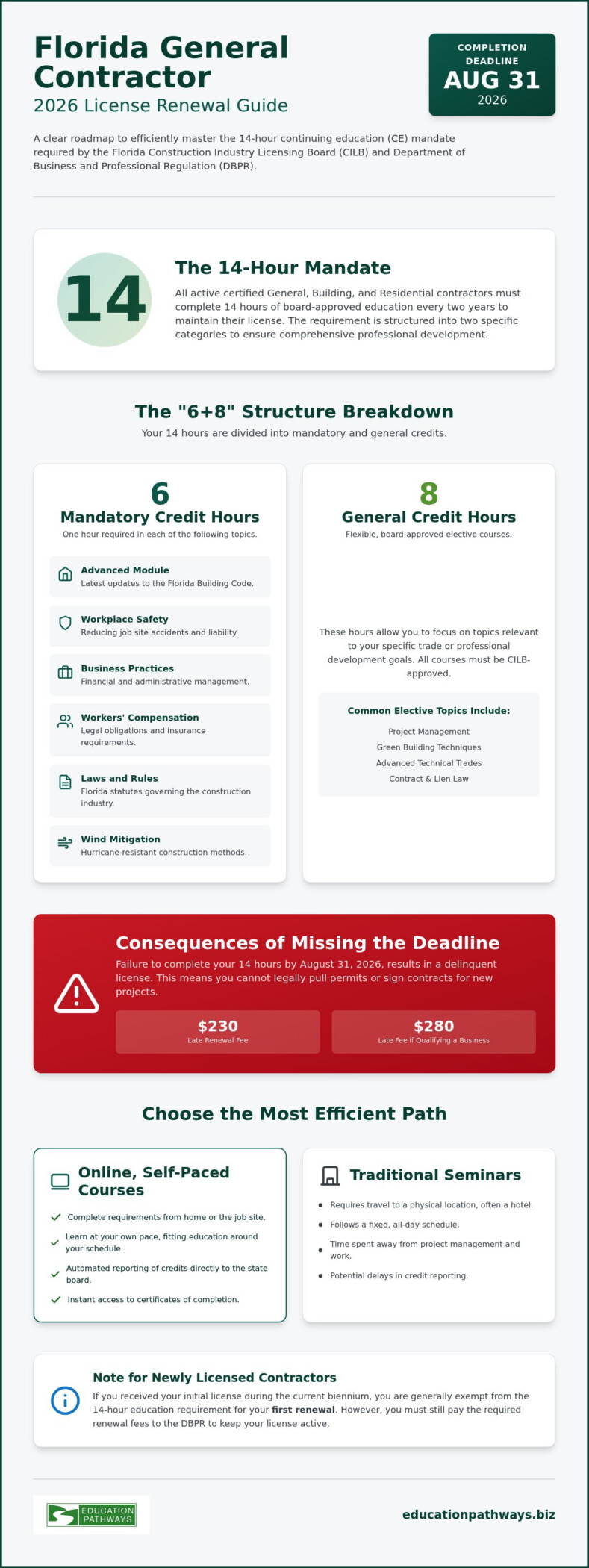
- Simplify the Florida general contractor CE requirements by mastering the “6+8” structure. You’ll need six hours of mandatory topics and eight hours of general credits.
- Skip the hotel seminars and choose a more efficient path. Online, self-paced modules allow you to finish your requirements without leaving the job site.
- Get instant proof of compliance. Look for courses that offer automated reporting to the state board and provide certificates immediately upon completion.
- Navigate the DBPR portal with confidence. A step-by-step renewal guide ensures you submit your application correctly before the deadline.
Understanding the Florida General Contractor CE Requirements for 2026
The Florida Construction Industry Licensing Board (CILB) requires all active licensees to complete 14 hours of board-approved education every two years. This mandate is more than a simple formality. It’s a regulatory safeguard enforced by the Florida Department of Business and Professional Regulation (DBPR) to ensure every contractor remains current on evolving building codes, safety standards, and business laws. Meeting the Florida general contractor CE requirements is essential for maintaining your professional standing and your ability to operate legally within the state.
Ignoring these requirements carries heavy penalties. If you miss the renewal window, your license status shifts to delinquent. A delinquent license is functionally inactive, meaning you cannot pull permits or legally sign contracts for new projects. Beyond the operational standstill, the financial impact is immediate. Late renewal fees for active licenses are $230, which increases to $280 if you qualify a business. Completing your hours on time protects your revenue and your reputation.
The 2026 Renewal Cycle: Key Dates to Remember
The current biennial cycle ends on August 31, 2026. This date is the firm deadline for certified contractors to have their 14 hours completed and reported to the DBPR. While registered contractors typically follow an odd-numbered year cycle, the 2026 deadline remains the primary focus for the bulk of Florida’s certified workforce. Waiting until August to start your courses is a risky strategy. High traffic on the state’s renewal portal can lead to technical delays, and processing times for credits can vary. We recommend finishing your Florida contractor license renewal requirements at least 30 days early to ensure a smooth transition into the next cycle.
Who Must Fulfill These Continuing Education Requirements?
These requirements apply to a wide range of professionals, including General, Building, and Residential contractors. If you hold multiple CILB certificates or registrations, you don’t need to double your workload. You only need to complete the 14-hour requirement once per renewal period to cover all licenses held by the same person. However, there is a specific exemption for newly licensed contractors. If you received your initial license during the current biennium, you are generally exempt from the CE requirement for your first renewal. You still must pay the required renewal fees to the DBPR, but the 14 hours of education will not be mandatory until your second renewal cycle begins.
Breaking Down the 14-Hour Florida Contractor CE Package
The 14-hour requirement isn’t just a random block of time. It follows a strict “6+8” structure mandated by the state. This means you need six hours of specific, mandatory topics and eight hours of general electives. The Construction Industry Licensing Board (CILB) oversees this content to ensure it meets current industry standards. Professional groups like the Florida Home Builders Association work alongside regulators to ensure these topics remain relevant to your daily operations. Mastering this breakdown is the first step toward a stress-free renewal.
The 6 Mandatory Credit Hours
These six credits are non-negotiable and must be completed individually. The state requires one hour in each of the following specific categories:
- Specialized or Advanced Module: Typically focused on the latest Florida Building Code updates.
- Workplace Safety: Essential for reducing job site accidents and liability.
- Business Practices: Covers the financial and administrative side of running a construction firm.
- Workers’ Compensation: Reviews legal obligations and insurance requirements.
- Laws and Rules: Focuses on the statutes governing the construction industry in Florida.
- Wind Mitigation: Mandatory for General, Building, and Residential contractors to address hurricane-resistant construction.
The 8 General Credit Hours
Once you finish the core hours, you have eight hours of general credits to complete. These hours offer more flexibility. You can use them to focus on professional development or technical skills that benefit your specific trade. Common topics include project management, green building techniques, or advanced technical trades. The most important factor is ensuring these electives are board-approved. If your elective hours aren’t vetted by the CILB, they won’t count toward your Florida general contractor CE requirements, which could put your license at risk.
Choosing a provider that bundles all these requirements into a single package is the most efficient strategy. You don’t want to buy multiple courses only to realize you’re missing the Wind Mitigation hour or the Advanced Building Code module. A comprehensive package ensures every box is checked in one place. This approach is particularly effective for contractors holding multiple CILB licenses. A single 14-hour course can satisfy the requirements for all your licenses at once, saving you significant time and effort. If you want to simplify this process, our Florida contractor CE hub offers complete, board-approved packages designed for maximum efficiency.
Online vs. Traditional CE: Finding the Most Efficient Path
Modern contractors are trading hotel ballrooms for digital portals. Meeting the Florida general contractor CE requirements no longer requires sitting in a physical classroom for two straight days. Digital compliance has become the industry standard because it respects your time. While traditional seminars served their purpose in the past, they often involve hidden costs like travel, lodging, and missed project hours. Moving to an online format allows you to keep your crew on-site while you handle your administrative obligations in the evenings or during downtime.
Florida law mandates that online courses must be “interactive” to qualify for credit. Some professionals mistake this for a live video feed, but it actually refers to the underlying course structure. DBPR-approved courses use strategic checkpoints and quizzes to ensure you’re engaging with the material. This method verifies participation without forcing you to follow a rigid, external schedule. Organizations like the NAHB Education Programs highlight how digital learning has evolved to support high-level professional development across the construction sector.
The Benefits of 100% Online, Self-Paced Learning
Self-paced learning is the ultimate tool for a busy professional. You can start your 14 hours on a rainy Tuesday and finish them over the weekend. There’s no travel time. You don’t have to deal with traffic or find parking at a convention center. If a specific section on the Florida Building Code is complex, you can review it as many times as needed. Conversely, if you’re already an expert in workplace safety, you can move through that section at a faster clip. This customized speed ensures you actually retain the information rather than just waiting for a clock to run out in a crowded room.
Why Livestream and Classroom Options May Slow You Down
Many competitors still push livestream courses as a modern solution. While these are technically “online,” they aren’t truly flexible. Livestreams require you to be present at a specific time, often for seven or eight hours at a stretch. If your internet drops or a client calls with an emergency, you risk losing credit for that entire session. Classroom settings are even more restrictive. You’re at the mercy of the instructor’s pace and the distractions of other students. For most, meeting the Florida general contractor CE requirements through Florida contractor CE classes online provides a much more reliable path to compliance. You get the same official credit without the logistical headaches of a live event.
The Step-by-Step Guide to Renewing Your Florida Contractor License
Starting your renewal doesn’t have to be a complex ordeal. Once you understand the Florida general contractor CE requirements, the actual execution follows a logical sequence. The process begins with enrolling in a board-approved course that covers the necessary hours. After finishing your modules, the focus shifts to the DBPR online portal. This digital hub is where you’ll officially submit your application and pay your biennial fees. We’ve simplified the path so you can focus on your projects instead of paperwork.
You should verify your current status through the “Manage My License” section of the DBPR website well before the 2026 deadline. This portal acts as the official record for your professional standing. It allows you to see exactly which credits have already been applied to your account. If you’ve been licensed for several cycles, your portal will show a comprehensive history of previous completions. For the current cycle, you must ensure every mandatory category shows as “Satisfied” before the system will allow you to proceed with the final renewal payment.
Tracking Your Credits and Automated DBPR Reporting
One of the biggest advantages of working with Education Pathways is our automated reporting system. We report your completed credits to the DBPR within 24-48 hours. This eliminates the need for you to manually mail paper certificates to the state board. While we handle the heavy lifting, you should still check your DBPR account to confirm the credits appear as “Posted.” This verification gives you the peace of mind that your Florida contractor license renewal is on the right track and prevents any last-minute surprises.
Avoiding Common Renewal Delays and Penalties
Waiting until the final week of August is the most common mistake contractors make. While our reporting is fast, the state’s internal systems can experience lags during the high-volume “August rush.” If you finish your CE on August 30th, you might not see the credits reflected in time to submit your renewal application without a late fee. Completing your Florida general contractor CE requirements early is the best way to protect your active status.
Discrepancies can occasionally occur between your completion certificate and state records. If you notice a missing hour in your portal, having your instant certificate from our Florida contractor CE hub allows you to resolve the issue quickly with the DBPR. To avoid these technical headaches, aim to have your 14 hours finalized at least two weeks before the deadline. Complete your 14-hour CE requirement now to ensure a smooth 2026 renewal.
Simplify Your Compliance with Education Pathways Online Courses
Education Pathways has served the Florida construction community since 2002. We understand that your time is best spent on the job site, not in a classroom. Our platform is built to simplify the Florida general contractor CE requirements by providing a streamlined, digital experience. We’ve vetted every module to ensure it meets the highest standards of regulatory compliance while remaining practical for your business operations. Choosing a seasoned partner gives you the confidence that your license is protected by experts who know the Florida system inside and out.
Our commitment to 100% online, self-paced learning means you’re always in control. You don’t need to coordinate with a live instructor or wait for a scheduled session. This flexibility is vital as the August 31, 2026, deadline approaches. Whether you need a full 14-hour package or specific elective hours, our system is designed for speed and reliability. Beyond general contracting, we provide education for community association managers, real estate professionals, and architects, making us a comprehensive resource for all your professional licensing needs.
DBPR-Approved Curriculum Designed for 2026
Every course we offer is fully DBPR-approved. Our 14-hour package is specifically curated to include all six mandatory topic hours. This includes the required hours for workplace safety, workers’ compensation, business practices, laws and rules, and wind mitigation. We also include the advanced Florida Building Code module. Using Florida contractor CE classes online ensures you aren’t just checking a box. You’re engaging with high-quality content that addresses the real-world challenges you face in the 2026 construction environment.
Instant Certificates and Reliable State Reporting
The moment you finish your final module, your certificate of completion is available for download. There’s no waiting for a physical copy in the mail. This instant verification provides immediate peace of mind, especially if you’re renewing close to the deadline. Our automated reporting system then takes over. We send your data directly to the CILB within 24 to 48 hours, ensuring your Florida general contractor CE requirements are officially recorded without any manual effort on your part. If you ever have a question about the process, our reliable customer support team is available to guide you through the renewal steps.
Secure Your 2026 License Renewal Today
Maintaining your professional standing doesn’t have to be a source of stress. By focusing on the August 31, 2026, deadline early, you avoid the risks of technical delays and late fees. You now have a clear roadmap for the 14-hour requirement, from the mandatory wind mitigation module to the flexible general credits. Choosing a 100% online, self-paced format allows you to fulfill these obligations without sacrificing time on your active job sites.
Education Pathways has been a trusted, DBPR-approved provider since 2002. We’ve built our system to handle the heavy lifting for you. With instant certificates and automated reporting to the state board, you can verify your compliance immediately. Meeting the Florida general contractor CE requirements is the final step in protecting your business and your reputation for the next cycle.
Take the first step toward a hassle-free renewal. Fulfill your Florida Contractor 14-hour CE requirement online today!
We’re here to help you succeed and keep your projects moving forward.
Frequently Asked Questions
How many hours of continuing education does a Florida general contractor need?
Florida general contractors must complete 14 hours of board-approved continuing education every two years. This total includes 6 mandatory hours covering specific topics: workplace safety, workers’ compensation, business practices, laws and rules, wind mitigation, and an advanced module on the Florida Building Code. The remaining 8 hours are general credits. Meeting the Florida general contractor CE requirements ensures your license remains in good standing and allows you to continue pulling permits for your projects.
When is the next Florida contractor license renewal deadline in 2026?
For certified contractors, the next firm deadline is August 31, 2026. This date marks the end of the current biennial cycle. You must have all 14 hours finished and reported to the DBPR before this cutoff. Registered contractors typically renew in odd-numbered years, but certified professionals should prioritize this 2026 date. Finishing your courses early helps you avoid technical delays or late fees that occur during the final August rush.
Do online CE courses count toward my Florida contractor license renewal?
Yes, 100% online courses are fully accepted by the DBPR as long as the provider is board-approved. Education Pathways has provided these digital solutions since 2002, offering a flexible alternative to traditional classroom settings. These self-paced modules allow you to engage with the material whenever your schedule permits. You don’t have to travel to a hotel seminar or sit through a rigid livestream to satisfy your Florida general contractor CE requirements.
What happens if I miss the August 31, 2026 CE deadline?
If you miss the deadline, your license status shifts to delinquent. This means you cannot legally sign contracts or pull new permits. You’ll also face financial penalties, including a late renewal fee of $230 for active licenses. If your license qualifies a business, that fee increases to $280. To return to active status, you must complete the required 14 hours of education and pay all associated state fees and penalties.
Are these CE courses reported automatically to the Florida DBPR?
Yes, Education Pathways handles the reporting for you. Once you finish your final module, our automated system transmits your completion data directly to the Construction Industry Licensing Board (CILB) within 24 to 48 hours. This process removes the need for you to manually mail or upload certificates to the state. We recommend checking your DBPR account a few days after completion to confirm that all credits show as “Posted” in your official record.
Can I take my Florida contractor CE courses on a mobile device?
Our platform is designed for modern professionals on the move. You can access your 14-hour course package from any mobile device, tablet, or desktop computer with an internet connection. This accessibility makes it easy to finish a module while you’re on a job site or during your lunch break. The self-paced nature of the courses means your progress is saved automatically, so you can pick up exactly where you left off.
How soon after completing a course will I receive my certificate?
You will receive your certificate of completion the moment you finish your final module. There is no waiting period or processing delay for the digital document. You can download and print your certificate immediately from your account dashboard. While we report your credits to the state automatically, having this instant certificate provides immediate proof of compliance should you need it for a permit application or an internal audit.
Is wind mitigation a mandatory CE topic for Florida contractors?
Wind mitigation is a mandatory 1-hour requirement for General, Building, and Residential contractors in Florida. This specific module focuses on construction techniques designed to prevent or lessen property damage caused by high winds and hurricanes. It’s one of the six core mandatory hours you must complete every cycle. Our 14-hour package includes this essential hour to ensure you meet every state mandate without having to purchase additional individual classes.