
Florida Residential Contractor CE: The Complete 2026 Renewal Guide

On August 31, 2026, thousands of active Florida residential contractor licenses will expire, and many professionals will lose their ability to pull permits simply because they miscalculated their credit hours. It’s a high-stakes deadline that can cause unnecessary stress when you’re already managing busy job sites and tight project timelines. Completing your Florida residential contractor CE shouldn’t feel like a second job or a gamble with your credentials.
We know you’d rather be in the field than stuck in a classroom or hunting for DBPR-approved courses that actually count toward your 14-hour requirement. This guide provides a streamlined path to compliance, ensuring you master every mandatory hour with zero stress. We’ll break down the specific credits you need, including workplace safety, wind mitigation, and business practices; while showing you how to get instant certificates and automatic reporting to the board. You’ll learn exactly how to secure your 2026 renewal using mobile-friendly, self-paced tools that respect your time and your professional reputation.
Key Takeaways
- Identify the mandatory subject areas required by Florida law to ensure your Florida residential contractor CE hours meet every state standard.
- Compare the time saving benefits of 100% online courses against traditional classroom formats to stay productive on the job site.
- Follow a clear, step by step guide to selecting a DBPR approved provider and completing your curriculum efficiently.
- Leverage automated reporting and instant certificates to remove the administrative burden from your 2026 licensing cycle.
Understanding Florida Residential Contractor CE Requirements for 2026
Every two years, the Florida Department of Business and Professional Regulation (DBPR) requires licensed contractors to prove they are staying current with industry standards. For those holding a residential license, this means completing 14 hours of board-approved Florida residential contractor CE. This isn’t just a bureaucratic hurdle. It is a measure designed to ensure public safety and structural integrity across the state. Using a state-approved provider is critical for your license validity. If your courses aren’t officially recognized, the DBPR won’t accept your credits, which can lead to an expired license and a complete work stoppage.
Florida maintains some of the most rigorous standards in the country compared to general U.S. contractor licensing patterns. The 14-hour Florida residential contractor CE package is specifically tailored to address local risks like hurricane preparedness and the latest building codes. The DBPR mandates specific subject areas because high-quality construction directly impacts the safety of Florida residents. Staying compliant ensures you remain a trusted professional in a competitive market while avoiding the stress of last-minute filings.
The Biennial Renewal Cycle Explained
Certified contractors must complete their requirements and submit their renewal by August 31, 2026. This deadline is absolute. If you miss it, your license status changes to inactive or delinquent. This status legally prevents you from signing new contracts or pulling permits. Certified contractors renew in even-numbered years, while registered contractors follow an odd-numbered year cycle. Don’t wait until the final week of August to start your courses. Early completion allows for the 24 to 48 hour reporting window required for the DBPR systems to update your professional status.
Who Needs Continuing Education?
This requirement applies to Residential, General, and Building contractors across the state. If you hold an active license, you must fulfill the 14-hour mandate to stay in good standing. There are a few exceptions to keep in mind. Newly licensed individuals might be exempt from certain CE requirements during their very first renewal cycle. If you hold multiple licenses, you usually only need to complete the 14 hours once, as long as the curriculum meets the criteria for each license type. You can verify your specific status through the Florida contractor license renewal portal to avoid any surprises. Staying organized is the best way to protect your business and your professional livelihood.
Breaking Down the 14-Hour Florida Contractor CE Package
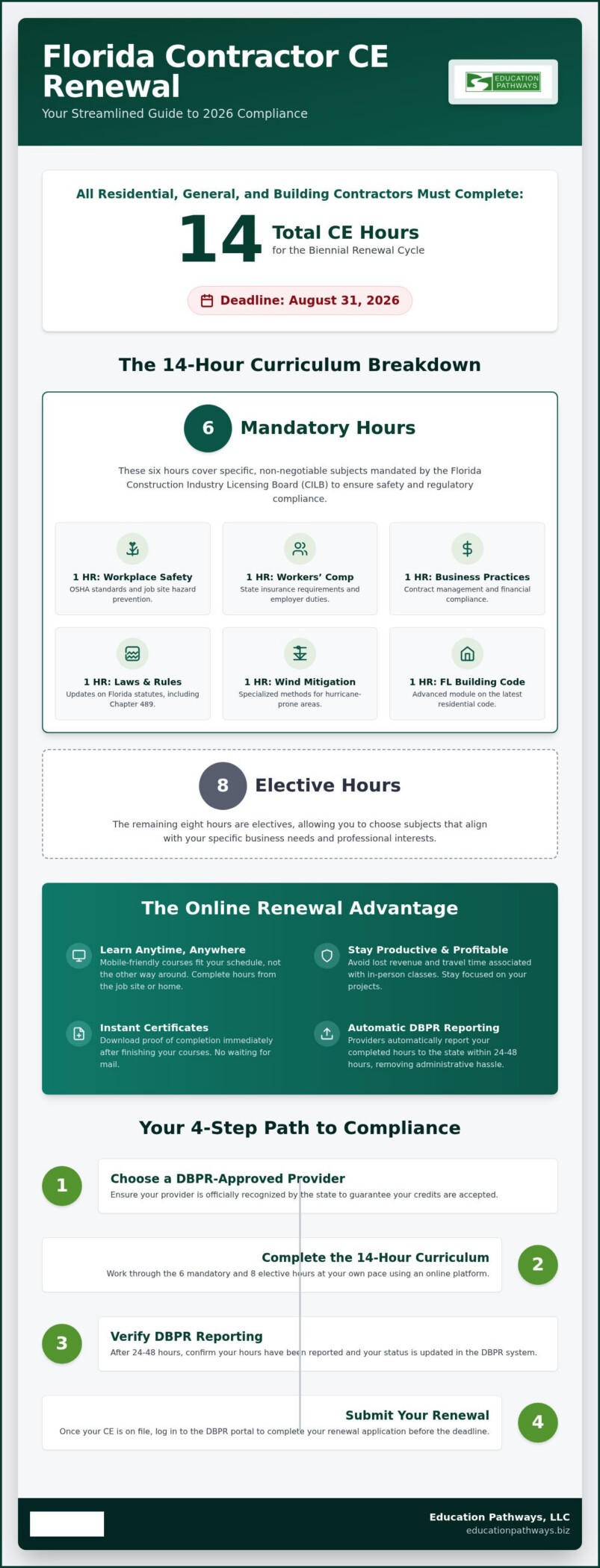
Understanding the specific components of your 14-hour Florida residential contractor CE requirement is the first step toward a stress-free renewal. The Florida Construction Industry Licensing Board (CILB) dictates a precise curriculum that every residential contractor must follow. While it might seem complex, these hours are divided into six mandatory categories and eight elective hours. This structure ensures you stay updated on legal changes, safety protocols, and regional building challenges that impact your daily operations.
Mandatory Credit Hour Subjects
Six of your 14 hours must focus on specific regulatory pillars. These subjects are non-negotiable for maintaining an active license in the state of Florida.
- 1 hour of Workplace Safety: Focuses on OSHA standards and site hazard prevention.
- 1 hour of Workers’ Compensation: Covers employer responsibilities and state insurance requirements.
- 1 hour of Business Practices: Addresses contract management and financial compliance.
- 1 hour of Laws and Rules: Updates on Chapter 489 and other relevant Florida statutes.
- 1 hour of Wind Mitigation: Specialized methodology for storm resilience.
- 1 hour of Florida Building Code (Advanced): In-depth look at the latest 2023 Residential Advanced Florida Building Code.
Wind Mitigation is particularly vital for those completing Florida residential contractor CE. It directly impacts insurance rates and structural integrity in storm-prone areas. Similarly, the Advanced Building Code module keeps you aligned with current state mandates. Failing to complete even one of these specific hours can result in a rejected renewal application.
The Value of Elective Credits
Once you satisfy the mandatory requirements, you have eight elective hours to complete. These credits allow you to customize your learning to fit your specific business goals. You might choose to focus on project management, green building techniques, or specialized technical skills. Choosing relevant electives turns a mandatory task into a tool for professional growth. This flexibility helps you stay competitive in the local market. Instead of picking separate classes, most pros find it easier to use a pre-vetted bundle. You can explore our Florida Contractor CE Package to see how we’ve curated the best elective topics for residential pros.
Bundling these 14 hours into a single package is the most efficient way to handle your 2026 renewal. It eliminates the risk of missing a mandatory hour or wasting time on non-approved content. By choosing a comprehensive hub, you ensure every minute spent learning moves you closer to a successful filing. If you’re ready to get started, our DBPR-approved online classes offer the fastest route to completion.
Online vs. Classroom: Choosing Your CE Format
Choosing the right format for your Florida residential contractor CE often comes down to a single question: how much do you value your time? Traditional classroom seminars require you to leave the job site, sacrifice billable hours, and navigate traffic to reach a physical location. Digital learning removes these barriers entirely. Some contractors still hold the myth that online courses aren’t as “valid” as in-person training. In reality, the DBPR fully authorizes 100% online formats, provided the provider is state-approved. You receive the exact same legal credit without the logistical headache of a hotel conference room.
The state’s continuing education requirements are consistent across all delivery methods. This means you get the same professional standing from a digital module as you would from a two-day lecture. Online bundles are significantly more cost-effective. They eliminate travel expenses and the hidden cost of lost productivity that occurs when a project manager is away from their crew. For a modern residential professional, the efficiency of a digital platform is an essential business tool.
Why Self-Paced Online Learning Wins
Active residential project managers rarely have 14 hours of uninterrupted free time. Online modules adapt to your schedule, not the other way around. You can start a safety chapter in your truck while waiting for an inspector and finish it at home later that evening. This flexibility is a game-changer. Mobile-friendly access means your training travels with you. If a sub-contractor is running late, you can knock out twenty minutes of elective credits right from your phone. You don’t have to choose between your education and your project deadlines.
Instant Certificates and Verified Compliance
One of the biggest risks of traditional training is the lag in reporting and the potential for lost paperwork. When you finish an online course with a reputable provider, you receive an instant certificate of completion. This digital record is your first line of defense during an audit. It provides immediate peace of mind that you’ve met your obligations for the 2026 cycle. Beyond the certificate, a professional platform handles the heavy lifting of reporting your hours directly to the DBPR. You can learn more about Fulfilling Your Florida Contractor 14 Hour CE Requirement through our streamlined portal. Digital records simplify your professional life and ensure your license remains active without the manual paperwork headache.
The Step-by-Step Florida Contractor License Renewal Process
Renewing your professional credentials doesn’t have to be a complicated ordeal. By following a structured four-step process, you can move from an expiring license to a fully renewed status in just a few sittings. This sequence ensures you meet all legal obligations while maintaining your presence on the job site. Most contractors find that starting early is the best way to avoid the technical bottlenecks that often occur during the final week of August.
- Step 1: Selecting a DBPR-approved education provider. Your first priority is ensuring the credits you earn are legally recognized. Choose a provider with a long history of state approval to guarantee your hours are counted toward your renewal.
- Step 2: Completing the 14-hour curriculum. Progress through the interactive modules at your own pace. This is where you’ll finish the mandatory hours discussed earlier, covering safety, building codes, and business practices.
- Step 3: Verification of automated credit reporting. Once you finish your Florida residential contractor CE, the provider should handle the data transfer. You’ll want to confirm that your credits have been successfully transmitted to the state board.
- Step 4: Paying the state renewal fee on the DBPR portal. After your credits appear on your transcript, log into the MyFloridaLicense portal. Complete the final application and submit your renewal fee to finalize your active status for the next two years.
If you want to start Step 1 right now, you can access our complete CE hub to begin your 14-hour requirement immediately.
How Credits are Reported to the State Board
The reporting phase is where many contractors feel the most anxiety. We use an automated system to streamline your Florida residential contractor CE reporting. Once you complete a course, the data is sent electronically to the DBPR. It’s a hands-off process for you, but you should still verify the results. You can check your official transcript by logging into the MyFloridaLicense website. For a more detailed walkthrough of this interface, consult our Florida Contractor License Renewal Guide. Generally, it takes 24 to 48 hours for the state system to reflect your new credits.
Handling Last-Minute Renewals
Life on the job site is unpredictable, and sometimes the August 31st deadline sneaks up on you. If you’re renewing late in the cycle, you must account for the 24 to 48 hour reporting buffer. Don’t wait until August 30th to finish your last hour. While our platform provides instant certificates of completion, these serve as your personal proof of compliance. The DBPR system still needs that short window to process the electronic filing before you can pay your renewal fee. Finishing your hours at least one week before the deadline is the safest way to avoid late fees or a delinquent license status.
Streamlining Your Professional Compliance with Education Pathways
Choosing a partner for your Florida residential contractor CE is about more than just checking a box. It’s about finding a provider that understands the nuances of state regulations and the pressures of your daily workload. Since 2002, Education Pathways has focused on creating a frictionless experience for licensed professionals. We’ve refined our platform to ensure that every interaction is intuitive, fast, and reliable. Our interface is specifically designed for busy contractors who need to move quickly between the job site and their compliance requirements. You won’t find unnecessary fluff here. We provide the technical industry terminology you expect with the accessibility you need to finish your hours efficiently.
Why Experience Matters in CE
Regulatory landscapes change frequently. Working with a veteran provider means you’re leveraging over 20 years of expertise in Florida professional licensing. We don’t just offer classes; we provide a vetted curriculum that aligns perfectly with the latest DBPR standards. Our team stays on top of Florida-specific statutes so you don’t have to. When you enroll in our Approved Florida Contractor CE Classes, you’re trusting a system that has successfully guided thousands of contractors through multiple renewal cycles. This institutional knowledge allows us to anticipate common reporting issues and provide proactive support that newer, less experienced providers simply can’t match. We act as a bridge between complex state mandates and your successful license renewal.
Ready to Renew Your License?
The 2026 renewal cycle doesn’t have to be a source of stress. Our comprehensive 14-hour bundles cover all state-mandated topics in one organized package. You get the workplace safety, workers’ compensation, wind mitigation, and advanced building code hours you need without having to hunt for individual credits. We handle the automated board reporting to the DBPR and provide instant certificates of completion the moment you finish a module. This results-driven approach is why residential pros return to us every two years. We value your time as much as you do. Our platform is mobile-friendly, allowing you to stay productive while meeting your legal obligations.
If you’re looking for more in-depth information on maintaining your credentials long-term, check out our Florida Contractor Continuing Education Guide. We’ve done the heavy lifting of vetting information so you can proceed with confidence. Don’t let the August 31st deadline disrupt your business operations. Start your 14-hour Florida residential contractor CE package today and secure your license with a trusted, efficient partner. We make compliance simple so you can stay focused on the job site.
Secure Your 2026 License Renewal Today
Maintaining your professional standing shouldn’t be a source of anxiety. You now have a clear roadmap for your 14-hour Florida residential contractor CE requirement. Remember that staying compliant involves mastering the six mandatory subject areas and choosing relevant electives that serve your business growth. By opting for a digital format, you reclaim your schedule and avoid the lost wages associated with traditional classroom training. It’s about working smarter, not harder, to meet state mandates.
Our 100% online and self-paced platform is built for your convenience. We provide instant certificates and handle automated DBPR reporting so you can focus on the job site instead of paperwork. Every module is designed to move you closer to a successful filing with zero stress. Don’t wait for the August deadline to disrupt your momentum or cause a last minute rush. Enroll in your Florida Contractor 14-Hour CE Package today and experience a streamlined path to compliance. You have the tools to protect your livelihood; it’s time to put them to work and finish your renewal with confidence.
Frequently Asked Questions
How many continuing education hours do Florida contractors need for 2026?
Active certified contractors must complete 14 board-approved hours of continuing education every two years. This total includes six mandatory subject hours and eight elective hours. Completing your Florida residential contractor CE ensures you maintain your professional standing and legal ability to pull permits. These requirements apply to most active licenses regulated by the CILB and must be finished before the state renewal window closes to avoid complications.
When is the deadline to renew a Florida residential contractor license?
Certified contractors must renew their licenses by the August 31, 2026 deadline. This specific date applies to the even-numbered year cycle for certified professionals in the state. Registered contractors typically follow a different timeline in odd-numbered years. It’s best to finish your requirements early to account for the processing window required by the state portal. Missing this date results in a delinquent license and additional late fees.
Are the 14 hours of CE reported automatically to the DBPR?
Yes, we handle the reporting process for you automatically. Once you successfully complete your coursework through Education Pathways, our system transmits your credits electronically to the Florida DBPR. This automated submission generally reflects on your state transcript within 24 to 48 hours. This feature removes the administrative burden from your shoulders, allowing you to focus on your construction projects while we ensure your compliance data reaches the board.
Can I complete my Florida contractor CE entirely online?
You can complete 100% of your Florida residential contractor CE requirements online through state-approved providers. The DBPR authorizes digital learning as a valid method for fulfilling the 14-hour mandate. Our courses are self-paced and mobile-friendly, giving you the flexibility to train between job site inspections or from your home office. There’s no requirement for in-person classroom attendance, making the online format the most efficient choice for busy pros.
What happens if I miss the contractor license renewal deadline?
Missing the August 31st deadline causes your license to become delinquent. You’ll be legally barred from pulling permits or signing new contracts until the license is restored. Additionally, you’ll face higher renewal fees. For an active certified license, the fee increases from $205 to $230 if renewed late. If you qualify a business, the late fee rises to $280. Staying ahead of the deadline protects your income and professional reputation.
What specific subjects are mandatory for the 14-hour CE requirement?
The state mandates six specific one-hour subjects as part of your 14-hour total. These include:
- Workplace Safety
- Workers’ Compensation
- Business Practices
- Advanced Module Building Code
- Laws and Rules
- Wind Mitigation Methodology
The remaining eight hours are electives. You can use these to study topics that align with your specific residential project needs and professional development goals.
How do I verify if my CE credits have been reported to the state board?
You can verify your credit status by logging into the MyFloridaLicense.com official portal. Navigate to your license profile to view your current continuing education transcript. It’s important to remember that most providers require a 24 to 48 hour window for the electronic data to process through the state’s system. If your hours aren’t visible after two business days, contact your education provider to ensure the reporting was successfully triggered.
Do I get a certificate immediately after finishing my online course?
Yes, you receive an instant certificate of completion the moment you finish your coursework. Our platform allows you to download and print your verified certificate immediately for your personal records. While we report your hours to the DBPR automatically, having this document provides immediate proof of compliance. This is especially helpful for your own filing systems or if you need to provide evidence of education to an employer or insurance carrier.