
NMLS Renewal Period Explained: Key Dates and Steps for 2026

December 31 is the NMLS renewal deadline, but waiting until the final days leaves little time to resolve a continuing education or state-specific issue. The NMLS renewal period explained simply: the 2026 renewal window runs from November 1 through December 31. If you miss the deadline, your license expires on January 1.
It’s understandable to want clear dates and a straightforward checklist, especially when requirements differ by state. A general reinstatement period runs from January 1 through the end of February, but not every state participates and late fees may apply. MLOs also need to complete approved CE, and finishing a course does not submit a renewal application.
This guide explains the annual renewal and reinstatement windows, what to review in NMLS and with your state regulator, and how CE affects eligibility. It also covers how to plan coursework and filing ahead of the deadline. Self-paced, online NMLS-approved CE can help you fit required learning around work, while keeping course completion separate from the renewal filing.
Key Takeaways
- NMLS renewal period explained: the standard 2026 window runs November 1 through December 31, followed by a possible reinstatement period that may vary by state.
- Review your NMLS record and identify the requirements set by each state agency where you hold a license.
- Check CE requirements and eligibility early. Course completion, reporting, and renewal status are connected but separate steps.
- Prepare the required materials and submit your renewal request through NMLS. Completing CE alone does not renew a license.
- Use a chronological plan to catch record or eligibility issues before the deadline creates added pressure.
What the NMLS renewal period means for an individual MLO
Annual renewal is the process an individual mortgage loan originator (MLO) uses to request continued license status through the Nationwide Multistate Licensing System and Registry (NMLS). NMLS is the system for submitting licensing filings. State agencies issue and oversee licenses, and they determine which requirements apply to each MLO.
In practical terms, the renewal period is the window for submitting a renewal request. It is not a label for every task that affects approval. Your renewal concerns an individual license record. Company and branch filings are separate, so completing or submitting one type of renewal does not complete another.
Who uses the NMLS individual renewal process?
This process applies to individual mortgage loan originators renewing their own state license records. It does not describe a company’s renewal or a branch filing. Each filing relates to a different licensee or business record. If you work with a mortgage company, focus on the requirements tied to your own individual license.
State-specific rules can affect what you need to do. If you hold licenses in more than one jurisdiction, review the requirements for each one rather than assuming they are identical.
Renewal dates are not the same as CE requirements
The renewal window is the period for submitting your request. Continuing education (CE) is a separate requirement that may affect your eligibility to renew. Treating them as one task can cause a last-minute problem: the filing date on your calendar does not tell you whether your CE is complete or whether your record meets the applicable requirements.
Check the relevant state agency’s current instructions and your NMLS record for jurisdiction-specific CE requirements. A requirement in one state may not apply to every license you hold.
Keep the process clear by separating the questions you need to answer:
- Which record am I renewing? Confirm that you’re reviewing your individual MLO license, not a company or branch filing.
- Which agency’s rules apply? Identify the requirements for each jurisdiction where you hold a license.
- What affects my eligibility? Review CE and any other applicable requirements in your NMLS record and agency guidance.
- What action remains? Track the renewal request separately from course completion so you don’t mistake one step for the other.
This distinction gives you a more reliable starting point for renewal planning. NMLS provides the filing system, but state agencies set license requirements. Use the dates as a filing schedule, then confirm that your individual record and jurisdiction-specific obligations are ready before submitting.
NMLS renewal dates in 2026: the standard window and what follows
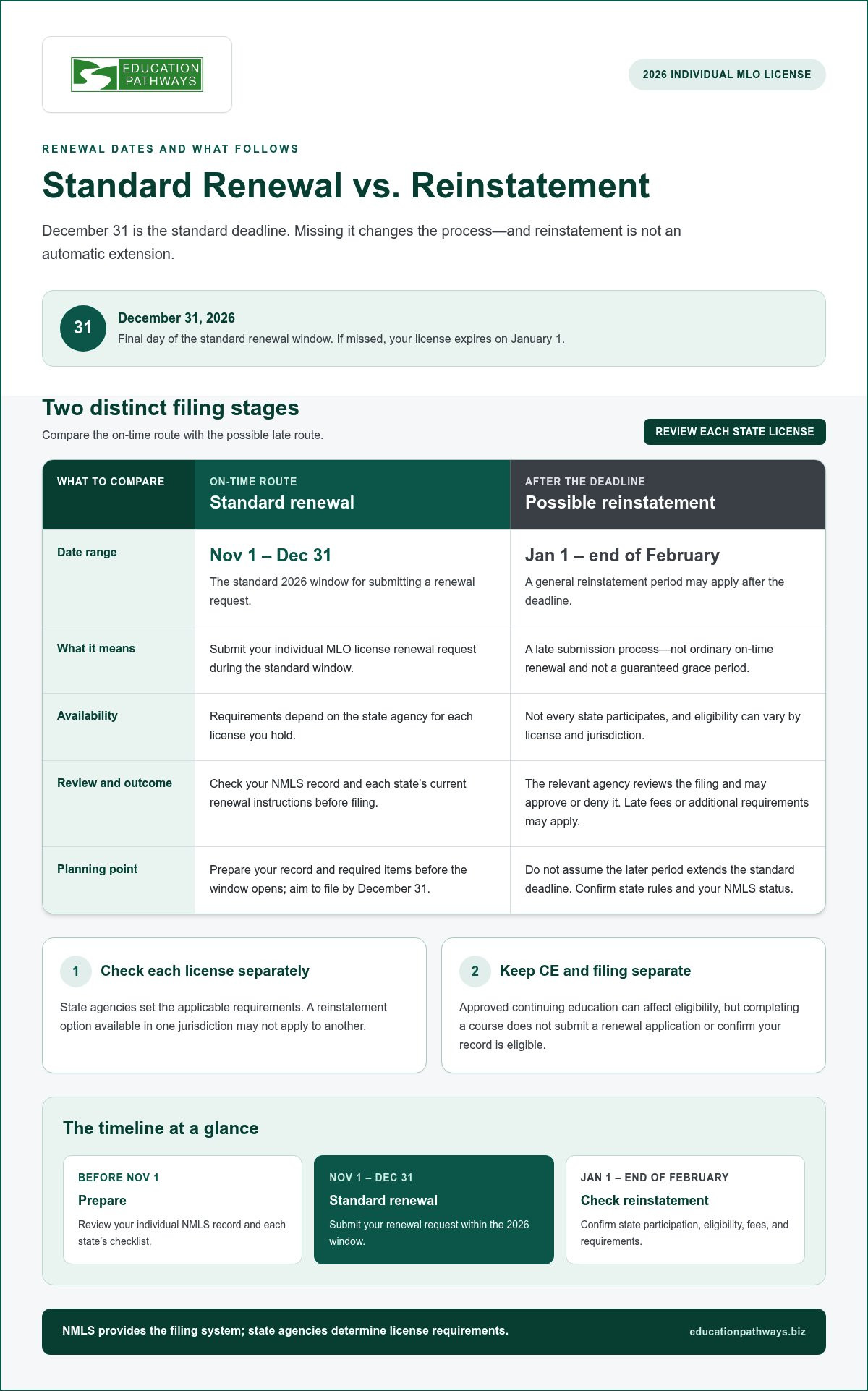
For 2026, the standard NMLS renewal window runs from November 1 through December 31. If you miss the December 31 deadline, a possible reinstatement period runs from January 1 through the last day of February. Reinstatement is not an automatic extension, and it is not available or approved in every situation.
The NMLS renewal period explained here has two distinct stages: the standard window for submitting a renewal request and a possible reinstatement route for eligible licenses in participating states. State agencies set the applicable requirements, so review current 2026 guidance for every jurisdiction where you’re licensed. The Conference of State Bank Supervisors (CSBS) NMLS page provides an authoritative overview of NMLS and its role in licensing and registration.
Before November 1: prepare your renewal record
Use the time before the window opens to review your individual NMLS record and address any visible deficiencies. Check the current renewal checklist for each state license you hold, since instructions and requirements can differ. Track CE completion separately from renewal eligibility: finishing a course does not confirm that your record is eligible or that you have filed a renewal request.
Build a simple timeline for each license. Note the filing dates, the state-specific checklist, and any outstanding items to resolve. If you’re planning CE, self-paced online MLO courses can help you schedule study around work. Explore NMLS-approved MLO continuing education as one part of your preparation.
After December 31: understand reinstatement limits
Reinstatement is a late submission process, not ordinary on-time renewal. From January 1 through the end of February, reinstatement may be possible for an eligible license in a participating state. It is not a guaranteed grace period: state participation, eligibility, fees, and additional requirements can vary. The relevant agency reviews the filing and may approve or deny it.
Before relying on reinstatement, review the current rules from the state agency for each affected license and check your NMLS status. An option available in one jurisdiction may not apply to another. The standard window and possible reinstatement period are separate stages, so don’t plan as though the later period automatically extends the December 31 deadline.
Use the dates as planning markers, not as a substitute for license-specific instructions. Review your record before November, prepare the required items, and aim to submit within the standard window. If the deadline has passed, confirm whether reinstatement applies to your license and what the agency requires before filing.
Standard renewal vs. reinstatement: what changes if you miss December 31?
Missing December 31 does not produce the same outcome for every MLO or every state license. Standard renewal and reinstatement are separate paths. A reinstatement request may be available for eligible licenses in participating states, but filing during that period does not guarantee approval.
Use this comparison to understand what changes. The relevant agency’s current instructions and your license status determine which requirements apply.
| Factor | Standard renewal | Reinstatement |
|---|---|---|
| Timing | Submit during the annual window, November 1 through December 31. | May be available from January 1 through the end of February for eligible licenses in participating states. |
| Eligibility | Depends on meeting the requirements that apply to the individual license. | Depends on state participation and license-specific eligibility. It is not automatic. |
| Agency review | The renewal request is subject to applicable review. | The agency reviews the request and may approve or deny it. |
| Additional requirements | Follow the current state checklist and applicable requirements. | State-specific requirements or late fees may apply. |
The central difference is straightforward: standard renewal is the on-time filing route, while reinstatement is a conditional option after the deadline. Don’t treat reinstatement as extra time that every license automatically receives.
What remains different during reinstatement?
Reinstatement is a late submission process, not ordinary on-time renewal. Agencies may set criteria, additional requirements, and fees that differ by state. If you miss the deadline, first review the affected license’s status in NMLS, then read the current instructions from the agency responsible for that license. Don’t assume requirements for one state apply elsewhere.
What can happen if a reinstatement request is denied?
NMLS or the relevant regulator determines the outcome after reviewing the request under applicable requirements. NMLS guidance indicates that a denied request can leave the license terminated. Reinstatement may not be available through that filing. Don’t assume approval or a universal appeal route; follow the agency’s instructions for your specific license.
Consider an MLO licensed in two states who misses the deadline. One license might be eligible for reinstatement if its state participates and the individual meets that state’s criteria. The other license may have a different outcome. Missing the deadline alone doesn’t establish either result. Check each license separately, and don’t treat one state’s status as proof of the other’s.
If the deadline has passed, focus on the facts: confirm each license’s status, identify whether the agency offers reinstatement for that license, and review the stated requirements before submitting. If you’re still within the standard window, filing on time avoids relying on a conditional process. In either case, the applicable agency’s current rules determine the outcome for your license.
How to prepare your NMLS renewal and track eligibility
A clear sequence makes it easier to see what’s complete and what still needs attention. Treat your license record, state requirements, continuing education (CE), eligibility status, and renewal filing as connected steps, not one task. Course completion does not confirm that NMLS has recorded the credit or that you’re eligible to renew.
Use this chronological checklist for each individual license:
- Review your license record. Check each individual license and its current status in NMLS. Note visible deficiencies, outdated information, or other outstanding items.
- Identify state requirements. Review the current renewal checklist and instructions for every jurisdiction where you hold a license. Record any state-specific deadlines or requirements.
- Complete required CE. Match your courses to the requirements for the applicable license and renewal cycle. For broader context on course requirements and ethics, see the NMLS continuing education and ethics guide.
- Monitor reporting and eligibility. Check whether course completion has been reported and whether your NMLS record reflects the status needed for renewal.
- Submit the renewal request. Follow the steps shown in NMLS, including any applicable attestations and payment instructions.
Review your license record and state requirements
Start with the record attached to each license, not a general checklist copied from another jurisdiction. A deficiency or missing item may affect one license without applying to all of them. Address issues early when NMLS or the relevant state agency identifies them, and keep each state’s instructions distinct. That makes it easier to see which requirement belongs to which filing.
If you hold licenses in multiple states, organize the checklists side by side. Compare requirements and deadlines rather than assuming one state’s rules cover every license.
Complete CE, confirm reporting, and submit
After completing the required courses, allow time for reporting and system processing. A course certificate, a course completion report, and an eligibility status shown in NMLS are related but separate indicators. Don’t assume that an instant certificate means your NMLS record has updated or that eligibility is confirmed.
Processing timelines can vary. Follow the instructions in NMLS and from the applicable regulator instead of relying on a universal turnaround estimate. Check your status again before submitting, then complete the renewal request and any applicable attestations or payment steps shown in the system. Keep your course records and confirmation details together so you can refer to them while tracking each license.
For a more manageable CE step, explore NMLS-approved MLO continuing education with a self-paced online format that fits around your work schedule.
Complete NMLS-approved MLO CE as part of your renewal plan
Continuing education is one part of renewal readiness, not a replacement for submitting your renewal request. Complete the CE that applies to your license and renewal cycle, then follow the separate filing steps in NMLS. Keeping these tasks distinct helps prevent the assumption that finishing coursework renews your license.
Start course selection with the current requirements for the state license you’re renewing. Review the relevant NMLS information and state regulator instructions before choosing courses. Requirements can differ by jurisdiction, so don’t rely on a general course-hour assumption to determine what your license needs. The NMLS-approved MLO continuing education guide offers broader context as you plan.
Choose CE that matches your renewal requirements
Match each course to the applicable state and renewal cycle. If you hold licenses in multiple jurisdictions, compare their current requirements individually. A course that satisfies one license’s CE requirement may not cover another’s. Use NMLS and regulator instructions to guide course selection, and keep a record of which courses you’re completing for each obligation.
Education Pathways offers NMLS-approved MLO CE through fully online, self-paced courses. This format lets busy professionals plan coursework around their work schedules. Review the applicable requirements first, then set aside study time early enough to complete the right coursework before filing.
Make completion easier to track
Education Pathways courses include instant certificates and reporting to appropriate licensing boards. Keep your certificate as a record of course completion. It’s useful documentation, but it does not prove that your license has been renewed or that NMLS has updated your eligibility status.
After completing CE, check that reporting and eligibility information appear as expected in the relevant systems. Course completion, reporting, and renewal eligibility are connected, but they’re separate steps. Don’t assume an instant certificate means reporting or a status update is immediate. Follow current NMLS and regulator instructions, and allow for processing without relying on a specific update timeline.
A practical tracking note can help: record the course, the license or jurisdiction it applies to, the completion date, and any status you still need to verify. This gives you a clear reference as you move from coursework to the renewal filing. It also makes it easier to spot a missing report or unresolved eligibility item before submitting.
CE planning can make the education portion of your renewal more manageable, while filing and eligibility checks remain separate tasks. Explore online continuing education courses when you’re ready to plan your next step.
Make renewal preparation part of your annual routine
Turn renewal planning into a recurring calendar task rather than a year-end scramble. Set a reminder to review your license requirements well before the filing window, then track each requirement to completion. This gives you more time to address record or eligibility questions without relying on reinstatement.
The NMLS renewal period explained here is a useful starting point, but your next step is to confirm the instructions that apply to your licenses and choose CE that fits those requirements. Education Pathways has served learners since 2002, helping professionals make continuing education part of their licensing routine.
Build your CE plan around your schedule with courses designed for online, self-paced study. Each course includes an instant certificate and reporting to appropriate licensing boards. Remember, completing education supports renewal readiness, while the renewal request remains a separate step.
Explore self-paced NMLS-approved MLO continuing education and take one practical step toward a more organized renewal cycle. Prepare with confidence, one requirement at a time.
Frequently Asked Questions
Is the NMLS renewal period the same in every state?
The standard annual NMLS renewal window is November 1 through December 31, but that doesn’t mean every state has identical renewal rules. State agencies set requirements for the licenses they oversee, and reinstatement participation may differ. For example, two MLOs filing during the same annual window may have different state checklist items. Review the instructions for each jurisdiction where you hold a license, especially if you’re licensed in multiple states.
Can I renew my MLO license before November 1?
You can prepare before November 1, but the standard renewal window doesn’t open until that date. Use the lead-up to review your license record, identify state requirements, and complete applicable CE. Then submit the renewal request when the window opens, following the steps in NMLS. Preparing early can help you find missing information with time to address it, rather than discovering an issue while completing the filing.
How long does it take for completed CE to appear in NMLS?
Timing can vary. Course providers may have up to seven calendar days to report a completion to NMLS, and system processing can also affect when information appears. Keep your certificate as a completion record, then check your NMLS account for the reported credit and eligibility status. If the credit hasn’t appeared, review current NMLS instructions before assuming your renewal eligibility is complete.
What happens if my reinstatement request is denied?
A denied reinstatement request can leave your license terminated, according to NMLS guidance. The outcome depends on review of the request and the requirements that apply to your license. Don’t assume denial creates an automatic appeal option or that another state will reach the same decision. Read the regulator’s notice carefully and follow its stated instructions to understand your status and any next steps for that specific license.
Do I still need to submit a renewal request after completing CE?
Yes. Completing CE addresses an education requirement, but it doesn’t file a renewal request or renew your license by itself. Even if your course completion is recorded, you still need to follow the applicable NMLS filing steps and complete any required attestations or payment steps shown there. Check the status of both your CE and your renewal filing so you don’t mistake one completed task for the other.
Can every state license use the NMLS reinstatement period?
No. The reinstatement period isn’t available for every state license because agency participation and eligibility can vary. If you hold licenses in several states, check each one separately rather than assuming reinstatement applies across your entire portfolio. Review the current NMLS status and the relevant regulator’s instructions for each license. This state-by-state review helps you identify whether reinstatement is an option and what conditions apply.
How much are NMLS late renewal or reinstatement fees?
There isn’t one universal reinstatement fee amount for every state license. Late fees may apply, and state-specific charges or requirements can vary. Review the current fee information in NMLS and the instructions from the agency responsible for your license before submitting. Don’t assume a standard renewal charge covers reinstatement or that the fee for one state applies to another license you hold.