
Online PDH for Engineers: 2026 Compliance Guide

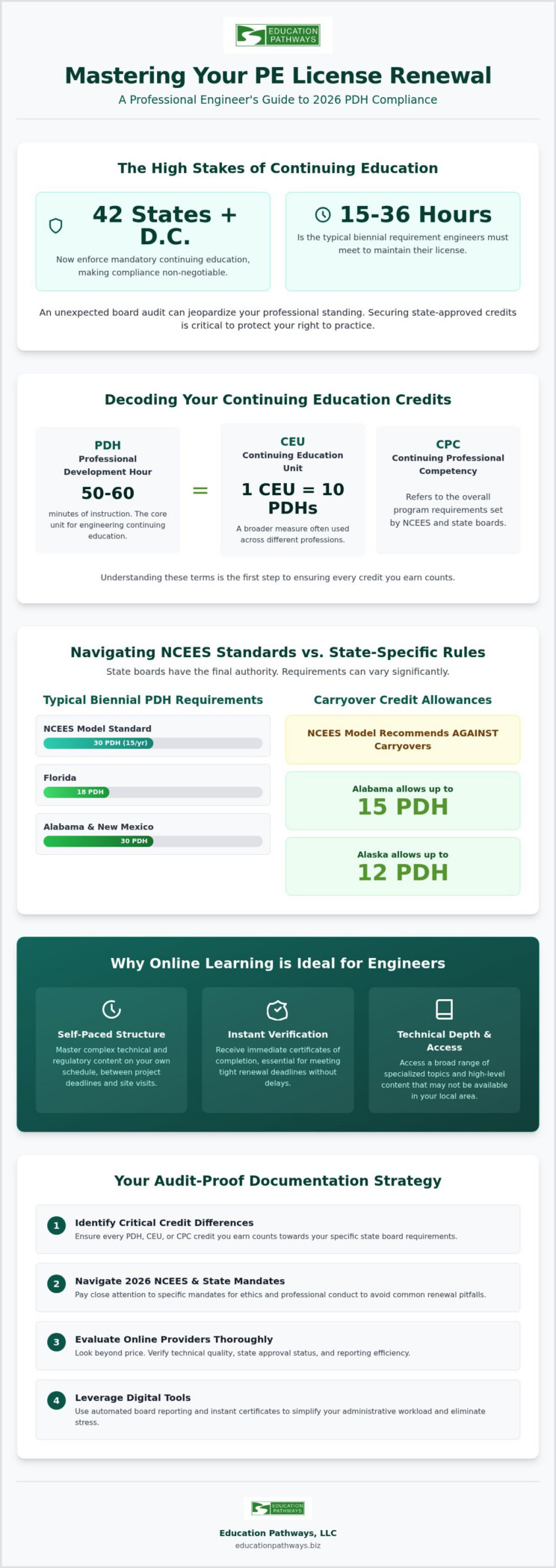
An unexpected board audit can jeopardize decades of hard-earned professional standing in a single afternoon. With 42 states and the District of Columbia now enforcing mandatory continuing education, the margin for error in your licensing documentation is thinner than ever. Finding reliable online PDH for professional engineers isn’t just about checking a box; it’s about protecting your right to practice with credits that actually meet 2026 standards. You shouldn’t have to guess if a technical course counts toward your specific 15 to 36-hour biennial requirement.
You likely feel the weight of complex state regulations and the frustration of wasting hours on low-quality content that offers zero technical value. It’s exhausting to track different renewal dates for multiple jurisdictions while managing a full project load. This comprehensive guide will help you master your PE license renewal through state-approved credits and streamlined compliance reporting. We’ll break down the latest NCEES standards, specific state mandates for 2026, and how to use automated board reporting to eliminate administrative stress. By the end, you’ll know exactly how to secure instant certificates and maintain your professional standing with total confidence.
Key Takeaways
- Identify the critical differences between PDH, CEU, and CPC to ensure every credit you earn counts toward your specific board requirements.
- Navigate the 2026 NCEES standards and state-specific mandates for ethics and professional conduct to avoid common renewal pitfalls.
- Learn how to evaluate online PDH for professional engineers based on technical quality, state approval status, and reporting efficiency.
- Discover how to leverage automated board reporting and instant certificates to simplify your administrative workload and meet tight deadlines.
- Build an audit-proof documentation strategy that protects your license and professional reputation from unexpected regulatory scrutiny.
Understanding Online PDH for Professional Engineers
Professional Development Hours (PDH) represent the core unit of measurement for an engineer’s continuing education. One PDH equals 50 to 60 minutes of technical instruction. While you might see terms like Continuing Education Units (CEU) or Continuing Professional Competency (CPC), they aren’t interchangeable. A single CEU typically equals 10 PDHs. CPC refers to the overall program requirements established by the National Council of Examiners for Engineering and Surveying (NCEES). In 2026, securing online PDH for professional engineers has become the preferred method for maintaining licensure. It eliminates the logistical hurdles of travel while ensuring you meet the 15 to 36-hour requirements mandated by 42 different states. Choosing a state-approved provider is the only way to safeguard against audit failures that could pause your career.
The Core Purpose of Continuing Competency
State boards adopt the NCEES Model Law to ensure a uniform standard of practice across the country. This framework prioritizes the protection of public health, safety, and welfare (HSW). By participating in Understanding Professional Development through structured learning, you demonstrate a commitment to evolving industry standards. Most states operate on a biennial renewal cycle, requiring you to report your hours every two years. Failure to maintain these competencies doesn’t just risk an audit; it compromises the integrity of the projects you oversee. It’s your responsibility to ensure the content you consume meets the specific HSW criteria defined by your jurisdiction.
Why Online Learning Suits the Engineering Profession
Engineering isn’t a desk job for everyone. Field engineers and project managers often work irregular hours that make traditional classroom sessions impossible. Online platforms offer the flexibility to complete coursework between site visits or during evening hours. This digital shift has turned mandatory compliance into a manageable part of your workflow, much like how Future Me, Answered helps high school students streamline their own career discovery process before they even enter the workforce.
- Self-Paced Structure: You can pause a complex technical module and return to it when your schedule allows. This is ideal for mastering dense regulatory or safety codes.
- Instant Verification: Digital platforms provide immediate certificates of completion. These are essential for meeting 2026 compliance deadlines without waiting for manual processing.
- Technical Depth: Modern online courses provide high-level documentation and assessments that mirror real-world engineering challenges.
Utilizing online PDH for professional engineers allows you to focus on relevant technical content rather than sitting through generic, unapproved seminars. It’s an efficient way to manage your professional standing without sacrificing project deadlines. By moving your education online, you gain access to a broader range of specialized topics that might not be available locally; for instance, to see how engineering expertise applies to high-value tax incentives, you can check out Engineered Tax Services.
Decoding PDH Requirements: NCEES Standards vs. State Rules
Understanding the interplay between national guidelines and local board mandates is vital for a seamless renewal. The National Council of Examiners for Engineering and Surveying (NCEES) sets a model standard of 15 Professional Development Hours per year. However, state boards have the final authority. While 42 states have mandatory requirements, the specifics vary wildly. For example, Florida requires 18 PDH biennially, while Alabama and New Mexico demand 30 hours in the same period. When you select online PDH for professional engineers, you must verify that the content aligns with your specific board’s definitions of acceptable activity.
Carryover credits offer a strategic way to manage your workload across renewal cycles. Many states allow you to apply excess hours earned in one period to the next. Alabama permits a carryover of up to 15 PDH, whereas Alaska caps it at 12. It’s vital to track these carefully, as the NCEES model standard actually recommends against carryovers. For engineers licensed in multiple jurisdictions, the best approach is to choose courses that satisfy the strictest board first. This “highest common denominator” strategy ensures you remain compliant everywhere without duplicating efforts. If you need assistance identifying which courses fit your specific state mix, you can consult a state-approved provider for guidance.
The Ethics and Professional Conduct Mandate
Ethics requirements are a cornerstone of modern licensure. Most boards now mandate at least one to two hours of ethics or professional conduct training per renewal cycle. This isn’t just about general business practices; it focuses on the engineering-specific duty to the public. Following NSPE’s Continuing Education Standards helps you stay current with evolving professional expectations. Most states require a dedicated 1 to 2-hour ethics course to ensure engineers understand their legal and moral obligations to public safety.
Technical vs. Non-Technical Content Allowances
Not all learning hours are viewed equally by state boards. Technical content must directly improve your professional competency in your field of practice. This often falls under the Health, Safety, and Welfare (HSW) umbrella. Boards typically limit “soft skills” like office management or personal finance to a small percentage of your total hours, or they may disallow them entirely. High-quality online PDH for professional engineers clearly distinguishes between these categories. To verify HSW eligibility, ensure the course material addresses technical codes, advanced design methodologies, or environmental protections. Relying on vetted, technical content is the most effective way to protect your license during an audit.
Evaluating Online PDH Providers: Beyond the Price Tag
Choosing a provider based solely on a low-cost “unlimited” plan can be a costly mistake for your professional standing. While these packages seem like a bargain, they often prioritize quantity over technical relevance. High-quality online PDH for professional engineers should offer more than just a volume of credits. It must provide content written by subject matter experts and verified by peer reviewers with actual field experience. If the material is outdated or lacks technical depth, it won’t just bore you; it might fail to meet the rigorous standards of your state board. You need content that reflects current 2026 engineering practices, not generic modules from a decade ago.
Speed and reliability are also critical factors when your license is on the line. When your renewal deadline is approaching, you can’t afford to wait days for manual certificate processing. Instant certificates of completion give you immediate proof of compliance. Beyond the certificate, look for providers that offer automated board reporting. This feature significantly reduces the risk of administrative errors that lead to audit flags. It’s about peace of mind, knowing that your hard work is officially recorded without you having to chase down paperwork.
Reporting and Documentation: The Audit Trail
Maintaining a clear audit trail is a legal necessity for every licensed professional. Most states require you to keep your PDH records for at least 6 years. This timeline ensures you’re prepared if a board decides to review your past filings during a random audit. You can find more detail on Managing CE Credits: From Enrollment to Reporting to understand how structured documentation protects your credentials. Education Pathways simplifies this by handling automatic reporting to state boards, ensuring your data arrives accurately and on time. This level of service helps you meet specific State Licensing Board Requirements where verification is mandatory and strictly enforced.
User Experience and Technical Reliability
A platform’s technical reliability directly impacts your productivity. In 2026, mobile-friendly, self-paced platforms are essential for busy project managers. You should be able to transition from your desktop to a tablet without losing your progress. Trust is built through transparency, which is why “preview before pay” models are so valuable. They allow you to verify the quality of online PDH for professional engineers before committing your budget. Ensure your chosen platform includes automated assessments with instant results. This allows you to identify knowledge gaps immediately and move forward with your renewal without delay.
Step-by-Step Guide to Fulfilling Your 2026 PDH Credits
Managing your licensure renewal doesn’t have to be a source of anxiety. By following a structured roadmap, you can ensure every hour of online PDH for professional engineers you complete is valid and audit-proof. This systematic approach protects your credentials while maximizing your time. A project-based mindset helps you tackle these requirements without the last-minute rush that often leads to errors.
Step 1: Verify Your Specific Board Mandates
Start by reviewing your state board’s current requirements for the 2026 cycle. Some jurisdictions have specific daily limits. For example, Louisiana restricts engineers to earning a maximum of 8 PDH in a single day. Check for “Area of Practice” requirements that may mandate specific technical topics. You also need to identify if your state requires a “Laws and Rules” course from a pre-approved provider or if any state-approved course is acceptable. Don’t forget to calculate your carryover credits. States like Alabama allow you to carry over up to 15 PDH, which can significantly reduce your current year workload. For multi-state engineers, identify the state with the most rigid ethics or technical requirements to set your baseline.
Step 2: Select and Complete Your Courses
Once you’ve confirmed your required hours, select a curriculum that balances technical updates with mandatory ethics modules. Choosing online PDH for professional engineers that offers a self-paced format allows you to integrate learning into your project schedule without disruption. Focus on courses that provide deep technical insight rather than just meeting the minimum time requirement. Every course concludes with a mandatory assessment phase designed to verify your understanding of the material and ensure compliance with board standards. This phase is essential for validating the credit and generating your official documentation.
Step 3: Secure Your Certificate and Confirm Reporting
After passing your assessment, download your instant certificate immediately for your personal digital records. This digital file is your primary defense during a random board audit. You should also verify that Education Pathways has transmitted your credits directly to the state board. While the system is automated, a quick check of your board portal provides total peace of mind. Keep a backup copy of the course syllabus and your certificate for at least six years to maintain a complete professional history. This final step closes the loop on your compliance for the cycle and keeps your license in good standing.
Ready to start your renewal process with confidence? View our state-approved continuing education courses to secure your credits today.
Why Education Pathways is the Trusted Choice for Engineers
Choosing a continuing education provider is a decision that impacts your professional reputation. Education Pathways has served as a cornerstone of regulatory compliance since 2002. For over two decades, we’ve refined our platform to meet the evolving needs of licensed professionals. When you seek online PDH for professional engineers, you aren’t just looking for credits. You’re looking for a partner that understands the high stakes of licensure. Our 100% online, self-paced format allows you to complete your requirements on your own terms. Whether you’re in the office or on a job site, our system adapts to your schedule.
The “Instant Certificate” feature provides immediate peace of mind. You don’t have to wait for manual processing or mail delivery to prove your compliance. As soon as you pass your assessment, your documentation is ready for download. This efficiency is why thousands of engineers trust us for their biennial renewals. Education Pathways provides the most reliable online PDH for professional engineers by combining technical depth with administrative ease. We’ve built a platform that removes the friction from mandatory training, allowing you to focus on your actual work.
A Legacy of Compliance and Reliability
Experience matters when navigating complex state regulations. A provider that has survived 20+ years of legislative changes offers a level of stability that newer platforms can’t match. We maintain deep knowledge across various disciplines, including a broad range of Architect and Engineer Continuing Education offerings. Our expertise extends beyond engineering; we also provide state-approved curriculum for architects, social workers, and real estate professionals. This breadth allows us to support diverse professional needs simultaneously. If you hold multiple licenses, you can manage your entire portfolio from a single, reliable hub. We vet our curriculum against current 2026 standards to ensure every hour you earn is defensible during an audit.
Streamlined Reporting for Busy Professionals
Administrative errors are the leading cause of licensing delays. Our automated reporting process minimizes this risk by transmitting your credits directly to the appropriate state boards. You don’t need to spend your weekend filling out reporting forms or tracking down lost paperwork. Our per-course enrollment model is specifically designed for those who only need a few specific hours to finish their cycle. You only pay for what you need, making it a cost-effective solution for targeted learning. We handle the heavy lifting of verification so you can move forward with confidence. Our platform is built for speed, allowing you to navigate from enrollment to certificate in a single session.
Your license renewal shouldn’t be a source of stress. Browse our state-approved engineering PDH courses today.
Secure Your Professional Standing for 2026
Navigating the complexities of state-specific mandates and ethics requirements is the foundation of a successful renewal cycle. By following a structured roadmap and choosing technical content that aligns with NCEES standards, you protect your license from the risks of an unexpected audit. The shift toward online PDH for professional engineers has made it easier than ever to maintain your credentials without sacrificing your project deadlines or personal time.
Education Pathways has been a dedicated partner for licensed professionals since 2002. We provide the technical depth and regulatory reliability you need to practice with confidence. Our platform offers instant certificates upon completion and automated board reporting to eliminate administrative stress. You’ve worked hard for your license; let us help you keep it in good standing with a process that’s as efficient as your engineering projects.
View All State-Approved Engineering PDH Courses and complete your 2026 requirements today. We look forward to supporting your continued professional growth.
Frequently Asked Questions
Is online PDH accepted by all state engineering boards?
Online courses are accepted in all 42 states and the District of Columbia that have mandatory requirements as of 2026. While acceptance is universal, some boards may limit the number of hours you can earn through self-study formats. Using online PDH for professional engineers is a reliable way to meet your 15 to 36-hour biennial requirements. Always confirm if your specific state has a cap on non-interactive distance learning before enrolling in your next module.
What happens if I get audited by my state board?
You will receive a formal notice requiring you to submit proof of your completed hours within a specific timeframe. The board will review your certificates of completion and course syllabi to ensure they meet technical and HSW standards. Having instant digital records from a provider like Education Pathways, which has served professionals since 2002, ensures you have the documentation ready. This proactive approach eliminates the stress of searching for lost paperwork during a regulatory review.
Can I use the same PDH course for multiple state license renewals?
You can typically apply the same course to multiple state renewals provided the content satisfies the unique standards of each board. This is a highly efficient strategy for engineers who hold licenses in several jurisdictions simultaneously. You must ensure the course technical level and ethics focus align with the strictest requirements among your licenses. Tracking your biennial windows carefully is essential to ensure the credits are earned within the valid dates for every state.
What is the difference between a PDH and a CEU?
A Professional Development Hour (PDH) is defined as 50 to 60 minutes of instruction, whereas a Continuing Education Unit (CEU) equals 10 contact hours. If you complete a course that awards 1.5 CEUs, you have earned 15 PDHs toward your renewal. Most state boards in 2026 use the PDH as their primary metric for compliance. Understanding this 10:1 ratio is vital for accurately calculating your total credits and avoiding a shortfall during your renewal cycle.
How long do I need to keep my PDH certificates of completion?
Most state engineering boards mandate that you keep your records for a minimum of six years. This timeframe ensures you can provide proof of compliance for current and previous renewal cycles if an audit occurs. Maintaining a digital archive of your instant certificates is the most reliable method for long-term record keeping. Education Pathways allows you to download your certificates immediately, making it easy to build a permanent, audit-proof history of your professional development.
Does Education Pathways report my credits automatically to the board?
We offer automated reporting to state boards that accept electronic data transmissions from continuing education providers. This service minimizes the risk of manual entry errors and ensures your credits are recorded in the board’s system promptly. While we handle the transmission, it’s a best practice to check your board portal to confirm the hours appear correctly. This dual-verification approach provides the highest level of security for your professional license and standing.
Are these courses self-paced or do I need to attend at a specific time?
Every course we offer is 100% online and self-paced, meaning you never have to attend at a specific time. You can start, pause, and resume your technical training whenever your project schedule allows. This flexibility is essential for field engineers and project managers who can’t commit to rigid webinar schedules. Our platform is designed for maximum efficiency, allowing you to complete your 2026 requirements at a speed that works for your unique professional life.
What are the ethics requirements for professional engineers in 2026?
Ethics mandates vary by state, but most boards now require 1 to 2 hours of professional conduct training per renewal cycle. These courses must address the engineer’s responsibility to public health, safety, and welfare rather than general business ethics. NCEES standards recommend at least 1 PDH in ethics annually to maintain a high standard of practice. Selecting online PDH for professional engineers that features state-approved ethics modules ensures you satisfy this critical requirement without any regulatory confusion.