
Texas Real Estate License Late Renewal: 2026 Guide

What happens to your pending commission check the moment your TREC license expires? It’s a chilling thought, yet many agents discover too late that missing a deadline does more than just trigger a fine. Understanding the specific penalty for late real estate license renewal in Texas is critical because costs escalate quickly, moving from simple late fees to the immediate loss of your right to practice. If you’re staring at an expired status in the REALM portal, the anxiety of losing your active standing is likely your top priority.
We understand that life gets busy and compliance can feel like a moving target. You deserve a clear, no-nonsense path to fix your status without the stress of regulatory guesswork. This guide provides the exact financial and legal consequences of missing your TREC deadline and outlines the fastest way to reinstate your license. You’ll learn how to handle the $200 deferral fee and avoid the steeper late reporting penalties that catch many professionals off guard.
We’ll break down the tiered fee structure for 2026, clarify the mandatory 18-hour CE requirements, and explain how to move back to active status efficiently. By the end of this article, you’ll have a complete roadmap to protect your business and your income.
Key Takeaways
- Identify the exact penalty for late real estate license renewal in Texas and how fees increase the longer you wait to reinstate your status.
- Learn how to navigate the $200 CE deferral fee and the strict 60-day window to avoid additional heavy fines.
- Understand the difference between active and inactive status and how to use the inactive safety net to protect your business.
- Get a clear breakdown of the 18-hour CE requirements for 2026, including the specific courses needed for both agents and brokers.
- Discover the fastest path back to compliance using TREC-approved online courses that provide instant certificates for immediate reporting.
The Financial Cost: TREC Late Fees and CE Deferrals
Missing your renewal deadline isn’t just a paperwork headache. It’s an expensive oversight that can halt your business. Every Texas real estate license is a form of professional certification that requires strict adherence to state law. If you miss the last day of your birth month, your $110 standard online renewal fee jumps immediately. This starts a cycle of increasing costs that can quickly drain your marketing budget.
The primary penalty for late real estate license renewal in Texas is tiered based on how much time has passed since your expiration date. You also risk losing commissions on any deals currently in the pipeline. An inactive or expired license cannot legally perform brokerage activities, meaning your hard work on a pending closing could be at risk. Acting quickly is the only way to minimize these financial hits.
The CE Deferral Fee Explained
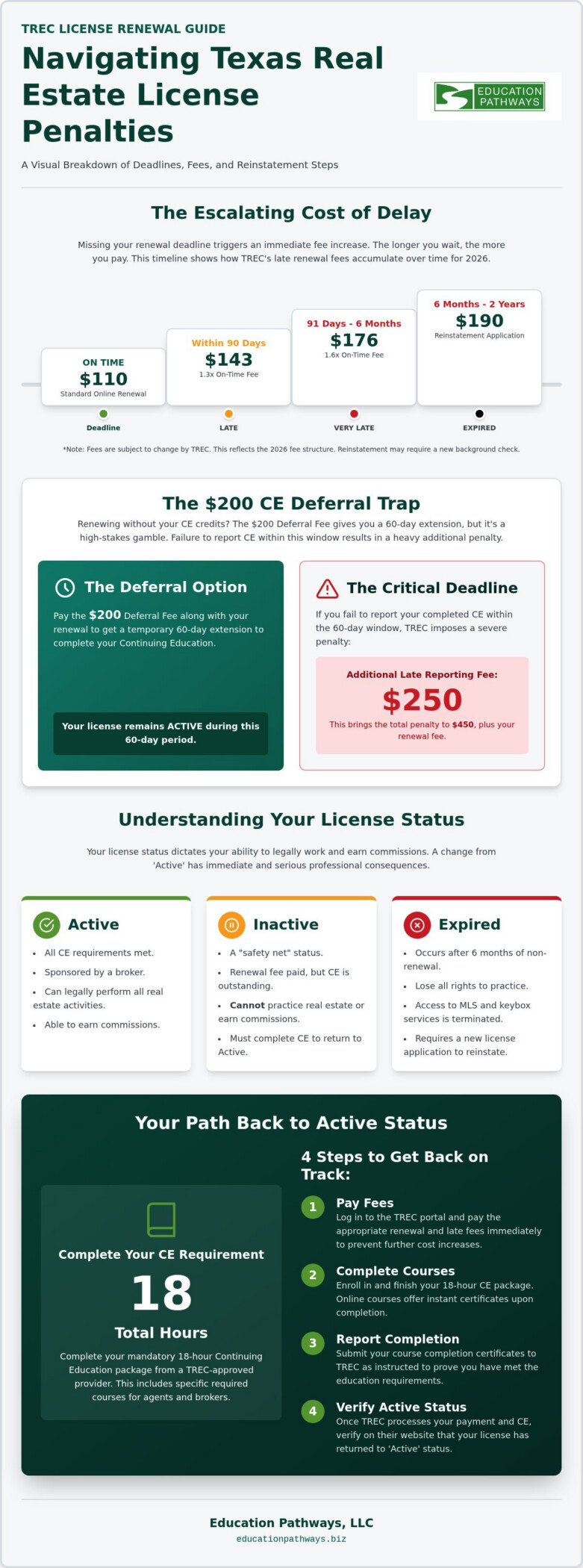
The $200 CE Deferral Fee is a specific mechanism for agents who have the funds to renew but haven’t finished their 18 hours of Continuing Education. It acts as a 60-day extension. By paying this fee along with your renewal, you stay active while you finish your coursework. However, this is a high-stakes solution. If you fail to report your credits within those 60 days, TREC adds a $250 late reporting fee. This brings your total penalty to $450, plus the original renewal fee. Completing your Texas real estate CE requirements before the deadline is always the more cost-effective choice. It’s a simple way to avoid the “deferral trap” that many busy agents fall into every year.
Late Renewal Fee Tiers
TREC uses a methodical system for penalties that punishes delay. The longer you wait, the more you pay to regain your professional standing. Here is the breakdown for 2026:
- Renewing within 90 days: The fee increases to $143.
- Renewing between 91 days and 6 months: The fee rises to $176.
- Reinstatement (6 months to 2 years): You must pay a $190 fee.
If you let your license stay expired for more than six months, you hit a financial “cliff.” Beyond the higher fees, TREC may require a new background check and fresh fingerprints. These additional costs add up fast. You’ll face more than just the penalty for late real estate license renewal in Texas; you’ll deal with administrative delays that keep you out of the field. Maintaining your status is far cheaper than trying to recover it after a long lapse.
License Status: Active, Inactive, and Expired
Your status with the Texas Real Estate Commission (TREC) dictates your ability to earn. Active status means you have a sponsoring broker and have met all education requirements. If you miss your deadline, your status changes instantly. This shift is a core part of the penalty for late real estate license renewal in Texas. You cannot legally represent clients or negotiate deals the moment your status slips from active. Operating without an active license is a gamble that rarely pays off.
Inactive status serves as a temporary safety net. If you pay your renewal fee late but haven’t finished your CE, TREC will renew your license as inactive. This stops the clock on certain administrative penalties but halts your professional activity. It’s a strategic move if you need more time for coursework, but it requires immediate communication with your broker. You must stay vigilant during this period to ensure you don’t inadvertently cross into unlicensed activity.
Operating on an Inactive License
Can you still get paid? You can only collect commissions for work completed while your license was active. Any brokerage activity performed while inactive is considered unlicensed activity. This is a serious violation that can lead to permanent disciplinary action on your record. You must notify your sponsoring broker immediately if your status changes. They are legally responsible for your actions; keeping them in the dark puts both of your licenses at risk. If you need to get back to active status quickly, completing your Texas real estate CE classes is the first step.
The Consequences of Full Expiration
Full expiration occurs after the six-month late renewal window closes. At this point, you lose more than just your license. Your access to the MLS and keybox services will be terminated. Your professional reputation may also suffer, as status changes are public record on the TREC website. If you let your license stay expired for more than six months but less than two years, you’ll have to re-apply for a license and pay a $190 reinstatement fee. If it’s over two years, you must start from scratch. This includes retaking the state exam. Avoiding this cliff is essential for any serious professional. The administrative burden of reapplying is far more taxing than simply completing your renewal on time.
Mandatory CE Requirements for Late Reinstatement
Reinstating a license requires more than just paying a fee. You must prove competency through specific coursework. The penalty for late real estate license renewal in Texas often stems from incomplete hours rather than just a missed payment. TREC requires 18 hours of Continuing Education (CE) every two years for most agents. If you’re renewing for the first time, you fall under Sales Agent Apprentice Education (SAE) rules. SAE involves 270 total qualifying hours. This is a much larger hurdle to clear if you miss your deadline, as the volume of work is significantly higher.
Speed is your best ally when you’re already behind. This is where instant certificates become your most valuable tool. TREC requires providers to report hours, but having your own certificate allows you to verify completion immediately if a discrepancy arises. Choosing a TREC-approved provider that offers 24/7 access and immediate reporting can save you from the $250 late reporting fee. It turns a high-stress situation into a manageable administrative task.
The 18-Hour Continuing Education Core
For established agents, the 18-hour block is non-negotiable. TREC mandates specific topics to ensure you stay current on state laws and ethical standards. You can’t just take any 18 hours of training; they must fit the following 2026 criteria:
- Legal Update I (4 hours): Covers recent legislative changes and TREC rule updates.
- Legal Update II (4 hours): Focuses on ethics, agency laws, and consumer protection.
- Contract-related coursework (3 hours): A mandatory requirement for 2026 focusing on proper form usage.
- Electives (7 hours): General real estate topics that meet TREC standards.
Choosing the right Texas real estate CE classes ensures your credits are accepted without delay. In 2026, the 3-hour contract course is a mandatory part of this mix for all agents, regardless of their specialty.
Broker Responsibility and Late Renewal
Brokers carry a heavier compliance load than sales agents. As of January 2026, all brokers must complete the 6-hour Broker Responsibility course at every renewal. If a designated broker’s license expires, the consequences ripple through their entire firm. All sponsored agents are shifted to inactive status instantly. This creates a massive business disruption and potentially thousands of dollars in lost productivity. Brokers must prioritize their renewal to protect their entire team from the penalty for late real estate license renewal in Texas. A single missed deadline for a broker can stop every deal in the office.
Step-by-Step: How to Recover from a Missed Deadline
Realizing you missed your TREC deadline is a high-stress moment, but your recovery depends on how quickly you act. You’re currently in the six-month late renewal window. This is a critical grace period where you can still reinstate your license without retaking the state exam. However, the penalty for late real estate license renewal in Texas grows the longer you wait. Your first priority is to stop all brokerage activities immediately to prevent disciplinary action for unlicensed practice. Once you’ve paused your active deals, you can focus on the administrative steps required to fix your status.
The path you choose depends on your current CE progress. If you’ve finished your hours but forgot to pay, you simply file a late renewal. If you’re short on hours, you must decide between paying the $200 deferral fee to stay active or renewing as inactive. Most professionals find that the fastest way to resolve the issue is to complete their education through an online Texas real estate CE course with instant reporting. This ensures TREC receives your credits as quickly as possible, allowing you to move forward with your filing.
The Fast-Track Recovery Process
Efficiency is key when your income is on the line. Follow these three steps to clear the penalty for late real estate license renewal in Texas and get back to work:
- Step 1: Stop all brokerage activity. This includes showing homes, negotiating contracts, or hosting open houses. Even one day of unlicensed activity can lead to a permanent mark on your TREC record.
- Step 2: Complete your missing CE. Enroll in a TREC-approved course that offers immediate certificate issuance. You’ll need these certificates if there’s a delay in automated reporting.
- Step 3: Pay your fees. Log into the TREC Online Services portal (REALM) to pay your late renewal or deferral fees. The system updates in real-time, which is the fastest way to see your status change.
Moving from Inactive to Active
If you renewed as inactive to save on deferral fees, you aren’t done yet. You must formally activate your license once your 18 hours of CE are complete. This involves filing an “Application for Inactive Broker or Sales Agent Status” to move back to the active roster. You’ll also need your sponsoring broker to log in and confirm your sponsorship. This digital “handshake” is required before TREC officially lists you as active. Don’t assume you’re ready to work just because you finished your classes; always verify your status on the TREC website first. If you’re ready to start your hours now, explore our Texas real estate license renewal options to find the right courses for your needs.
Avoid Future Penalties with Education Pathways
Recovering from a missed deadline is a stressful lesson in the value of time. The easiest way to avoid the penalty for late real estate license renewal in Texas is to stay ahead of the clock. Education Pathways provides a streamlined solution that fits into your busy schedule. We remove the hurdles that cause agents to delay their filings. Our platform is designed for professionals who value efficiency and reliability. We act as a dependable guide to ensure you never face the anxiety of an inactive status again. By choosing a partner that understands the pressure of TREC deadlines, you can focus on your clients instead of your compliance paperwork.
Why Our Texas CE Courses Stand Out
Our TREC-approved curriculum is built specifically for 2026 standards. It’s not just a list of topics; it’s a practical guide to current regulations. You can access your courses 24/7 from any device. This mobile-friendly approach means you can finish your hours between showings or while waiting at a title company. We also offer automatic reporting options. This ensures your credits reach TREC fast, often within 24 to 48 hours of completion. You won’t have to worry about manual data entry or reporting delays. If you’re in a rush, our instant certificates provide immediate proof of compliance. This is your best defense against the $200 deferral fee trap. We’ve performed the heavy lifting of vetting the information so you can proceed with confidence.
Stay Compliant and Stress-Free
Managing your 18-hour requirement shouldn’t feel like a second job. We allow you to bundle your courses for maximum efficiency. This ensures you meet the specific Legal Update and contract-related requirements without guesswork. You can Browse Texas Real Estate CE Requirements on our site to verify your specific needs for the current cycle. As you finish your 2026 renewal, it’s a perfect time to set reminders for your 2028 cycle. Planning ahead is the only guaranteed way to skip the penalty for late real estate license renewal in Texas. We’re here to be your long-term partner in professional compliance. Peace of mind comes from knowing your license is secure and your business is protected. Don’t let a simple calendar date interfere with your professional success.
Secure Your Professional Standing Today
Managing a license lapse requires immediate action to protect your income and reputation. We’ve detailed the tiered fee structure and the specific 18-hour coursework required for 2026, including the mandatory Broker Responsibility and contract-related modules. While the penalty for late real estate license renewal in Texas can be costly, it doesn’t have to be a permanent setback for your career. By understanding the 60-day deferral window and the shift to inactive status, you can navigate the TREC requirements with confidence.
Education Pathways is here to simplify your compliance process. As a TREC Approved Education Provider serving professionals since 2002, we offer 100% online courses designed for your busy schedule. Our platform provides instant certificates of completion to help you report your credits and resolve your status quickly. Don’t let administrative delays keep you out of the field or put your commissions at risk.
Get Your Texas Real Estate CE Credits Instantly and return to active status today. You’ve worked hard to build your business; we’re ready to help you protect it.
Frequently Asked Questions
How much is the late fee for a Texas real estate license renewal?
Late fees are tiered based on how long your license has been expired. If you renew within 90 days, the fee is $143. For renewals between 91 days and six months, the fee increases to $176. Beyond six months, you must pay a $190 reinstatement fee. These costs are in addition to your standard $110 renewal fee. Prompt action is the best way to minimize the financial penalty for late real estate license renewal in Texas.
Can I still sell real estate if my Texas license is expired?
No, you cannot legally perform any brokerage activities if your license is expired or inactive. This includes showing properties, negotiating contracts, or hosting open houses. Engaging in these activities without an active license is considered unlicensed activity. This violation can lead to disciplinary action from TREC and may result in the forfeiture of commissions for any deals closed during the period you were not properly licensed.
What is the $200 CE deferral fee in Texas?
The $200 CE deferral fee is a payment that allows you to renew your license on active status even if you haven’t completed your 18 hours of Continuing Education. You must pay this fee and your renewal fee by your expiration date. This grants you a 60-day extension to finish your coursework. If you fail to report your credits within those 60 days, you’ll face an additional $250 late reporting fee.
How long do I have to renew my Texas real estate license after it expires?
You have up to six months to renew your license using the late renewal process. If you miss this window, you must apply for reinstatement, which is available for up to two years after your expiration date. During this entire time, you cannot practice real estate. If your license remains expired for more than two years, you lose the ability to renew or reinstate and must start the initial application process again.
What happens if I don’t finish my CE by my renewal date?
If you don’t finish your CE by your renewal date, you have two main options. You can pay the $200 deferral fee to keep your license active for 60 days while you finish your hours. Alternatively, you can renew your license on inactive status. Renewing as inactive stops the clock on some late fees but prevents you from practicing real estate until you complete your hours and apply for active status.
Do I need to retake the Texas real estate exam if my license expires?
You only need to retake the Texas real estate exam if your license has been expired for more than two years. Within the first two years of expiration, you can either renew late (up to six months) or apply for reinstatement (six months to two years). These processes require paying higher fees and completing all mandatory CE, but they don’t require you to sit for the state licensing exam again.
How do I move my Texas real estate license from inactive to active status?
Moving from inactive to active status requires two main steps. First, you must complete all 18 hours of required Continuing Education and ensure they are reported to TREC. Second, you must file the “Application for Inactive Broker or Sales Agent Status” to request the change. Your sponsoring broker must also log into their TREC account to confirm your sponsorship before your status will officially update to active in the REALM portal.
Can my broker get in trouble if I renew my license late?
Yes, your broker can face disciplinary action if you engage in unlicensed activity while your license is expired. Brokers are legally responsible for the professional acts of the agents they sponsor. Additionally, if your broker’s own license expires, your license will immediately be placed on inactive status. This prevents you from earning commissions and performing any real estate tasks until your broker reinstates their status or you find a new sponsor.