
What Happens If My Florida Contractor License Expires? Consequences & Recovery Guide

Imagine walking onto your job site on a Monday morning only to find your permits pulled and a DBPR inspector waiting with a $10,000 fine. It’s a nightmare scenario that often starts with a single missed deadline. If you’ve realized your renewal date has passed, you’re likely asking, what happens if my Florida contractor license expires? The answer depends entirely on how quickly you act. Whether you missed the August 31, 2026, deadline by a day or several months, your professional standing and your livelihood are currently at risk.
We know that managing a busy construction business makes it easy to overlook administrative paperwork. It’s stressful to face a “delinquent” status when you have projects to complete and crews to pay. This guide provides the clarity you need by detailing the exact legal and financial consequences of an expired license. You’ll discover the specific steps to navigate the DBPR reactivation process, including how to use continuing education to save your license before it becomes “null and void.” We’ll cover grace periods, fee structures, and a clear recovery plan to get your business back in good standing.
Key Takeaways
- Learn the difference between standard renewal fees and expensive delinquent penalties to avoid unnecessary business costs.
- Understand exactly what happens if my Florida contractor license expires, including the critical two-year “delinquent” window before your license becomes permanently “null and void.”
- Discover why local building departments immediately freeze permits and inspections for expired licenses, halting your active projects and revenue.
- Follow a step-by-step roadmap to audit your continuing education credits and complete the required 14-hour or 28-hour packages.
- Find out how to use automated DBPR reporting and mobile-friendly courses to fast-track your license reactivation and get back to work.
Immediate Consequences of an Expired Florida Contractor License
License expiration is the specific point in time where a contractor’s legal authority to pull permits or sign new construction contracts ceases. It isn’t merely an administrative delay; it’s a total suspension of your professional standing. Under general occupational licensing regulations, your right to operate is contingent upon maintaining an active status with the Department of Business and Professional Regulation (DBPR). The moment your license hits the expiration date without a renewal, your business is technically unauthorized to perform any work requiring a license.
The “Permit Freeze” is often the first painful reality contractors face. Local building departments across Florida regularly sync their databases with the DBPR. If your license status changes to “Delinquent,” building officials will immediately stop all inspections on your active jobsites. You won’t be able to close out existing permits, and your applications for new ones will be rejected. This halt can lead to massive project delays, liquidated damages, and a complete breakdown of your production schedule.
Contractual and liability risks also escalate the second you lose your active status. You need to understand what happens if my Florida contractor license expires regarding your legal protections. Florida courts have frequently ruled that contracts signed by unlicensed contractors are unenforceable. If a client refuses to pay for work completed while your license was lapsed, you may have no legal standing to sue for breach of contract. Furthermore, insurance providers may deny workers’ compensation or general liability claims if the incident occurred while you were operating under an expired license.
Operational Shutdown: What Happens at the Jobsite
You cannot legally supervise construction work or hire subcontractors if your license isn’t active. If a local code enforcement officer visits your site and discovers the lapse, they will likely “Red Tag” the project. This forced stoppage remains in effect until you prove your license is reactivated. If you find yourself in this situation, be direct with your clients. Explain that you’re resolving an administrative update with the DBPR to prevent them from hearing it first from an inspector, which could permanently damage your professional reputation.
The Legal Reality of Unlicensed Contracting
Florida Statute 489 creates a clear distinction between a simple late renewal and the crime of unlicensed contracting. Performing work with the knowledge that your license has expired can lead to a first-degree misdemeanor charge. For repeat offenders, this can escalate to a third-degree felony. Additionally, an expired license strips you of your right to file a construction lien. Without a valid license at the time the work was performed, you lose one of the most powerful tools available to ensure you get paid for your labor and materials.
DBPR Penalties and Financial Risks of Lapsed Licenses
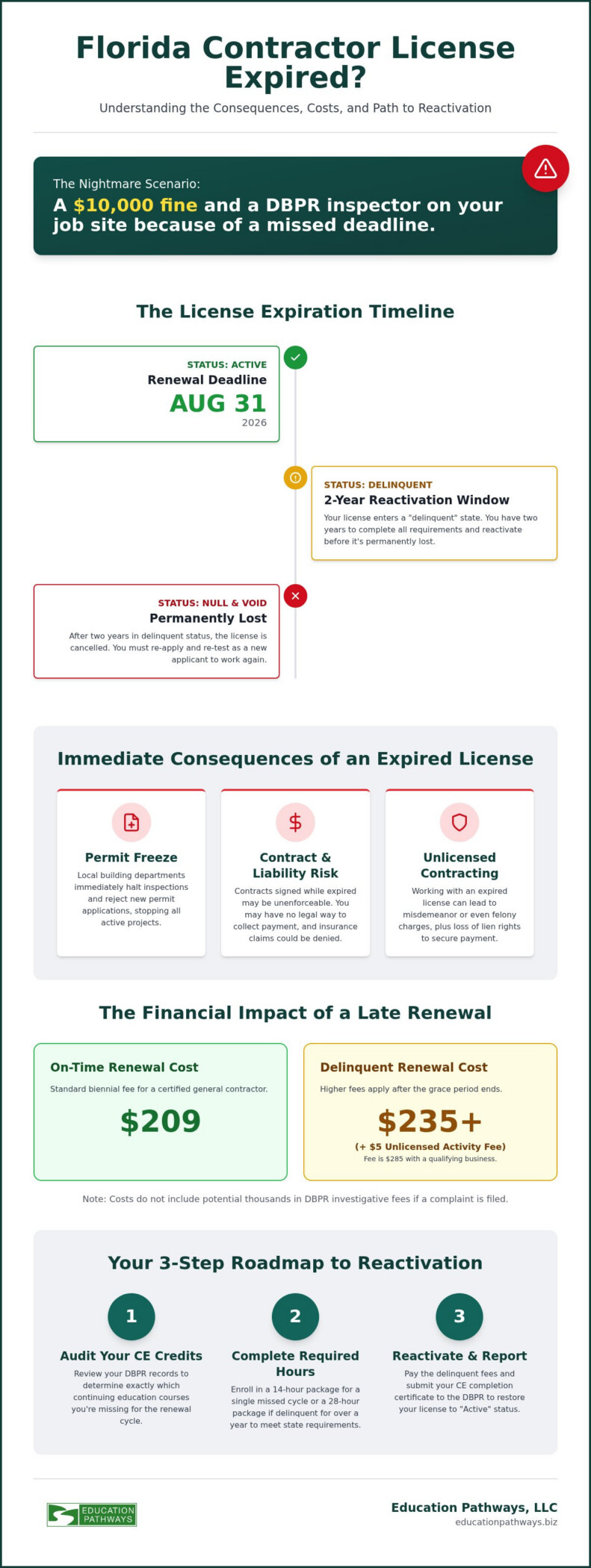
Missing the August 31, 2026, deadline triggers a cascade of financial penalties that go beyond a simple late fee. If you’re wondering what happens if my Florida contractor license expires, the first change you’ll notice is in your bank account. A standard biennial renewal for a certified general contractor costs $209. However, if you miss the deadline but apply within the 30-day grace period, a $25 late fee applies. Once that grace period ends, your status shifts to delinquent, and the costs increase significantly.
According to the Florida DBPR license status definitions, a delinquent license requires a higher fee to reactivate. You should be prepared for the following costs:
- Delinquent active renewal fee: $235 (or $285 with a qualifying business)
- Delinquent inactive renewal fee: $85
- Unlicensed activity special assessment: $5
These figures don’t include the potential for investigative costs. If the DBPR receives a complaint while your license is expired, you may be held responsible for the hourly rates of state investigators and legal staff. These administrative expenses often total thousands of dollars before you even address the underlying fine.
Financial risks also extend to your overhead costs. Operating with a lapsed license is a major red flag for insurance carriers. A break in licensure can cause your general liability and workers’ compensation premiums to spike during your next audit. Many providers view a lapse as an increase in risk, which they’ll offset by raising your rates for years to come.
Direct DBPR Fines and Citations
The Construction Industry Licensing Board (CILB) has the authority to impose administrative fines of up to $10,000 per violation. The board tracks how often a contractor allows their status to slip. If you’re asking what happens if my Florida contractor license expires multiple times, expect the CILB to increase the severity of the penalties. These citations become a matter of public record. A public reprimand on your permanent DBPR profile can deter sophisticated clients who perform due diligence before hiring a firm.
Impact on Business Credit and Bonding
Your ability to secure work is tied to your financial credibility. Surety bond companies monitor Florida contractor license renewal status closely. If your license isn’t active, a provider may revoke your bonding capacity immediately. This disqualifies you from bidding on most government contracts and large commercial projects. Acting within the first 30 days is the best way to mitigate these long-term financial damages and keep your bonding limits intact.
Understanding License Status: Delinquent vs. Null and Void
Your professional standing doesn’t just vanish the moment a deadline passes. Instead, the state moves your license through specific stages of non-compliance. Understanding what happens if my Florida contractor license expires requires a clear look at the timeline the DBPR follows. If you miss the August 31, 2026, renewal deadline, your status immediately shifts from “Active” to “Delinquent.” This isn’t a permanent loss, but it is a serious legal suspension of your right to work.
The Two-Year Delinquent Window
The delinquent phase is a two-year window where your license is essentially “down but not out.” During this time, the DBPR still recognizes you as the license holder, but you lack the legal authority to pull permits or sign contracts. You have exactly one licensure cycle to rectify the situation. To move back to an active status, you must pay all delinquent fees and complete the mandatory continuing education requirements you missed. You cannot simply skip a cycle and pay for the current one. The state requires you to make up for the period you were out of compliance to ensure you are up to date on current building codes and safety regulations.
For many contractors, this two-year period is the final opportunity to save their business without starting over. The Florida DBPR Contractor License FAQs provide a detailed breakdown of how these status changes affect your ability to operate. If you fail to act within this window, the consequences become much more severe.
When a License Becomes Null and Void
Failing to renew for two consecutive cycles, which equals four years of non-renewal, results in a “Null and Void” status. This is the point of no return for most professionals. When a license reaches this stage, it’s legally cancelled. You lose your license number and your history with the board. To work as a contractor again, you’re usually required to undergo a “hard reset.” This means reapplying as a new applicant, paying all initial application fees, and retaking the entire Florida contractor examination.
The only way to avoid re-testing is through a rare “Hardship Petition.” You must prove to the Construction Industry Licensing Board that your failure to renew was caused by extreme circumstances, such as a major illness or severe economic hardship. These petitions are not guaranteed and require significant documentation. The most efficient way to protect your livelihood is to prioritize your Florida Contractor License Renewal before the delinquent window closes. If you aren’t currently working, consider moving your license to an “Inactive” status. This keeps the license valid and prevents it from ever reaching the null and void stage, even if you aren’t pulling permits today.
The Roadmap to Reactivation: CE Requirements and Steps
Reactivating a delinquent license is a methodical process that requires more than just a payment. If you’ve been wondering what happens if my Florida contractor license expires, the answer is that you must prove your competency through continuing education. You can’t simply pay a fine and move on. The DBPR requires a full audit of your current standing before they’ll flip your status back to active. Following a structured plan is the only way to ensure you don’t waste time on incorrect courses or unnecessary paperwork.
Start by checking your account on the DBPR portal to determine your exact credit deficit. You need to know if you’re missing one cycle or two. If you missed the 2026 deadline, you likely owe 14 hours. If you’ve been delinquent for a longer period, you may owe 28 hours. Once you know the number, select a provider that offers automated reporting. This is the only way to ensure the state receives your data without manual errors. After your education is verified, log back into the portal to pay your delinquent fees and submit your reactivation request.
Fulfilling the 14-Hour CE Requirement
The Florida contractor 14 hour CE package is designed to cover the mandatory pillars required by the Construction Industry Licensing Board. You’ll need one hour each of Workers’ Compensation, Workplace Safety, Business Practices, and Florida Laws and Rules. Many contractors struggle with the “Advanced Building Code” credit. It’s a specific requirement that many generic courses miss. Choosing a self-paced, online format allows you to knock out these hours in a single weekend. It’s the fastest way to bridge the gap between delinquency and compliance.
Reporting and DBPR Processing Times
Speed is critical when your permits are frozen and jobsites are at a standstill. Most contractors expect an instant status change, but the DBPR system takes time to process incoming data. When you complete your courses through the Florida Contractor CE Hub, reporting is automated. Usually, the state updates its records within 24 to 48 hours of course completion. Always keep your “Instant Certificate” on hand. While the digital system is the official record, having a PDF copy of your certificate can help you provide proof of compliance to local building inspectors while the state’s database catches up.
Secure your business future by enrolling in our Florida Contractor CE Hub today to start your reactivation immediately.
Streamlining Your Recovery with Education Pathways, LLC
Facing a delinquent license is overwhelming. When you’re trying to figure out what happens if my Florida contractor license expires, you need a partner that understands the urgency. Since 2002, Education Pathways, LLC has helped professionals move through the DBPR reactivation process with ease. Our courses are 100% online and mobile-friendly. This allows you to complete your requirements on the jobsite, in your truck, or at home. You don’t have to sacrifice a workday to sit in a classroom. We provide an efficient path back to active status so you can resume pulling permits and closing deals.
Our system is specifically updated for the 2026 renewal cycle. We’ve removed the friction from mandatory licensing. You’ll find that our platform is designed for speed and clarity. We don’t use dense academic jargon. Instead, we offer practical information that you can actually use in the field. Understanding what happens if my Florida contractor license expires is the first step; taking action with a state-approved provider is the second. This results-driven approach ensures you stay compliant without wasting time.
Why Our 14-Hour Package Works
The core of our recovery solution is the DBPR-approved 14-hour package. It covers all the mandatory pillars you need for reactivation. This includes critical topics like workplace safety, workers’ compensation, business practices, and Florida building codes. We use a “no-fail” approach to assessments. Our goal is to support your learning and ensure you understand the material. If you need a deeper dive into the renewal process, check out our sibling article: Florida Contractor Continuing Education: The Ultimate Guide.
Reporting You Can Trust
Manual reporting is a major source of anxiety for contractors in a compliance crunch. One typo in a license number can lead to weeks of delays. We eliminate this risk with our automated reporting system. Education Pathways, LLC commits to reporting your completed hours to the DBPR within 24 to 48 hours. This fast-paced communication is essential when you’re trying to resolve a delinquent status quickly and get back to work.
You also get instant access to your certificates. As soon as you finish a module, your proof of completion is ready to download. This provides immediate peace of mind while the state updates its official database. You can show these certificates to building officials to prove you’ve taken action. Don’t let an administrative lapse derail your business any longer. Get started with your Florida Contractor CE Hub today and put your licensing worries behind you.
Secure Your Professional Standing and Resume Your Projects
An expired license is more than a minor administrative oversight. It triggers immediate permit freezes, unenforceable contracts, and potential DBPR fines. Understanding what happens if my Florida contractor license expires is your first line of defense against the permanent “null and void” status. If you act within the two-year delinquent window, you can avoid the “hard reset” of retaking the entire state exam. Protecting your professional reputation starts with recognizing these risks before they escalate.
Your recovery plan is straightforward. By completing the mandatory 14-hour CE requirement and paying your delinquent fees, you can restore your active status and get back to the jobsite. Education Pathways, LLC has been a DBPR Approved Provider since 2002, specializing in streamlined compliance for busy contractors. Our 100% online, mobile-friendly platform ensures you don’t lose another day of work to classroom training. We provide the tools you need to bridge the gap between delinquency and a fully active license.
Complete your Florida Contractor CE and Reactivate Your License Now. With our instant certificate downloads and automated state reporting, we handle the heavy lifting so you can focus on your clients. You have the power to protect your livelihood and your professional reputation. Take the first step toward reactivation today and secure your business for the 2026 cycle and beyond.
Frequently Asked Questions
Can I pull a permit with a delinquent Florida contractor license?
No, you cannot pull a permit or request inspections if your license is in a delinquent status. Local building departments sync their databases with the DBPR to verify your eligibility. If your status isn’t “Active,” officials will immediately reject new applications and halt progress on existing ones. This freeze ensures work is only performed by legally authorized professionals, protecting the consumer and the integrity of the building code.
How much is the late fee for a Florida contractor license in 2026?
The cost depends on how long you’ve waited past the August 31, 2026, deadline. If you renew within the 30-day grace period, the DBPR applies a $25 late fee. However, if your status shifts to delinquent, you’ll face higher costs. To reactivate a delinquent license to active status, the fee is $235, or $285 if you have a qualifying business. These fees are in addition to the standard biennial renewal costs.
What is the difference between an inactive and an expired license?
An inactive license is a valid professional status you choose when you aren’t currently pulling permits or signing contracts. You still pay reduced renewal fees and complete CE to keep it valid. In contrast, an expired or delinquent license is a failure to meet state requirements. If you’re wondering what happens if my Florida contractor license expires, the biggest difference is the risk of it becoming permanently null and void after four years.
Do I have to retake the contractor exam if my license is delinquent?
You don’t have to retake the contractor exam as long as your license remains in the “Delinquent” phase. This window lasts for one full licensure cycle, which is two years. If you fail to reactivate the license before the end of the second cycle, it becomes null and void. At that point, the DBPR typically requires you to start over as a new applicant, which includes passing the entire state examination again.
How long does it take for the DBPR to show my license as Active again?
The DBPR usually updates your status from “Delinquent” to “Active” within 24 to 48 hours after they receive your CE data and fee payments. Using a provider with automated reporting is the fastest way to trigger this update. While the online portal reflects changes quickly, it’s smart to keep your certificates of completion on hand. This allows you to prove your compliance to local inspectors while the state database processes the update.
What happens if I work on a jobsite with an expired license?
Working on a jobsite with an expired license is classified as unlicensed contracting. Under Florida Statute 489, a first offense is a first-degree misdemeanor, which can lead to one year in jail and a $1,000 fine. Subsequent offenses are third-degree felonies. Beyond criminal charges, you lose your right to file a construction lien and your insurance carrier will likely deny any liability or workers’ compensation claims that occur during the lapse.
Can I renew my Florida contractor license if I am past the deadline?
Yes, you can renew your license even if you are past the deadline, provided you are still within the two-year delinquent window. You must use the DBPR online portal to submit your reactivation request. This process requires you to pay the delinquent fees and provide proof of completed continuing education. It’s important to act quickly to avoid the “null and void” status that occurs after two consecutive cycles of non-renewal.
How many hours of continuing education do I need for a late renewal?
You generally need 14 hours of DBPR-approved continuing education for each two-year cycle you missed. If you’re asking what happens if my Florida contractor license expires for just one cycle, you’ll need the standard 14 hours. These hours must include mandatory pillars such as workers’ compensation, workplace safety, and the Florida Building Code. If you’ve been delinquent for longer, you may be required to complete 28 hours to satisfy both cycles.