
Check Your License Continuing Education Requirements

Your professional license is the foundation of your career, and a single missed deadline can bring your work to a sudden, stressful halt. It’s a common frustration that state board websites often feel like a maze designed to keep you from finding the simple answers you need. You want to stay compliant, but the specific rules for your profession often remain buried under layers of outdated links and confusing regulatory jargon.
You are likely searching for exactly how to check continuing education requirements for my license without spending hours on hold or navigating broken portals. We understand the pressure of keeping your credentials in good standing while balancing a full-time schedule. Whether you are a Florida contractor or a Texas real estate agent facing a 2026 renewal, the process should be streamlined and predictable rather than overwhelming.
This guide provides a clear roadmap to verify your renewal status and ensure your credits are reported before your deadline. We will walk through the three pillars of license compliance: identifying your specific board mandates, verifying your current transcript, and selecting state-approved providers to finish your remaining hours with confidence. You will gain a practical strategy to move from uncertainty to total peace of mind.
Key Takeaways
- Understand how state-level regulations dictate your specific mix of mandatory core topics and elective credits.
- Learn the precise steps for how to check continuing education requirements for my license using official state portals and board databases.
- Follow a three-step checklist to verify your current license status and accurately calculate the hours remaining on your transcript.
- Identify standard reporting timelines to ensure your completed credits are electronically submitted to the board before your expiration date.
- Discover how to simplify your renewal using state-approved, online courses that provide instant certificates and automated reporting.
Understanding Professional License Renewal Requirements by State
Licensing is a state-level responsibility. This means your colleague in Georgia follows different rules than you do in Florida. Most professionals find that Understanding Continuing Education begins with recognizing these jurisdictional gaps. Your requirements usually break down into three distinct categories: total credit hours, mandatory core topics, and elective credits. A compliance cycle is the period between license issuance and expiration. These cycles vary significantly. Some states demand annual updates, while others use biennial or triennial schedules.
If you are wondering how to check continuing education requirements for my license, you must first pinpoint the specific agency that oversees your trade. These agencies don’t just track hours; they verify the quality and relevance of the content you consume to ensure it meets current legal standards. Using an unapproved provider can lead to a rejected renewal, even if you completed the correct number of hours.
The Role of State Licensing Boards
Boards act as the final regulatory authority for professional standards and education quality. In Florida, the Department of Business and Professional Regulation (DBPR) manages a wide array of licenses, including Florida contractor license renewal and community association management. In Texas, the Texas Real Estate Commission (TREC) oversees agents and brokers with strict oversight. Because these boards have high levels of autonomy, they can change rules annually based on new state legislation. This makes your board’s official website the only definitive source for the most current mandates. This is why knowing how to check continuing education requirements for my license is a recurring task rather than a one-time check.
Why Your Industry Dictates Your CE Path
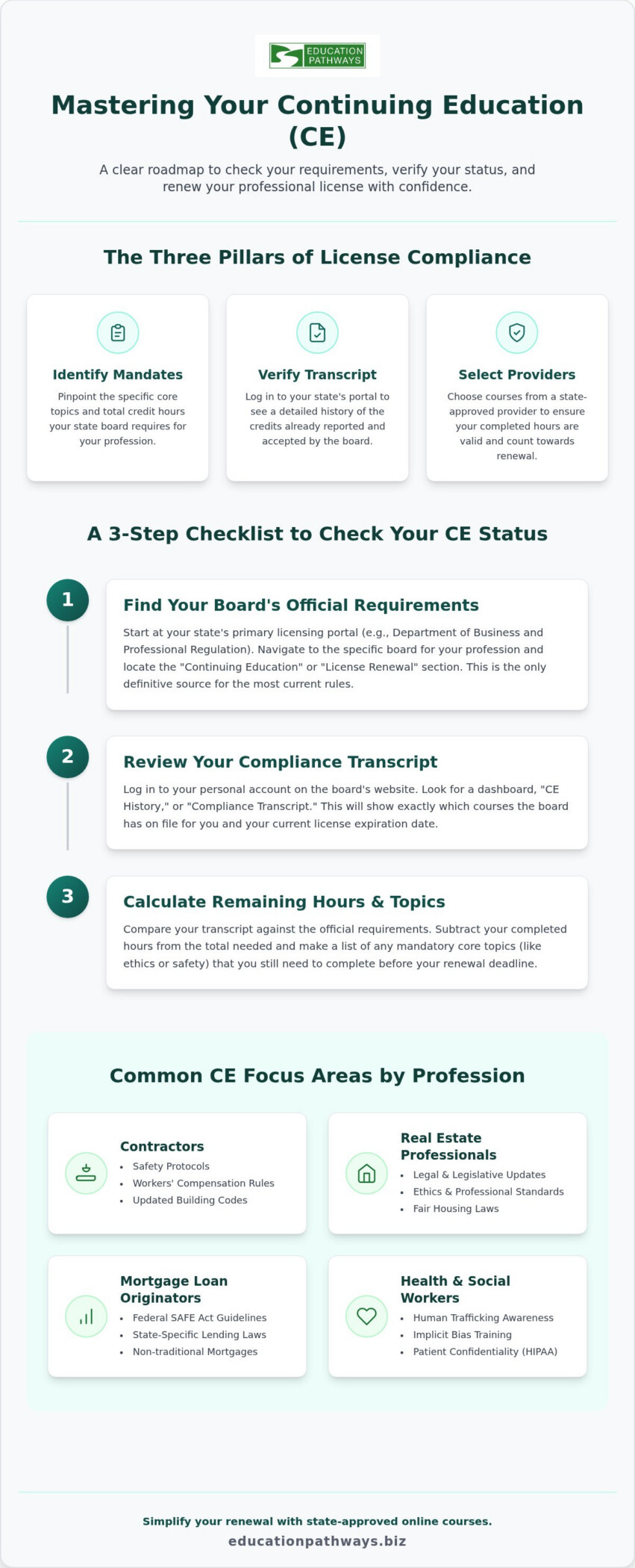
Your specific field determines the topics you must master to remain in good standing. These paths ensure that professionals stay current on the most relevant risks in their daily work. Requirements often follow these industry patterns:
- Contractors: Focus heavily on safety protocols, workers’ compensation, and evolving building codes.
- Real Estate Professionals: Usually require legal updates and ethics training to navigate property laws.
- Mortgage Loan Originators (MLOs): Must follow federal SAFE Act guidelines along with state-specific hours.
- Social Workers and Health Professionals: Frequently face mandates for human trafficking awareness or implicit bias training.
Board autonomy ensures that these courses remain practical. For example, a state board might add a mandatory course on hurricane mitigation after a severe storm season. Staying aligned with these industry-specific shifts prevents last-minute surprises during your renewal window.
Where to Find Your Specific License Requirements
Finding the right information is the first step toward compliance. You should start with your state’s primary licensing portal. This is often hosted by the Secretary of State or the Department of Labor. Once there, you must look for the “Continuing Education” or “License Renewal” tab specific to your board. This is the most reliable way to learn how to check continuing education requirements for my license without relying on third-party hearsay. Understanding CE Requirements is essential because standards for non-health professions vary wildly between states. Boards often update these pages to reflect new legislative mandates, so checking back every few months is a smart professional habit.
Navigating Online Licensing Portals
Most states provide a “License Search” or “Verify a License” tool. These public databases allow you to confirm your current expiration date and license status. For a more detailed view, log in to your professional account. Most modern boards now offer a “Compliance Transcript” or “CE History” page. This dashboard shows exactly which courses the board has already accepted. If you are managing a Florida contractor license renewal, the DBPR portal is your primary resource for verifying these hours. Always look for an “Approved Provider List” on these portals. If your provider isn’t on that list, your credits won’t count toward your renewal, potentially leaving you short on hours at the last minute.
Industry-Specific Resource Hubs
Different industries use specialized platforms that offer more granular detail than general state sites. For instance, mortgage professionals use the NMLS (Nationwide Multistate Licensing System) to track credits across multiple states simultaneously. Real estate agents should head directly to their state’s Real Estate Commission. If you need to verify Texas real estate CE requirements, the TREC website provides a clear breakdown of legal updates and elective hours. Contractors should look for the Construction Industry Licensing Board (CILB) within their state’s regulatory agency. These hubs often contain the most up-to-date information on legislative changes. Once you’ve identified your missing hours, you can find state-approved, online courses at Education Pathways to complete your requirements with ease.
A 3-Step Checklist to Check Your CE Status
Managing your renewal is easier when you follow a structured process. Instead of guessing, use this checklist to gain total clarity on your standing. This approach ensures you don’t miss hidden deadlines or specific subject mandates that could stall your career. Knowing how to check continuing education requirements for my license prevents the panic of a last-minute rush and keeps you in control of your professional credentials.
- Step 1: Identify your license expiration date and current status. Your board portal will list whether your license is “Active” or “Inactive.” If you’re currently inactive, you might face additional re-activation hours beyond the standard renewal requirements. Knowing your exact expiration date is the foundation of a stress-free renewal.
- Step 2: Calculate the total hours required vs. the hours already appearing on your transcript. If you’ve taken courses recently, they might not show up yet. Compare the total credits the board expects against what they officially recognize today. This simple math reveals your remaining workload and helps you plan your schedule.
- Step 3: Cross-reference mandatory “Core” topics. Every license has specific subjects you cannot skip, such as Laws and Rules, Ethics, or Safety. Elective hours cannot usually replace “Core” requirements. Focus on these high-priority credits first to satisfy the board’s most rigid standards.
Auditing Your Current Transcript
Accuracy is your responsibility. Compare your physical certificates of completion against the board’s digital record. If you took a course in the last 30 days, it might still be in the reporting queue. However, if a certificate from six months ago is missing, you’ll need to contact the provider immediately. Digital records are generally reliable, but reporting errors do occur. Also, confirm that you haven’t taken duplicate courses within the same compliance cycle. This is a critical part of how to check continuing education requirements for my license because most boards won’t award credit for the same course twice in one renewal period. Taking the same “Ethics 101” course twice might feel safe, but it often results in zero credit for the second attempt.
Identifying Mandatory vs. Elective Hours
Most licenses require specific updates on ethics or state laws. Failure to complete even one specific core hour can result in a rejected renewal, even if your total hour count is correct. For example, Florida CAM CE requirements include specific categories like legal updates and insurance. If you finish 15 hours but miss the legal update, your license remains at risk. Boards view these core topics as essential for public safety and professional integrity. Focus on these non-negotiable hours early in your cycle to ensure a smooth submission process. Once your core hours are satisfied, you can use electives to round out your requirement and explore new professional interests.
Reporting Timelines: Ensuring Your Credits Are Counted
Completing your courses is only half the battle. You must ensure the state board actually receives and records your progress before your license expires. Most professionals assume the board’s transcript updates the moment they finish a class. In reality, providers typically have a window of 7 to 30 days to report your hours to the state. This reporting delay is why waiting until the final week of your renewal cycle is a high-risk strategy. If your hours aren’t processed by the deadline, you could face late fees or a temporary license suspension.
When you are researching how to check continuing education requirements for my license, you’ll find that manual reporting is increasingly rare. Most modern boards now require electronic submission directly from an approved provider. Your “Instant Certificate” serves as your personal receipt and backup proof of compliance. Always keep digital copies of these certificates in a dedicated folder. If a board audit occurs or a technical glitch wipes your digital transcript, these documents are your only defense to prove you met the requirements on time.
You should also verify if your state offers a grace period. Some jurisdictions allow for late renewal if you pay an additional fee, while others offer no wiggle room. If your credits aren’t reported by the cutoff, your ability to legally work may be revoked immediately. Proactive tracking is the only way to avoid these professional interruptions.
How Automated Board Reporting Works
Modern compliance systems rely on speed and accuracy. Education Pathways reports credits automatically to boards like the Florida DBPR, which removes the administrative burden from your shoulders. This automated system requires your professional license number to be entered exactly as it appears on your pocket card. A single typo during enrollment can prevent the system from matching your credits to your official file. To see how these details impact specific industries, read our guide on Reporting Florida CAM CE Credits.
What to Do if Credits Are Missing
If your hours don’t appear on your transcript after 30 days, don’t panic. Contact the education provider first to verify the date they submitted the roster to the state. Check your certificate of completion for any typos in your license number or name. You should also account for seasonal peaks. Board processing times often increase significantly during major renewal months when thousands of licensees are submitting credits simultaneously. If you need a reliable partner to help you meet a fast-approaching deadline, you can browse our state-approved online courses to get started immediately.
Simplifying Renewal with Education Pathways
Once you’ve mastered how to check continuing education requirements for my license, the next step is choosing a provider that respects your time. Education Pathways, LLC offers a streamlined solution designed for busy professionals who need to stay compliant without sacrificing their work schedule. Our catalog features 100% online, self-paced courses that allow you to complete your hours whenever and wherever it’s convenient for you. You won’t have to deal with rigid classroom schedules or outdated training materials.
Since 2002, we’ve served as a dependable guide for thousands of licensed individuals across multiple industries. We understand that license renewal isn’t just a checkbox; it’s your livelihood. That’s why we provide instant certificates the moment you finish a course. We also include automated board reporting to ensure your credits reach the state quickly and accurately. You can choose from comprehensive packages that consolidate all your mandatory core and elective hours into one simple purchase, removing the stress of tracking individual credits.
State-Approved Online CE Classes
Our platform hosts specialized hubs for various industries, including a dedicated Florida contractor CE hub. Every course in our library is fully optimized for both mobile and desktop use. This flexibility means you can progress through your training during a lunch break or while on a job site. Most importantly, our content is strictly updated to meet 2026 compliance standards. This ensures that the information you learn is not only relevant to your daily work but also fully accepted by your state board. We’ve done the heavy lifting of vetting the regulations so you can focus on your career.
Fast-Track Your License Renewal
We eliminate the guesswork by offering pre-bundled packages that are guaranteed to meet all your state requirements. Instead of hunting for individual classes to fill specific core mandates, you can select a single bundle that covers everything from legal updates to safety protocols. This is the most efficient way to handle how to check continuing education requirements for my license while simultaneously completing them. Once you finish your coursework, you’ll receive an instant notification confirming that your credits have been processed and reported. This transparency gives you the confidence that your renewal is moving forward as planned. View our state-approved CE course catalog and start your renewal today to secure your professional standing.
Secure Your Professional Standing for 2026
Maintaining your professional license doesn’t have to be a source of constant stress. By identifying your specific state board mandates and auditing your official transcript early, you avoid the high-risk gamble of last-minute reporting delays. You now have a practical roadmap for how to check continuing education requirements for my license and a clear understanding of the critical difference between mandatory core subjects and elective credits. Success in renewal is about accuracy and timing rather than just completing hours.
Once you’ve identified your missing hours, the next step is choosing a partner that makes compliance effortless. Education Pathways offers a streamlined experience with 100% online and self-paced courses that fit into your busy professional schedule. You’ll benefit from our automated board reporting and receive instant certificates of completion for your personal records. Our system is specifically designed to remove the friction from the regulatory process so you can stay focused on your career.
Find Your State-Approved CE Courses Now and take control of your upcoming renewal cycle today. Move forward with the peace of mind that your credentials are secure and your professional future is well protected.
Frequently Asked Questions
How many continuing education hours do I need for my license?
Your required hours depend entirely on your specific state board and profession. For example, California Registered Nurses must complete 30 contact hours every two years, while Texas real estate agents require 18 hours after their first renewal. Florida cosmetologists only need 10 hours per cycle. Always verify your specific total through your board’s official website to ensure you meet the current 2026 standards for your trade.
Where can I find my continuing education transcript?
You can access your official continuing education transcript through your state licensing board’s online portal. Most agencies, such as the Florida DBPR or Texas TREC, provide a “Verify a License” or “CE History” tool. Log in to your professional account to see a detailed breakdown of accepted credits. If you’re unsure how to check continuing education requirements for my license, starting with these secure databases is the most reliable method.
What happens if I don’t finish my CE credits by the deadline?
Missing your deadline usually results in an immediate change to your license status, moving it from “Active” to “Inactive” or “Expired.” You will likely face late renewal fees, which can be significant. For instance, California RNs face a $90 late fee on top of the $190 renewal cost. Most importantly, you cannot legally work until you satisfy the requirements and pay all associated penalties to the board.
Can I take the same CE course twice for credit?
Most licensing boards do not allow you to receive credit for the same course taken twice within a single compliance cycle. Even if the content is valuable, the system will typically flag the duplicate entry and reject the second submission. Always vary your course selection each renewal period to ensure every hour counts toward your total. Check your transcript before enrolling to avoid accidentally repeating a recently completed class.
How long does it take for CE credits to be reported to the state board?
Providers generally have between 7 and 30 days to report your completed hours to the state board. While some systems update faster, you should allow for this processing window when planning your renewal. During peak months, board systems often experience delays due to high volume. It’s best to finish your courses at least one month before your expiration date to ensure your status remains active without interruption.
Are online CE courses accepted by my state licensing board?
Yes, most state boards fully accept online continuing education as long as the provider is officially approved by the regulatory agency. Online learning has become the standard for many professions due to its flexibility and ease of reporting. Before enrolling, verify that the provider holds a current approval number for your specific license type. This ensures that your self-paced study meets all state-mandated educational standards for 2026.
Do I need to send my certificates of completion to the state board myself?
In most modern systems, you don’t need to send certificates yourself because approved providers report credits electronically. However, you should always keep your digital certificates for at least four years as backup proof. If the board conducts a random audit or a technical error occurs during how to check continuing education requirements for my license, these documents are your primary evidence of compliance and professional standing.
How do I know if a CE provider is state-approved?
You can verify a provider’s status by searching the “Approved Provider List” on your state board’s website. Legitimate providers will also display their state-issued approval numbers prominently on their course pages and certificates. Using an unapproved source is risky, as the board will not recognize those hours for renewal. Always cross-reference the provider’s credentials with official state databases before making a purchase to guarantee credit acceptance.