
Florida CAM Ethics CE Course: 2026 Compliance & Renewal Guide

Understanding the Florida CAM Legal Update CE Requirement for 2026
For every Florida Community Association Manager (CAM), the biennial license renewal process is a critical checkpoint. While many search for a specific “Florida CAM ethics CE course,” the true cornerstone of your 2026 compliance is the mandatory Legal Update (LU) course. This course is non-negotiable and forms the bedrock of ethical practice by ensuring you are current with Florida’s rapidly changing statutes and regulations.
The Florida Department of Business and Professional Regulation (DBPR) mandates that all CAMs complete a specific number of continuing education (CE) hours every two years to maintain their license. For the renewal cycle ending September 30, 2026, understanding this requirement is more crucial than ever due to significant legislative changes.
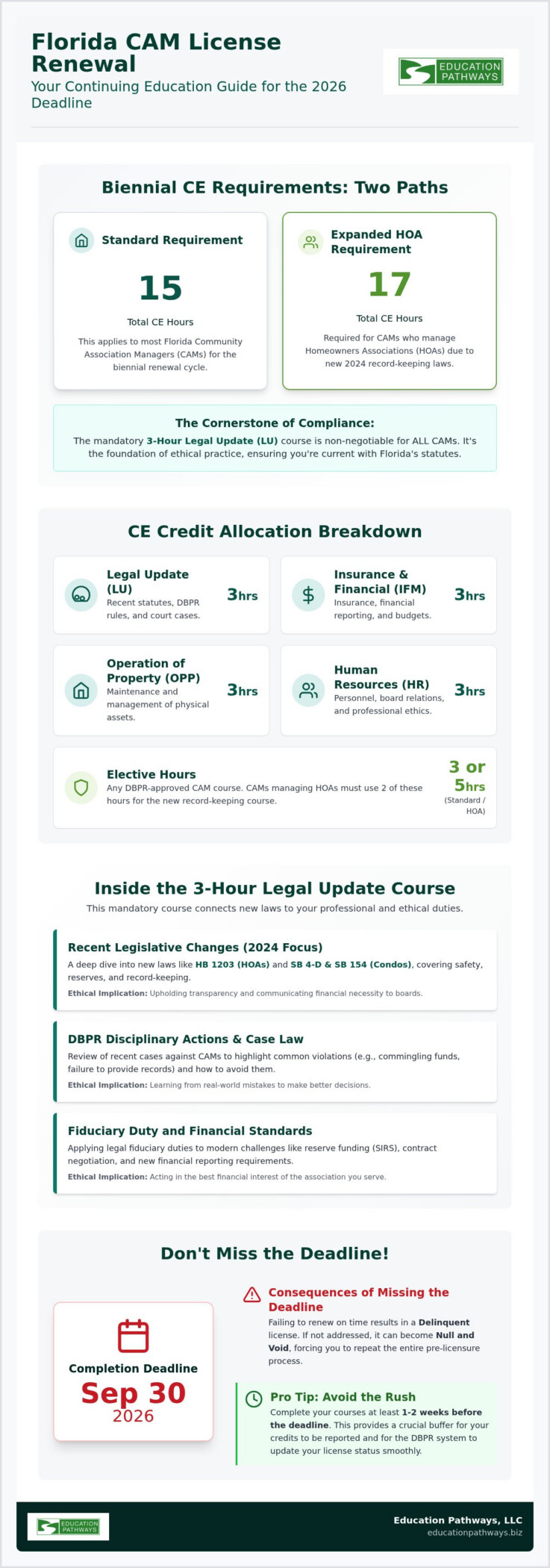
At its core, the requirement is 15 hours of state-approved CE. However, recent laws have created a distinction:
- Standard 15-Hour Requirement: This applies to most CAMs. These hours are divided into specific categories mandated by the DBPR.
- Expanded 17-Hour Requirement: This applies specifically to CAMs who manage Homeowners Associations (HOAs). The additional two hours cover new, stringent record-keeping laws passed in 2024.
The Legal Update course is the most scrutinized component of this requirement. It directly addresses the laws that govern your professional conduct, fiduciary duties, and operational responsibilities—the very definition of applied ethics in community management.
Mandatory CE Categories for CAMs
Whether you need 15 or 17 hours, your CE credits must be allocated across four required categories. The most critical of these is the Legal Update.
- Legal Update (LU): 3 hours covering recent changes to Florida Statutes, DBPR rules, and relevant court cases. This is a mandatory, standalone requirement for every CAM.
- Insurance and Financial Management (IFM): 3 hours dedicated to association insurance policies, financial reporting, and budget management.
- Operation of Physical Property (OPP): 3 hours focusing on the maintenance and management of the association’s physical assets.
- Human Resources (HR): 3 hours covering topics like personnel management, board member relations, and professional ethics. While this category officially contains “ethics,” the LU course provides the legal framework that dictates ethical behavior.
- Elective Hours: The remaining hours can be fulfilled with any DBPR-approved CAM course, including the extra 2 hours of HOA record-keeping for those who need the 17-hour total.
The September 30, 2026 Deadline
All continuing education credits must be completed and reported to the DBPR before the biennial deadline of September 30, 2026. Waiting until the last minute is a significant risk.
- Consequences of Missing the Deadline: Failing to renew on time can result in your license becoming delinquent. If not addressed, it can eventually become “null and void,” forcing you to go through the entire pre-licensure process again. For more details, see our guide on what happens if you miss your professional license renewal deadline.
- Allow for Reporting Time: While providers like Education Pathways report your credits automatically, the state’s system can take time to update. Completing your courses at least a week or two before the deadline provides a crucial buffer to ensure your license status is updated smoothly.
Core Topics in the Mandatory 3-Hour Legal Update Course
The Florida CAM Legal Update course is not a generic ethics seminar; it is a detailed review of specific legislative and administrative rule changes that directly impact your daily operations. Mastering this content is essential for both legal compliance and upholding your ethical duties to the communities you serve. The 2024-2026 renewal cycle focuses heavily on transparency, financial integrity, and board governance.
A DBPR-approved Legal Update course will cover critical areas, connecting new laws to your professional responsibilities.
- Analysis of Recent Legislative Sessions: A deep dive into new laws passed, with a heavy focus on bills like HB 1203 (for HOAs) and recent changes to condominium and cooperative acts.
- DBPR Disciplinary Actions and Case Law: Review of recent disciplinary cases against CAMs, highlighting common violations and how to avoid them. This provides real-world context for ethical decision-making.
- Fiduciary Duty in Practice: Applying the legal concept of fiduciary duty to modern challenges, such as reserve funding, contract negotiation, and record accessibility.
- Changes to Financial and Reporting Standards: Updates related to budgets, financial reporting, and the legal requirements for reserve studies and funding, especially in the wake of structural integrity reforms.
Recent Legislative Changes and Their Ethical Implications
The primary function of the Legal Update is to bring you up to speed on new statutes. For the 2026 renewal, this includes:
- New HOA Laws (HB 1203): Understanding the expanded record-keeping requirements, website mandates, and increased penalties for non-compliance. Ethically, this is about transparency and a member’s right to information.
- Condominium Safety and Reserve Laws (SB 4-D & SB 154): Navigating the complexities of Milestone Inspections and Structural Integrity Reserve Studies (SIRS). The ethical challenge here is communicating the financial necessity of these requirements to boards who may be resistant to costs.
- Board Governance and Member Rights: Reviewing any new regulations concerning board meetings, elections, and conflict of interest disclosures.
Case Law and DBPR Enforcement Priorities
The course also examines how the law is being interpreted and enforced. This is where legal theory meets management reality.
- Common Violations: Analysis of the most frequent reasons CAMs face disciplinary action, such as commingling funds, failing to provide records, or acting beyond the scope of their authority.
- Declaratory Statements: Understanding official opinions issued by the DBPR that clarify ambiguous sections of the law, providing a guide for compliant and ethical conduct.
- Real-World Scenarios: Applying legal principles to case studies involving vendor contracts, resident disputes, and financial mismanagement, showing how a strong legal foundation prevents ethical lapses.
Online vs. Classroom: Choosing Your Legal Update Training Format
As a busy professional, how you choose to complete your mandatory Legal Update course matters. While traditional classrooms exist, online education offers flexibility and efficiency that is perfectly suited to the demanding schedule of a Community Association Manager.
The primary benefit of online, self-paced learning is control. You decide when and where to study, fitting your CE requirements around board meetings, property inspections, and personal commitments.
- Self-Paced Convenience: Online courses allow you to start, stop, and resume your training at any time. You can complete the 3-hour Legal Update in a single session or break it into smaller, more manageable segments.
- Cost-Effectiveness: Digital courses and eBook formats are often more affordable than in-person seminars, as they eliminate costs associated with travel, physical materials, and time away from work.
- Built-in Compliance: Reputable online platforms integrate assessments and quizzes directly into the material, ensuring you have absorbed the key concepts required by the DBPR before issuing a certificate.
- Immediate Access: Unlike classroom courses that require you to wait for a scheduled date, online enrollment provides instant access to all course materials, making it the ideal solution for last-minute renewals.
The Speed of Online CE Completion
For CAMs facing the September 30 deadline, speed is paramount. The online format is purpose-built for rapid, efficient completion without sacrificing quality.
- Enroll and Begin in Minutes: There are no wait times. Once you sign up, you can immediately start your Legal Update course.
- No Fixed Schedules: Forget blocking out an entire day. You can complete your coursework early in the morning, late at night, or during a quiet afternoon.
- Instant Grading and Feedback: Quizzes and final exams are graded automatically, so you know immediately if you have passed and can move on to the next step.
Instant Certificates and Automated DBPR Reporting
The final steps of the CE process—documentation and reporting—are where online providers truly excel.
- Instant Certificate of Completion: Upon successfully finishing your course, Education Pathways provides an immediate, downloadable certificate for your records. This is your proof of compliance.
- Automatic Reporting to DBPR: We handle the most critical step for you. Your course completion is automatically reported to the Florida DBPR, ensuring your license renewal is processed without delay.
- Verify Your Credits: After we report your hours, you can confirm they have been posted by logging into your account on the DBPR’s MyFloridaLicense portal. We recommend learning how to check your CE credits online to ensure peace of mind.
How 2024 Legislative Updates Define Your 2026 Legal & Ethical Duties
The 2024 legislative session in Florida introduced some of the most significant changes to community association law in recent memory. These updates are the primary focus of the 2026 Legal Update CE course, transforming it from a routine requirement into an essential tool for risk management. For modern CAMs, ethical practice is no longer a matter of general principles; it is defined by strict adherence to these new, complex statutes.
Failure to understand and implement these changes is not just a compliance issue—it’s a direct breach of your fiduciary duty and professional responsibility.
- HB 1203’s Impact on HOA Management: This bill dramatically increased transparency and record-keeping requirements for Homeowners Associations.
- New Structural Integrity and Reserve Laws: Following the Surfside tragedy, laws like SB 4-D and SB 154 have revolutionized how condominiums must approach building safety and financial planning.
- Increased Penalties for Non-Compliance: The legislature has put teeth into these new laws, with stricter penalties for CAMs and boards who fail to comply.
- The Ethics of Record Accessibility: The legal mandate for accessible records is now a core ethical test. Withholding or delaying access to official records is a serious violation with significant consequences.
HB 1203 and the New Standard for HOA Recordkeeping
For CAMs managing HOAs of 100 or more parcels, HB 1203 created a new landscape of digital and physical record management. This is why these managers now require 17 total CE hours, including 2 hours specifically on these new rules.
- Mandatory Website and Document Posting: The law requires certain official records to be posted on a secure association website, making them readily available to members.
- Ethical Responsibility for Accuracy: As a CAM, you are ethically bound to ensure the information posted is accurate, current, and complete. This responsibility extends to advising the board on its legal obligations.
- Severe Penalties for Willful Non-Compliance: Knowingly failing to provide access to records is now a criminal offense under certain circumstances, elevating this administrative task to a critical ethical duty.
Reserve Reform and Your Fiduciary Duty
The new laws surrounding Structural Integrity Reserve Studies (SIRS) and milestone inspections for condominiums place CAMs at the center of complex financial and engineering discussions. Your role requires both technical understanding and ethical fortitude.
- Ethics in Communicating Reserve Needs: You have a professional duty to clearly and accurately explain the findings of a SIRS to the board and membership, even when the financial implications are severe.
- Navigating Pressure to Underfund: Boards may feel pressure from members to waive or underfund reserves. Your ethical and legal obligation is to advise them based on the law and the engineer’s report, not popular opinion.
- Professional Liability and Disclosure: Properly documenting your advice and the board’s decisions regarding reserves is crucial for mitigating your professional liability. This is an act of ethical self-preservation and responsible management.
Streamlining Your License Renewal with Education Pathways
Navigating the 2026 renewal requirements doesn’t have to be complicated. At Education Pathways, we specialize in providing DBPR-approved online CE courses designed for busy Florida CAMs. We translate complex legal mandates into clear, manageable online training that you can complete on your own schedule.
Whether you need the mandatory 3-Hour Legal Update, the full 17-hour package for HOA managers, or a standard 15-hour bundle, we have a solution that fits your needs. Our entire process is built for speed, compliance, and peace of mind.
- Comprehensive Course Bundles: Get all your required hours in one place with our Florida CAM CE online bundles. We’ve packaged the Legal Update, IFM, OPP, HR, and elective courses to ensure you meet every requirement.
- 20+ Years of Trusted Experience: We have been a DBPR-approved provider since 2002, helping thousands of Florida professionals maintain their licenses with reliable, state-accepted education.
- Automated Reporting Included: We take the guesswork out of compliance. Upon completion, we automatically report your credits directly to the DBPR, and you receive an instant certificate for your records.
- Flexible A La Carte Options: If you only need the 3-Hour Legal Update or another specific course to complete your hours, you can purchase it individually.
Why Managers Trust Education Pathways
Our platform is designed from the ground up to respect your time and eliminate the typical frustrations of continuing education.
- Mobile-Friendly and Accessible 24/7: Complete your courses on a desktop, tablet, or smartphone. Our system is available whenever and wherever you are ready to learn.
- State-Approved and Up-to-Date Curriculum: Our courses, including the critical 2026 Legal Update, are meticulously updated to reflect the latest Florida laws and DBPR regulations.
- Dedicated Support: If you have questions about the requirements or need to verify your reporting status, our support team is ready to assist.
Getting Started Today
Don’t wait until the September deadline is looming. Secure your compliance and peace of mind in three simple steps.
- Enroll in Your Course: Select the Legal Update course or the full 15/17-hour bundle and complete the simple online enrollment.
- Complete the Self-Paced Material: Access your course immediately and work through the material at your own pace.
- Receive Your Instant Certificate: Once you pass the final assessment, your certificate is available for download, and we handle the reporting to the state.
Frequently Asked Questions (FAQs)
- How many hours of Legal Update does a Florida CAM need for renewal in 2026?
- Every licensed Florida CAM must complete a 3-hour, DBPR-approved Legal Update (LU) course as part of their total continuing education requirement for the 2024-2026 renewal cycle.
- Does the mandatory Legal Update course cover ethics?
- Yes, absolutely. While there is a separate “Human Resources” category that includes ethics, the Legal Update course is where ethics are put into practice. It defines the specific laws, rules, and professional standards that govern your fiduciary duties, transparency, and conduct, forming the foundation of ethical management.
- Do I need 15 or 17 hours of CE for my 2026 CAM renewal?
- You need 15 hours of CE if you do not manage HOAs. You need 17 hours of CE if you manage an HOA with 100 or more parcels, due to the new 2-hour record-keeping requirement from HB 1203. Both totals include the mandatory 3-hour Legal Update course.
- How quickly are my CAM CE credits reported to the DBPR?
- Education Pathways typically reports your completed course credits to the DBPR within 1-2 business days. We handle this process for you automatically upon successful completion of your course.
- Can I take my Florida CAM Legal Update CE course on a mobile device?
- Yes. All of our courses are fully mobile-responsive, allowing you to complete your CE requirements on any smartphone, tablet, or computer with an internet connection.
- What happens if I miss the September 30, 2026 renewal deadline?
- Missing the deadline will cause your license to become delinquent. You will have a period to complete your CE and pay a late fee to reactivate it. If you fail to do so, your license could become null and void, requiring you to re-apply as a new licensee. We cover this in detail in our guide to expired professional licenses