
What Happens If I Miss My Professional License Renewal Deadline in 2026?

Imagine waking up on a Monday morning in 2026, ready to start your shift, only to realize your professional license expired at midnight. It’s a gut-wrenching feeling that many busy professionals face when administrative tasks slip through the cracks. You’re likely worried about heavy fines, legal issues regarding “unlicensed practice,” or how this lapse affects your professional reputation. You aren’t alone in this anxiety, and the good news is that there’s always a path forward.
This article breaks down exactly what happens if I miss my license renewal deadline, covering everything from immediate consequences to the step-by-step recovery process. You’ll discover how state-specific rules vary significantly. For instance, Illinois insurance producers face immediate reinstatement requirements with no grace period, while states like Idaho are shifting to biennial cycles. We will provide a clear path to reinstatement, including how to confirm your current status and the fastest way to complete missing CE credits. By the end of this guide, you’ll have a methodical roadmap to get back into compliance quickly and confidently.
Key Takeaways
- Learn the critical difference between an expired and delinquent status and why you must pause professional operations to avoid legal penalties.
- Discover exactly what happens if I miss my license renewal deadline, including how to navigate the 30-to-90-day grace periods offered by most boards.
- Understand the financial impact of a late renewal, including flat-fee penalties and the potential costs of failing a mandatory education audit.
- Find the fastest path to reinstatement by auditing your credits and using state-approved online courses that offer instant board reporting.
- Master proactive planning techniques like setting a six-month renewal calendar to prevent future administrative lapses and stress.
Immediate Impact: Is Your License Inactive or Void?
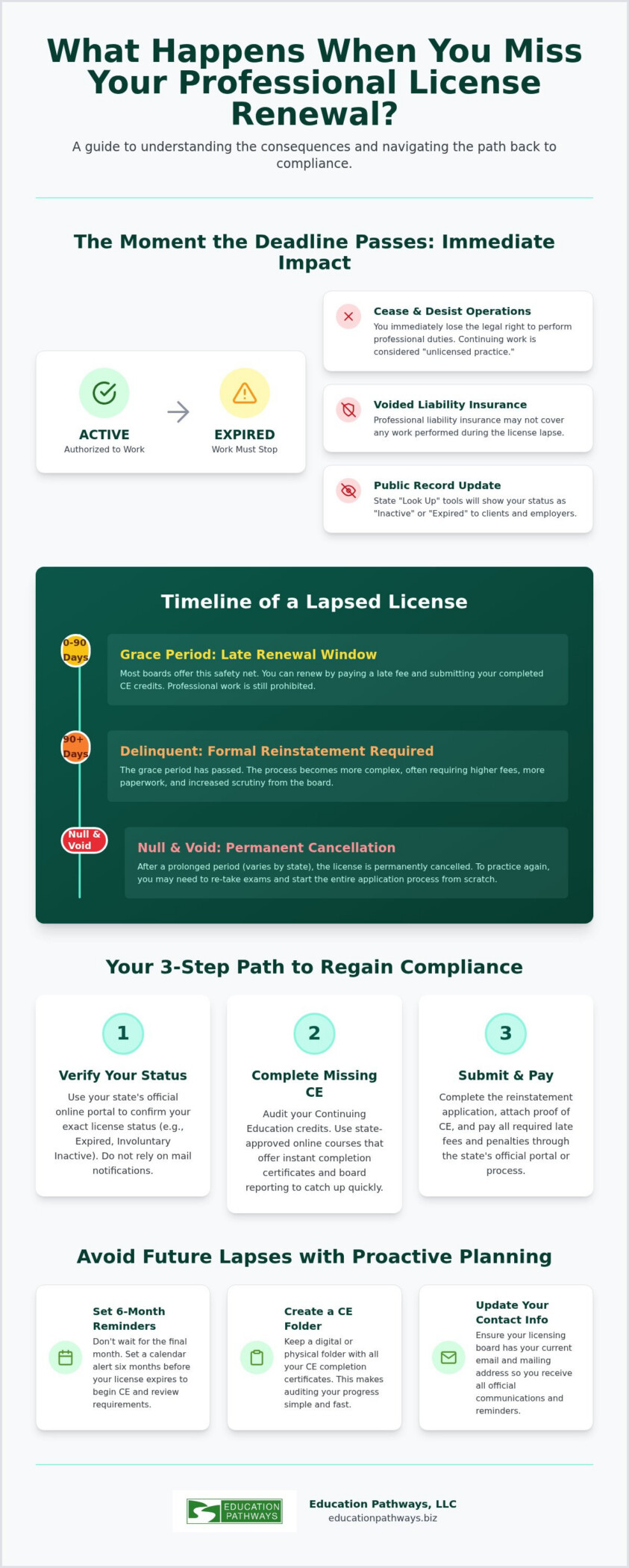
Missing a deadline isn’t just a clerical error; it’s a legal shift in your professional standing. If you’re wondering what happens if I miss my license renewal deadline, the first change is your legal authorization to work. Most states move your status from “Active” to “Expired” the moment the clock strikes midnight. This shift isn’t just a label on a website. It represents a total loss of the legal right to perform your professional duties.
In 2026 regulatory terms, the distinction between “Expired” and “Delinquent” is critical. “Expired” typically refers to the period immediately following your deadline where you may still be within a state-sanctioned grace period. “Delinquent” or “Lapsed” often indicates that the grace period has passed, moving you into a more complex reinstatement process. For example, Illinois insurance producers face a lapsed status immediately with no grace period, requiring a $430 resident reinstatement fee. Understanding professional license renewal as a mandatory compliance gate is the first step toward recovery.
The “Cease and Desist” reality is the most immediate threat to your livelihood. You must stop professional operations the moment your license expires. Continuing to work can lead to several severe complications:
- Voided professional liability insurance coverage for any work performed during the lapse.
- Immediate rejection of signed permits, blueprints, or official documents.
- Public record updates that show your status as “Inactive” or “Involuntary Inactive” to any client or employer who uses state “Look Up” tools.
The Legal Risks of Unlicensed Practice
Unlicensed practice is a statutory violation in most states. If you continue to work, you face significant civil penalties and state-level fines that often exceed the original renewal cost. In North Carolina, for instance, reinstatement for certain professions may even require a completely new background check. Beyond fines, a lapse can invalidate current contracts, potentially leading to lawsuits from clients who discover they hired an “unlicensed” professional during the gap period.
Checking Your Current License Status
Don’t wait for a physical letter to arrive in the mail. Physical mail reminders are often delayed or lost; boards generally consider it your responsibility to track your own dates. Use your state’s online portal to verify your exact status. Common status codes include:
- Active: You are fully compliant and authorized to work.
- Expired: Your deadline has passed, but you may still be in a grace period.
- Involuntary Inactive: You have missed both the renewal and grace period, requiring formal reinstatement.
If you’re a Florida professional, checking your status on the DBPR portal is the fastest way to confirm your standing. For those in the construction industry, visiting a dedicated Florida contractor license renewal resource can help clarify specific state requirements and deadlines for 2026.
Understanding Grace Periods vs. License Reinstatement
Missing your expiration date feels like a disaster, but it is often a fixable situation if you act quickly. If you are asking what happens if I miss my license renewal deadline, the answer depends largely on how much time has passed since the expiration. Most licensing boards recognize that administrative errors happen and provide a safety net known as a grace period. This window allows you to correct the lapse without losing your license permanently, though you will likely face financial penalties.
The transition from a simple late renewal to a formal reinstatement is where the administrative burden spikes. While a late renewal is usually a matter of paying a fee, reinstatement often involves a higher level of scrutiny from the board. In some states, if you allow a license to remain inactive for too long, it reaches a “Null and Void” threshold. At this stage, your license is permanently cancelled. To practice again, you might be required to undergo a full re-examination, effectively starting your professional journey from scratch. Reviewing specific state regulations for license renewal can help you identify exactly when these thresholds occur for your specific industry.
The Late Renewal Window (0-90 Days)
This initial period is your best opportunity for a quick recovery. Most boards offer a 30 to 90 day window where you can still renew by paying a standard late fee and providing proof of your completed continuing education (CE). It’s essential to ensure your credits meet the “Classroom Equivalent” rule, meaning your online courses must be state-approved to count during this sensitive time. For example, Florida contractor license renewal policies allow for a specific late window, but the clock never stops ticking on your compliance requirements.
The Reinstatement Phase (90+ Days)
Once you move past the 90-day mark, you typically enter the reinstatement phase. This process is much more involved than a standard renewal. You may need to submit a formal petition to the licensing board explaining why the deadline was missed. Some boards include “Hardship” clauses for professionals who faced documented medical or family emergencies. However, the burden of proof is on you to demonstrate your professional competency hasn’t diminished during the lapse. If you find yourself in this position, finishing your Texas real estate CE classes or other relevant courses immediately shows the board you are serious about regaining compliance.
Financial and Regulatory Penalties for Late Renewals
Missing your expiration date triggers a cascade of financial consequences. If you’re wondering what happens if I miss my license renewal deadline, be prepared for more than just a single late fee. Regulatory boards don’t just want you to catch up; they use financial penalties to enforce administrative compliance. These costs can scale quickly, often doubling or tripling the original renewal price within just a few months.
Beyond the obvious fees, hidden costs can surprise even seasoned veterans. You might need to pay for new fingerprinting services, updated background checks, or administrative processing fees if your license stays inactive for too long. For example, the Virginia professional license renewal regulations outline a strict 30-day window for late renewals before the process shifts into a more expensive reinstatement requirement. For those in the property management sector, completing Florida CAM CE online immediately is the most effective way to halt these escalating administrative burdens.
Breakdown of Common Renewal Fines
Late fee structures vary significantly between industries. Contractors often face higher flat fees compared to real estate agents, who might see percentage-based penalties added to their base renewal cost. In some jurisdictions, like Illinois, the reinstatement fee for an insurance producer license is $430, which is exactly double the standard resident renewal fee of $215. Fines are often non-negotiable and must be paid before your continuing education credits are even reviewed by the board. Some states also charge a “per-month” delinquency fee, meaning the longer you wait to address the lapse, the more expensive it becomes to regain your status. Professionals should consult the Florida contractor CE hub to see how specific trade penalties are calculated for 2026.
The Disciplinary Record Impact
The financial cost is only part of the equation. A lapsed license often creates a permanent mark on your disciplinary record. This “suspended” or “delinquent” status is a public red flag that can damage your professional reputation. If you plan to work in multiple states, a lapse in one can trigger a “domino effect” where reciprocity is denied elsewhere. You’ll also be required to disclose this disciplinary action on future employment or partnership applications. The long-term cost of a tarnished professional bio often far outweighs the immediate late fees. Taking your Texas real estate CE classes early ensures your record stays clean and your professional standing remains unquestioned.
Steps to Reactivate Your License and Regain Compliance
When you realize you’ve missed your date, the path back to compliance must be methodical. Many professionals assume they can simply pay a fine and move on, but most boards won’t process a late renewal until the “CE Gap” is closed. If you’re stressed about what happens if I miss my license renewal deadline, following these specific steps will help you regain your active status as quickly as possible.
Your first priority is a comprehensive audit of your existing Continuing Education credits. Review exactly which hours you completed before the expiration date and identify the specific categories you’re missing, such as Laws and Rules or specialized trade requirements. For those in the healthcare real estate sector, keeping up with these requirements is paramount; firms like the Assisted Living Real Estate Group rely on licensed expertise to navigate the complexities of senior care facility transfers. Once you know the deficit, you can move through the following reactivation sequence:
- Step 1: Audit: Verify your current credit count through your state’s licensee portal.
- Step 2: Enroll: Choose a state-approved, 100% online CE course to bridge the missing hours.
- Step 3: Pay: Settle all late fees and renewal balances through the official state portal.
- Step 4: Verify: Ensure your CE provider offers automated reporting to your licensing board.
- Step 5: Confirm: Wait for your status to update to “Active” before you resume any professional operations.
Finding Approved CE Courses Fast
Speed is your greatest asset during a grace period. You need a provider that offers “Instant Certificates” so you don’t have to wait days for manual processing. For those in the building trades, using Florida contractor CE classes online allows you to fulfill your entire hour requirement in as little as 24 hours. It’s vital that your chosen provider reports directly to the DBPR, NMLS, or your specific state board to avoid further administrative delays. If you need to catch up immediately, you can enroll in a state-approved course hub to start your hours right now.
Submitting Your Reinstatement Application
Navigating state portals like Sircon or the NMLS during a late renewal can be tricky. You must double-check that you’ve met all specific “Ethics,” “Safety,” or “Business” hour requirements, as missing even one hour in a mandatory category will cause the board to reject your application. For Florida-based professionals in the security industry, you can discover more about Security D License Training Courses through Optimal Security to ensure you have the correct documentation for your submission. Keep digital copies of your certificates for at least four years. Boards often conduct random audits on late renewals, and having your documentation ready will prevent future headaches. After you’ve submitted everything, check the portal daily. Don’t rely on email notifications; manual verification of your “Active” status is the only way to ensure you’re legally protected before returning to work.
Recovering from a missed deadline is stressful and expensive. Once you’ve navigated the immediate crisis of what happens if I miss my license renewal deadline, your focus should shift toward permanent prevention. The most effective strategy is to build a “Renewal Calendar” that begins at least six months before your 2026 expiration date. This buffer allows you to complete your requirements in small, manageable sessions rather than a frantic 48-hour marathon.
Early enrollment in your continuing education courses offers a distinct advantage. It eliminates the risk of technical glitches or board reporting delays that often occur during the end-of-cycle rush. Education Pathways, LLC simplifies this process for professionals holding multiple licenses across states like Florida and Texas. By centralizing your learning, you ensure that every hour is tracked and reported through automated services, giving the board real-time visibility into your compliance status. This centralized approach removes the guesswork and provides a clear audit trail for your records.
The 100% Online Advantage for Busy Professionals
Online learning is the ultimate tool for maintaining an active license without disrupting your billable hours. Self-paced courses beat in-person classroom training because they adapt to your schedule, not the other way around. Mobile-friendly platforms allow you to knock out a module while waiting at a job site or during a lunch break. If you’re a construction professional, the Florida Contractor CE Hub provides a streamlined package that covers all mandatory hours in one digital location. This flexibility ensures that even the busiest seasons don’t result in a lapsed status.
Monitoring Your Compliance Status
Don’t assume your credits are valid just because you finished a quiz. You must regularly check your official transcript on state board websites to verify that your hours have moved from “Completed” to “Reported.” There is often a processing lag between finishing a course and the board updating your public file. Proactive CE completion is the only 100% effective way to prevent license suspension and avoid the panic of wondering what happens if I miss my license renewal deadline in the future. By staying ahead of the curve, you protect your professional reputation and keep your business running without interruption. Set a recurring reminder on your digital devices and treat your renewal window as a non-negotiable business appointment.
Regain Your Professional Standing Today
Understanding what happens if I miss my license renewal deadline is the first step toward correcting a stressful administrative lapse. While the immediate consequences include an “Expired” status and escalating fines, the path to reactivation is straightforward when you have the right resources. You must audit your missing hours, settle all regulatory fees, and complete state-approved education to bridge the compliance gap. Acting quickly within your state’s grace period prevents the more complex, costly reinstatement process or the permanent loss of your professional credentials.
Education Pathways, LLC has served as a trusted partner for licensed professionals since 2002. We provide 100% online, self-paced courses that fit your busy schedule and offer instant certificates upon completion. With our automated reporting to licensing boards, you can focus on your work while we handle the heavy lifting of compliance verification. Browse State-Approved Online CE Courses and Renew Your License Today to protect your career and regain your peace of mind. You’ve worked hard for your license; don’t let a simple deadline derail your professional success.
Frequently Asked Questions
Is there a standard grace period if I miss my license renewal?
Most boards offer a 30 to 90 day grace period, but this varies significantly by state and profession. For example, Illinois insurance producers have no grace period and must reinstate immediately. During a grace period, you can usually renew by paying a late fee. However, you should never assume a window exists without checking your specific board’s 2026 regulations first to avoid a status lapse.
Can I still perform work if my license is in a delinquent status?
No, you must stop all professional operations immediately if your license is delinquent. Practicing with an expired license is considered unlicensed practice, which is a statutory violation in most states. This can lead to heavy civil penalties, voided insurance coverage, and rejected permits. You should wait until your status returns to “Active” on the state portal before resuming any billable work or signing documents.
How much are the late fees for missing a contractor license deadline?
Late fees for contractors are typically flat fees that can range from $50 to over $200 depending on the state. Some jurisdictions also apply a percentage-based penalty or a per-month delinquency charge. These fines are usually non-negotiable and must be settled before the board reviews your continuing education. It’s best to consult your specific state board’s 2026 fee schedule for exact amounts relevant to your trade.
What happens if I miss the deadline and haven’t finished my CE credits?
Your license will likely move to an “Expired” or “Inactive” status until all education requirements are met. You cannot simply pay a fine to bypass the education gap. You’ll need to complete the missing hours through a state-approved provider that offers instant reporting. This is often the primary reason professionals wonder what happens if I miss my license renewal deadline when they realize they’re short on credits.
How long does it take for CE credits to show up on my state transcript?
Reporting times vary, but many modern providers offer automated reporting that updates state records within 24 to 48 hours. Some platforms provide instant certificates that you can upload manually if the state portal allows it. If you’re using a provider with automated reporting, check your official transcript regularly. Don’t rely on the provider’s dashboard alone; always confirm the board has received and accepted your hours officially.
Will I have to retake my licensing exam if I miss the renewal date?
You typically won’t have to retake the exam if you’re within the grace period or reinstatement window. However, if your license reaches the “Null and Void” threshold, which often happens after two years of delinquency, you may be treated as a new applicant. This usually requires passing the full licensing exam again. Staying within the initial late renewal window is the best way to avoid this extreme requirement.
What is the difference between an inactive and a void license?
An inactive license is generally still valid but lacks the authorization for active practice. You can usually return to active status by completing CE and paying fees. A void license is permanently cancelled. Once a license is void, the state essentially views you as never having held it. This requires a completely new application process, including exams and background checks, to regain your professional standing from scratch.
Can I renew my license online after the expiration date has passed?
Yes, most states allow online renewals during the grace period or late renewal window. Online portals like Sircon or NMLS are designed to handle late fees and CE verification automatically. If you’re asking what happens if I miss my license renewal deadline, the online portal is your fastest path to recovery. Just ensure all your continuing education credits are reported before you attempt the final submission through the state website.