
How to Avoid Penalties for Not Completing Continuing Education in 2026

What if a single missed credit hour didn’t just result in a small fine, but a total suspension of your ability to earn a living? You’ve invested years into your professional standing, yet the constant shift in state requirements makes compliance feel like a moving target. It’s exhausting to track whether you need a specific ethics course or a new human trafficking module just to keep your license active. The anxiety of an unexpected audit or a tiered fine is a burden you shouldn’t have to carry.
This article explains the exact legal and financial penalties for not completing continuing education in 2026. You’ll discover how to identify your specific state’s risks, avoid common non-compliance scams, and secure your professional future. We’re breaking down the latest fine structures across various industries and providing a clear, automated path to ensure your credits are reported on time. By the end of this guide, you’ll have a foolproof plan to maintain your standing with total peace of mind.
Key Takeaways
- Distinguish between license inactivity and expiration so you don’t lose the legal authority to pull permits or sign contracts.
- Identify the specific financial penalties for not completing continuing education, ranging from hourly fines to significant administrative fees.
- Build a reliable compliance calendar that tracks core versus general requirements to stay ahead of state-specific deadlines.
- Spot the red flags of unapproved CE providers and phishing scams that target professionals during the renewal season.
- Master a 5-step strategy to audit your current credits and fulfill mandatory requirements with ease and confidence.
The Legal Consequences of Missing CE Deadlines
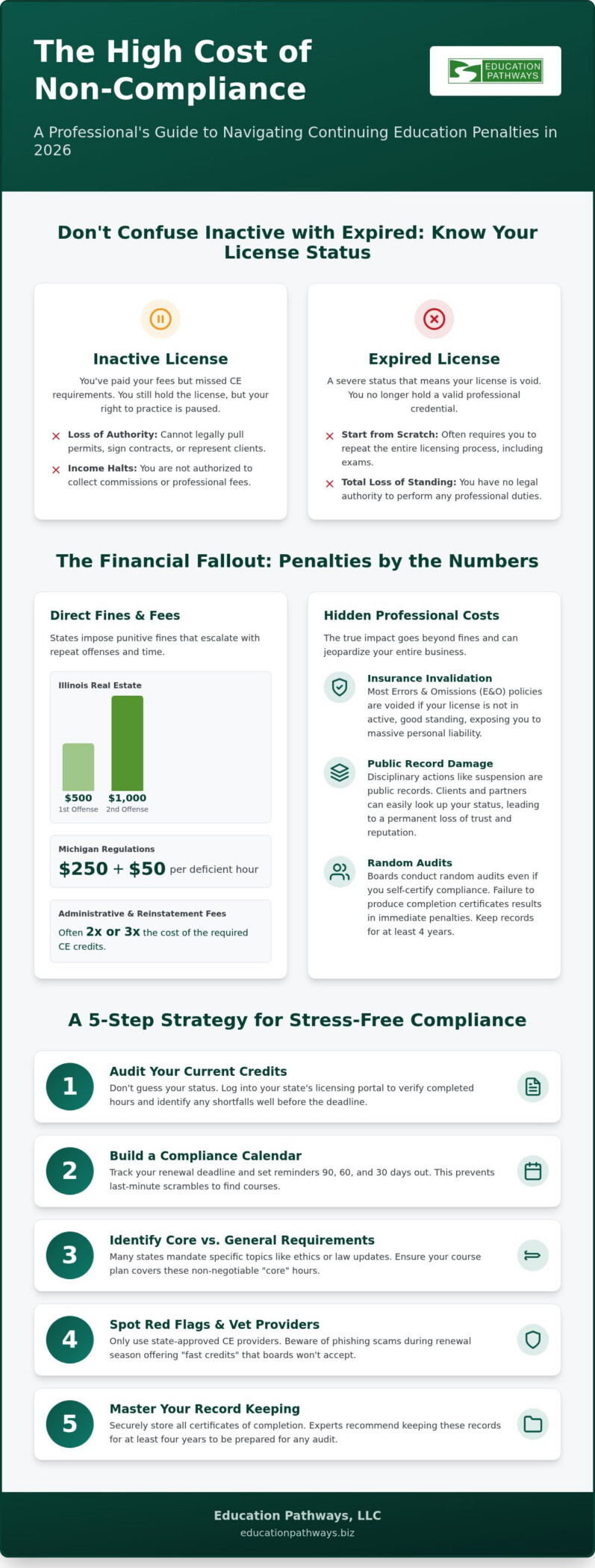
Missing a renewal deadline isn’t just a clerical error; it’s a legal event that changes your professional status instantly. Most state boards distinguish between a license being “Inactive” and “Expired.” An inactive license generally means you’ve paid your fees but failed to meet educational requirements. You still hold the license, but you can’t legally use it. Expiration is more severe, often requiring you to start the licensing process from scratch. Understanding What is Continuing Education? and its legal weight is the first step in protecting your career.
The moment your license status shifts to inactive, you lose the legal authority to perform your job. For builders, this means you can’t pull new permits or sign legally binding construction contracts. For real estate agents, it means you aren’t authorized to represent clients or collect commissions. Failing to meet the Texas real estate CE requirements or similar state mandates can halt your income overnight. Courts often view contracts signed by inactive professionals as void or unenforceable.
State boards now use sophisticated, automated databases to track compliance in real time. Systems like the DBPR in Florida or the NMLS for mortgage loan originators receive data directly from approved providers. If the system doesn’t see your credits by the deadline, it automatically flags your file. These automated triggers often initiate penalties for not completing continuing education before a human ever reviews your account. There is a clear line between a first-time oversight and willful non-compliance. An oversight might result in a fine, but repeated failures suggest a disregard for public safety and professional standards.
License Suspension and Revocation Risks
The timeline from a missed deadline to formal suspension is often shorter than professionals realize. Once the “grace period” ends, the board may move to suspend your right to practice. If you continue to work while suspended, you’re committing a serious regulatory violation. This can lead to permanent license revocation. Remember that disciplinary records are public. Anyone can look up your name and see a “Suspended” or “Disciplined” tag, which can permanently damage your professional reputation with clients and partners.
Regulatory Audits: What to Expect
Even if you “self-certify” that you’ve completed your hours during renewal, you aren’t in the clear. Boards conduct random audits to catch professionals who haven’t actually finished their credits. If you’re audited, the burden of proof is entirely on you. You must produce certificates of completion for every claimed hour. Most experts recommend keeping these records for at least four years to satisfy audit requests. The audit period for professional licenses is the designated timeframe during which a regulatory board reviews a professional’s records to verify compliance with mandatory education requirements.
Financial and Professional Penalties You Can Avoid
The financial fallout from a missed deadline extends far beyond a simple late fee. When you face penalties for not completing continuing education, you’re dealing with a multi-tiered cost structure that can drain your business capital. Direct fines are the most visible hit, but the secondary professional consequences often carry a much higher price tag. Understanding the total math behind non-compliance is the best way to prioritize your renewal cycle.
Direct fines vary significantly by state and profession, often scaling based on the severity of the oversight. In Illinois, a first-time real estate citation costs $500, while a second offense jumps to $1,000. Michigan regulations establish a base fine of $250 plus an additional $50 for every deficient credit hour. These legal and financial penalties demonstrate that state boards prioritize enforcement to ensure public safety. Paying for a course is always more affordable than paying a state-mandated penalty.
Direct Fines and Administrative Fees
Administrative fees are designed to be punitive. Boards calculate these charges based on how long your license has been delinquent. For example, during a Florida CAM license renewal, failing to meet the deadline doesn’t just result in a fine; it triggers a status change that requires expensive reinstatement fees. In some jurisdictions, late fees are double or triple the price of the actual CE credits. You aren’t just paying for the education; you’re paying a premium for your own delay.
Professional Liability and Legal Exposure
The “hidden” costs are often the most devastating. Most professional liability and Errors and Omissions (E&O) insurance policies require you to maintain a valid, active license. If you’re practicing with an inactive status due to missing credits, your carrier may void your coverage entirely. This leaves you personally liable for legal fees and settlements in the event of a lawsuit. Claiming you didn’t know the deadline is never a valid legal defense in court. Judges and regulatory boards expect licensed professionals to track their own compliance requirements without reminders.
Beyond insurance, non-compliance can disqualify you from government bidding or large corporate contracts. Most high-level projects require proof of active licensure for all key personnel. A single missing certificate can lead to a breach of contract or the loss of a lucrative partnership. To protect your bottom line, consider using state-approved online courses that offer automated reporting to eliminate the risk of manual filing errors.
How to Properly Track Your State CE Requirements
Managing license requirements across different states feels like a full-time job. Each board has its own set of rules, deadlines, and reporting methods. Avoiding the financial penalties for not completing continuing education requires a proactive strategy rather than a reactive scramble. Establishing a dedicated compliance calendar is the most effective way to stay ahead of these moving targets. This calendar should map out your specific license type and account for the different categories of credit hours you must earn.
State boards generally divide requirements into “Core” and “General” hours. Core hours cover mandatory topics like safety, ethics, and state-specific laws. General hours allow you more flexibility to choose subjects relevant to your trade. If you miss even one core hour, the state may reject your entire renewal application. The consequences of non-compliance often stem from a simple misunderstanding of these ratios. You should regularly log into state portals, such as the Florida DBPR or Texas TREC, to verify your current status and see exactly which credits the board has on file.
Understanding Your Renewal Cycle
License cycles vary by profession. Some states use an annual renewal, while many others use a biennial (two-year) cycle. Knowing your specific expiration date is vital because many boards don’t offer a grace period. Aim to enter the “Safe Zone” by finishing your credits at least 60 days before your deadline. This buffer allows for processing time and gives you a chance to fix any reporting errors. Remember that specialized requirements, like impairment in the workplace or medical errors, may only be required every other cycle. Double-check your board’s current 2026 mandates to ensure your course list is complete.
Verifying Credit Reporting Status
There’s a critical difference between receiving an “Instant Certificate” and successful “Board Reporting.” A certificate is your personal proof of completion, but it doesn’t mean the state knows you’re finished. Modern license maintenance relies on automated reporting. When you sign up for Florida contractor CE, you must provide your correct license number. If the number is off by a single digit, the automated system won’t match the credits to your file. If your credits aren’t showing up on the state website within a week, contact your provider immediately. Don’t wait until the week of your deadline to discover a reporting glitch. Staying organized is the only way to avoid penalties for not completing continuing education and keep your professional standing secure.
Protecting Your License from Continuing Education Scams
Deadline anxiety makes busy professionals easy targets for scammers. During peak renewal seasons, fraudulent companies ramp up their efforts to sell invalid credits. If you accidentally use an unapproved provider, you’ll still face penalties for not completing continuing education because the board won’t recognize your hours. Protecting your career starts with recognizing the red flags of a CE scam before you enter your credit card information.
One major warning sign is pricing that seems too good to be true. Developing high-quality, state-mandated content and maintaining automated reporting systems requires significant resources. If a course is priced far below the industry average, it’s likely a “credit mill.” These unauthorized sites sell worthless certificates that provide no legal standing. You should also watch for phishing attempts. Scammers often send fake “Deadline Expiring” emails or texts that mimic official board communications. These messages aim to steal your personal data or direct you to unsecure payment portals.
Identifying State-Approved Providers
Always verify a provider’s official credentials before enrolling. Every legitimate education company must have a state-issued provider number, such as those from the DBPR or NMLS. Don’t assume that a provider with “national approval” is valid for your specific state requirements. Licensing rules are state-specific, and a course that works in one region may be rejected in another. Longevity is another key indicator of reliability. A provider with over 20 years of experience understands the nuances of board reporting and is less likely to have their approval revoked.
Safe Online Enrollment Practices
Secure payment gateways are essential for protecting your financial data. Look for the padlock icon in your browser address bar and verify the site’s privacy policy. Be wary of any provider that promises a “No Exam” experience if your state board specifically requires an end-of-course assessment. To cross-reference a provider on a state portal, navigate to the official board website and use their search tool to look up the company’s name or provider license number. This simple step ensures your time and money aren’t wasted on invalid education. For a secure and reliable experience, enroll in state-approved Texas real estate CE classes that guarantee official reporting.
A 5-Step Strategy for Stress-Free CE Compliance
You don’t have to wait until the final week of your renewal cycle to secure your professional future. Following a structured plan eliminates the risk of facing penalties for not completing continuing education. It’s about moving from a state of deadline anxiety to a clear, methodical execution path. Use this five-step strategy to handle your 2026 requirements with total confidence.
Step 1: Audit your current status. Log in to your official state portal to see exactly which credits are already on file. Step 2: Calculate your gap. Identify the specific hours needed in mandatory categories like ethics, laws, or safety. Step 3: Select an all-in-one package. Choosing a bundled course ensures you meet every board requirement without the risk of missing a niche topic. Step 4: Complete self-paced modules. Use your low-stress hours, such as evenings or weekends, to progress through the material at your own speed. Step 5: Final verification. After completion, log back into the portal to verify the reporting of your Texas real estate license renewal credits or your specific state’s equivalent.
Choosing the Right CE Package
Efficiency is key for busy professionals. Bundled “Full Requirement” packages are superior to individual classes because they are pre-vetted to satisfy state mandates. This eliminates the manual work of matching courses to categories. Look for providers that offer instant certificate access. This allows you to have immediate physical proof of completion while the automated reporting system updates the board’s database. Ensure the course format is 100% online if you prefer a self-paced environment over fixed-schedule live sessions. Many also use this flexibility to pursue vocational skills, such as an online copywriting course UK, to enhance their professional communication. Always confirm the package is specifically approved for your license type in 2026.
Your responsibility doesn’t end the moment you finish a course. Create a digital filing system to store your certificates of completion. Most state boards suggest keeping these records for at least four years in case of a random audit. Digital storage is safer than physical paper, as it’s easier to retrieve during a regulatory request. Once you’ve secured your 2026 compliance, set a calendar reminder for your next renewal cycle immediately. This proactive approach ensures you never face penalties for not completing continuing education in the future. Ready to avoid the stress? Enroll in your state-approved courses today and gain total peace of mind.
Secure Your Professional Standing for 2026
Your professional license is your most valuable asset. As we’ve explored, the risks of non-compliance go far beyond a simple fine; they include immediate license inactivity, the loss of insurance coverage, and damage to your reputation that can take years to repair. Avoiding the steep penalties for not completing continuing education isn’t just about following rules. It’s about protecting your ability to provide for your family and grow your business. By using a verified tracking strategy and choosing approved providers, you eliminate the stress of the renewal cycle.
Education Pathways, LLC has been a trusted partner for licensed professionals since 2002. Our 100% online, self-paced courses allow you to fulfill your requirements without disrupting your busy schedule. We provide instant certificates and automated board reporting to ensure your credits are filed correctly and on time. Don’t leave your compliance to chance or wait until the final deadline scramble. Secure your professional future with state-approved online CE courses and enjoy the peace of mind that comes with a protected license. You’ve worked hard for your credentials; let’s keep them active and secure.
Frequently Asked Questions
Can I get an extension on my continuing education deadline?
Extensions are rarely granted and usually require documented proof of extreme hardship like a medical emergency or military deployment. Most state boards maintain strict deadlines with no automatic grace periods for professional renewals. If you don’t have a formal, pre-approved extension from your specific board, you’ll be subject to standard late fees. It’s always safer to complete your hours early rather than relying on a petition that the board might deny at the last minute.
What happens if I complete the wrong type of CE credits?
If you complete the wrong credits, your renewal application will be flagged as deficient during the board’s review process. This mismatch often occurs when professionals take general electives instead of mandatory “Core” topics like ethics or safety. You’ll likely face penalties for not completing continuing education because your license status will shift to inactive until the specific missing modules are finished and reported to the state database.
How much are the typical fines for late CE completion in 2026?
Financial penalties vary by state but follow a punitive structure to encourage compliance. Illinois real estate professionals currently face a $500 fine for a first-time oversight, while Michigan assesses a $250 base fee plus $50 for every missing credit hour. These costs are often triple the price of a standard education package. Failing to meet deadlines also triggers administrative fees that increase the longer your license remains in a delinquent or inactive state.
Do I have to retake my licensing exam if I miss the CE deadline?
Retaking the exam is generally not required for a standard late renewal. However, if your license remains inactive or expired for an extended period, typically two years or more, the board may declare it “Null and Void.” At that point, most jurisdictions require you to start the initial licensing process over. This includes paying all original application fees and passing the state licensing exam again to regain your legal authority to practice in your field.
How long does it take for my credits to show up on the state board website?
Reporting times depend on your education provider’s technology and reporting schedule. Education Pathways, LLC uses automated reporting to update state databases like the DBPR or NMLS within 24 to 48 hours of course completion. Some providers still use manual filing, which can take up to 30 days to reflect on your official record. Always choose a provider that offers instant certificates so you have immediate proof of completion while the state’s system updates.
Is online continuing education as valid as in-person classes?
Online continuing education is fully valid as long as the provider holds current state approval. Boards recognize that 100% online, self-paced learning is often more efficient for busy professionals than traditional classroom settings. In 2026, online courses are the primary method for license renewal across most industries. They provide the same legal credit as in-person classes while offering the convenience of automated reporting and instant digital certificates that you can store for audit protection. This digital-first model is also seen in specialized training sectors; for example, MyFiladelfia provides specialized online coursework in biblical counselling for those in the ministry and helping professions.
Inactive status means your license is technically current in the system, but you’re legally prohibited from performing work or signing contracts. This usually happens when you pay renewal fees but fail to finish your education by the deadline. To fix this, you must complete the missing credits and pay any associated penalties for not completing continuing education. Once the board verifies your compliance, you’ll need to file a reactivation form to move your license back to an active status.
Can I carry over extra CE credits to the next renewal cycle?
Most state boards don’t allow you to carry over extra credits to a future renewal cycle. Education requirements are designed to ensure your professional knowledge stays current with biennial law and safety changes. If you take 30 hours when only 14 are required, those extra 16 hours typically won’t count toward your next renewal. Always check your specific board’s administrative code, but plan on fulfilling a fresh set of requirements every cycle to maintain your standing.