
How to Meet Tennessee Contractor License Renewal Requirements in 2026

Starting July 1, 2026, the rules for keeping your professional standing in the Volunteer State are undergoing their most significant shift in years. Between the transition to Prov as the new exam provider and the introduction of surety bond alternatives, the Tennessee contractor license renewal requirements have become more complex than ever. You can’t afford to let a missed 30-day window or a technical glitch in the CORE portal halt your operations. It’s time to trade the confusion for a clear plan of action.
We know that managing financial statements and tracking CE credits feels like a full-time job on top of your actual projects. You want a process that’s fast, compliant, and predictable. This guide provides a complete roadmap to navigating the 2026 updates, from securing your financial documentation to submitting your application with ease. We’ll break down the mandatory CE hours, explain the new bond options, and show you exactly how to secure your renewal without the stress of late fees or rejected filings.
Key Takeaways
- Identify your specific biennial deadline and learn how to use the 90-day renewal window to stay ahead of expiration dates.
- Simplify the Tennessee contractor license renewal requirements for residential classifications by finishing your mandatory 8-hour CE credits through a 100% online platform.
- Determine whether your monetary limit requires self-prepared or CPA-compiled financial statements to ensure your documentation meets Board standards.
- Follow a direct, step-by-step process for scanning and uploading your credentials to the Tennessee CORE portal for faster approval.
- Use mobile-friendly courses with instant certificates to complete your professional obligations without disrupting your busy schedule on the job site.
Understanding the Tennessee Contractor License Renewal Cycle
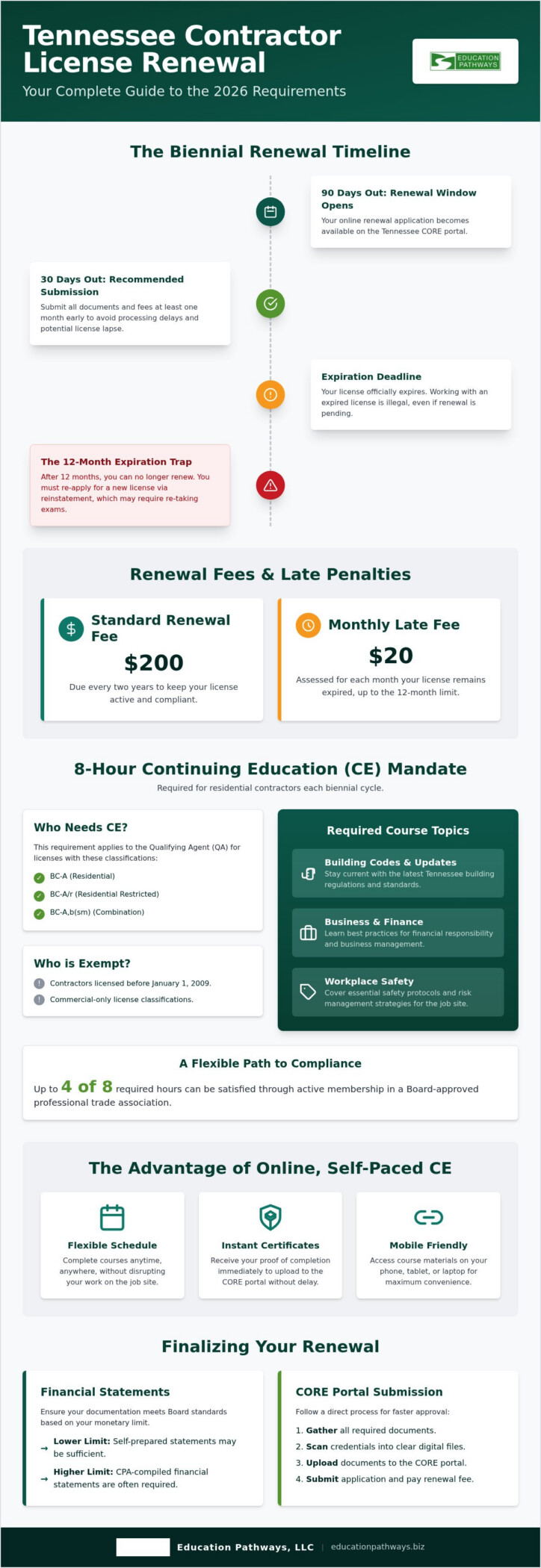
Tennessee contractor licenses follow a strict biennial schedule. Your renewal date is tied to the last day of the month your license was first issued. The Tennessee Board for Licensing Contractors (TBLC) opens your online renewal window 90 days before this date. Waiting until the last minute is a common mistake. You should aim to submit everything at least 30 days before expiration. This buffer accounts for administrative processing times and ensures your status remains active on the CORE portal. Working with an expired license is illegal, even if your application is pending. Meeting the Tennessee contractor license renewal requirements early protects your business from unnecessary downtime.
The 12-Month Expiration Trap
If you miss your deadline, you enter a grace period. This period lasts exactly 12 months. Once that year passes, your license is no longer eligible for a simple renewal. You fall into the reinstatement category. Reinstatement is essentially starting your career over from a regulatory standpoint. You may have to retake trade exams and resubmit all initial application documents. This is a common structure for Professional licensure in the United States to ensure ongoing competency. Losing your license this way halts your ability to pull permits or sign new contracts. It’s a massive business risk that is easily avoided with proper planning.
Renewal Fees and Late Penalties for 2026
Staying compliant requires a standard renewal fee of $200 every two years. If you miss the expiration date, the Board assesses a late fee of $20 for every month the license remains expired. These penalties stack up quickly until you hit the 12-month limit. Navigating the Tennessee contractor license renewal requirements involves more than just paying the fee. It requires timing your submission to avoid these extra costs. For contractors who are stepping away from active projects but want to keep their credentials, a retired status is an option. This keeps your records on file without the full cost or documentation of an active renewal.
Meeting the 2026 Tennessee Continuing Education (CE) Requirements
Residential contractors in Tennessee must complete 8 hours of Board-approved continuing education during every biennial renewal cycle to maintain an active license in 2026. This mandate applies to those with BC-A (Residential), BC-A/r (Residential Restricted), and BC-A,b(sm) combination classifications. The Board requires these hours to focus on essential industry standards. You will explore topics that directly impact your daily operations and professional liability. These include:
- Workplace safety protocols and risk management.
- Business management and financial responsibility.
- Current Tennessee building codes and regulatory updates.
Meeting these Tennessee contractor license renewal requirements ensures you remain competitive and compliant in an evolving regulatory environment.
Who Needs CE and Who is Exempt?
Not every license holder faces the same education demands. If you were licensed before January 1, 2009, you are currently exempt from the 8-hour CE requirement. Commercial-only classifications also do not have to meet this specific residential mandate. You should verify your specific classification by checking your current license pocket card. According to the Home Builders Association, only one Qualifying Agent (QA) per license must complete the 8-hour cycle. This rule allows firms with multiple agents to streamline their compliance efforts. Additionally, you can satisfy up to 4 of your 8 required hours through active membership in a Board-approved professional trade association.
The Benefits of Online, Self-Paced CE
Traditional classroom training often leads to lost wages and high travel costs. Digital course modules offer a more efficient alternative. You can complete your training from a job site, your home office, or even between meetings. This self-paced approach respects your schedule and allows you to learn at your own speed. Safety is a priority. Business management is essential. Building codes are non-negotiable. One of the most significant advantages of digital training is the delivery of instant certificates. You don’t have to wait for paper mail to arrive before you can finish your filing. Having your proof of completion immediately allows you to upload it to the CORE portal without a second thought. For a full breakdown of approved courses, visit our Tennessee contractor continuing education guide. Choosing a 100% online provider makes it easy to satisfy the Tennessee contractor license renewal requirements while keeping your projects moving forward. If you are ready to secure your status, our Tennessee Contractor License Renewal Courses provide the fastest path to compliance.
Preparing Your Financial and Legal Documentation
Financial responsibility is a core component of the Tennessee contractor license renewal requirements. The Tennessee Board for Licensing Contractors uses your financial documentation to determine your monetary limit for the next two years. If your requested limit is $1.5 million or less, you must submit a compiled financial statement prepared by a CPA. For limits exceeding $1.5 million, the Board requires a more rigorous reviewed or audited statement. You must ensure these documents are current and reflect your actual business standing at the time of filing. Accuracy is vital because the Board uses these figures to protect the public and ensure project stability.
Legal standing is equally important for a successful renewal. If you operate as an LLC or a Corporation, your business must remain in “Active” status with the Tennessee Secretary of State. The Board verifies this status during the renewal process. A revoked or inactive status will result in an immediate rejection of your application. It’s smart to check your status early. Resolving issues with annual reports or state fees before you begin the CORE submission prevents unnecessary delays.
New for 2026: The Contractors’ Surety Bond Option
A significant update takes effect on July 1, 2026. Contractors now have the option to use a surety bond as an alternative to CPA-reviewed or CPA-audited financial statements. This bond must be for at least 50% of your requested monetary limit. It is an excellent choice for mid-sized firms that want to bypass the high costs and time associated with full CPA audits. This flexibility allows you to meet the Tennessee contractor license renewal requirements without the heavy administrative burden of traditional financial reporting. It’s a faster, more accessible path for many growing businesses.
Insurance and Workers Comp Verification
You must provide current proof of General Liability and Workers’ Compensation insurance. Your Certificate of Insurance (COI) must specifically list the Tennessee Board for Licensing Contractors as the certificate holder. If you are a sole proprietor or meet specific criteria, you might be eligible for a Workers’ Comp exemption. You must register this exemption through the Secretary of State’s Workers’ Compensation Exemption Registry. Expired policies are one of the most common reasons for renewal delays. Verify that your coverage extends through your entire renewal window to avoid a “pending” status on your license.
Step-by-Step Guide to Renewing via the CORE System
The Tennessee CORE portal is the only way to finalize your renewal. This Comprehensive Online Regulatory & Enforcement system handles everything from document uploads to fee payments. Navigating this interface requires organization. You must have your digital files ready before you start the session. Meeting the Tennessee contractor license renewal requirements through CORE is straightforward if you follow a methodical sequence. Don’t wait until the final 48 hours to log in. System maintenance or heavy traffic can cause unexpected delays.
CORE Account Setup and Navigation
To begin, you must link your existing contractor license to your CORE user ID. If you are a new user, create an account using a permanent business email. The Board sends critical renewal notices and legal updates to the email on file. If you are already registered, select “Manage My Profile” to verify your contact information. Many contractors face login issues because of outdated browser settings or forgotten security questions. Clear your cache or use a private browsing window if the site fails to load correctly. Once logged in, look for the “Renew License” option next to your active license number.
The Online Upload Process
The CORE system is strict about file formats. It’s best to use PDF files for financial statements and JPEG or PDF for insurance certificates. Each document must be clear and legible. If the Board can’t read your scan, they will reject the application. This is where having instant digital certificates is a major advantage. You don’t need to scan paper copies. You simply download your proof of completion and upload it directly. It’s a faster way to ensure accuracy.
Before you hit submit, check the “Required Documentation” section on your dashboard. Every field must show a green status indicator. This confirms the system has recognized your attachments. If a field remains red, the “Submit” button will stay inactive. Double-check that your General Liability and Workers’ Comp certificates are properly attached. Once everything is green, proceed to the payment screen. You can pay the $200 renewal fee using a credit card or electronic check. After payment, you’ll receive a confirmation number. Use the “Track My Application” feature to monitor the Board’s progress. If you need to finish your hours today, start your Tennessee Contractor License Renewal Courses now for instant certificate delivery.
Why Education Pathways is the Professional Choice for TN Renewal
Selecting the right provider is the final step in mastering the Tennessee contractor license renewal requirements. Since 2002, Education Pathways has served as a primary resource for professionals seeking reliable, state-approved education. We understand that your time is your most valuable asset. Our platform is 100% online and built for the modern contractor. You can access your coursework from a smartphone at the job site or a tablet at home. This flexibility eliminates the need for travel and the loss of billable hours.
We’ve updated all materials to reflect the 2026 standards. This ensures you aren’t just checking a box, but gaining relevant industry knowledge. Our system generates instant certificates the moment you finish. This feature is critical for those approaching the 30-day Board submission window. You don’t have to worry about administrative delays or mailing times. You get your proof of completion immediately, allowing you to finalize your CORE application today.
The Education Pathways Advantage
Our system is designed for zero downtime. You can start a module during a lunch break and pick up exactly where you left off later that evening. This self-paced structure fits into the unpredictable schedule of a construction professional. We also believe in transparency. There are no hidden fees or surprise charges for your certificate. A one-time enrollment covers all content, assessments, and your official proof of completion. It’s a straightforward solution that has earned the trust of thousands of licensed individuals across the United States.
Streamlining Your Compliance Workflow
Efficiency is the key to meeting the Tennessee contractor license renewal requirements without stress. We help you bundle your CE requirements into a single, cohesive workflow. This organization makes it easy to track your progress and stay ahead of biennial deadlines. Your certificates remain accessible in your account long after you finish. If you ever face a state audit or need to verify your credentials for a new project, your records are only a few clicks away. Don’t let your license status fall into the expiration trap. Ready to renew? Enroll in your Tennessee Contractor CE courses today and secure your business for the next two years.
Secure Your Professional Standing for 2026
Navigating the 2026 updates doesn’t have to be a burden on your business. You now have the tools to manage your renewal cycle, from leveraging the new surety bond options to submitting documents through the CORE portal. Remember that the 30-day window is your safety net against administrative delays. By organizing your financial statements and completing your 8-hour CE mandate early, you protect your active status and your ability to pull permits. Staying ahead of the Tennessee contractor license renewal requirements is the best way to ensure your projects continue without interruption.
Education Pathways makes this process simple. We’ve been a state-approved provider since 2002, helping thousands of professionals maintain compliance with zero classroom time. Our platform delivers instant certificates, so you can upload your proof of completion to the Board immediately. Don’t let a looming deadline create unnecessary stress. Fulfill your Tennessee CE requirements with our 100% online courses today. You’ve built a strong reputation in the field. We’re here to help you keep it.
Frequently Asked Questions
How many hours of continuing education do Tennessee contractors need in 2026?
Residential contractors with BC-A or BC-A/r classifications must complete 8 hours of Board-approved continuing education every biennial cycle. This requirement applies to those licensed after January 1, 2009. Only one Qualifying Agent per license needs to finish the hours. You can satisfy up to 4 hours through active membership in an approved trade association. Staying current with these hours is a vital part of the Tennessee contractor license renewal requirements.
Can I renew my Tennessee contractor license if it has already expired?
Yes, you can renew an expired license for up to 12 months after the expiration date. You will be assessed a late fee of $20 for every month it remains expired. However, you cannot legally perform any contracting work while the license is in an expired status. If you fail to renew within that one-year window, you must apply for reinstatement, which often involves retaking trade exams.
What is the new 2026 surety bond option for Tennessee contractors?
Starting July 1, 2026, contractors can use a surety bond as an alternative to submitting CPA-reviewed or CPA-audited financial statements. The bond must be for at least 50% of your requested monetary limit. This update provides significant flexibility for firms that want to avoid the high costs of traditional audits. It simplifies the financial documentation process while still proving your business has the stability required by the state board.
How do I upload my CE certificate to the Tennessee CORE portal?
Log in to your account on the Tennessee CORE portal and select the “Renew License” option. You will see a section for “Required Documentation” where you can upload digital files. Ensure your certificate is in a PDF or JPEG format. If you use a provider like Education Pathways, you receive an instant digital certificate that is ready for immediate upload. This eliminates the need for scanning paper copies and speeds up your approval.
What financial statements are required for a TN contractor license renewal?
The type of statement depends on your monetary limit. If your limit is $1.5 million or less, you need a compiled financial statement from a CPA. Limits exceeding $1.5 million require a reviewed or audited statement. Effective July 1, 2026, you may also opt for a surety bond to meet these financial obligations. These documents prove your net worth and working capital meet the standards for your license classification.
Is there a grace period for Tennessee contractor license renewals?
Tennessee provides a 12-month late renewal period, but it is not a “grace period” in the traditional sense. While you can still renew during this time by paying a $20 monthly penalty, your license is technically expired. You are prohibited from bidding on or performing work until the Board processes your renewal. To avoid these gaps and late fees, you should submit all materials through the CORE portal at least 30 days before expiration.
Are online CE courses approved for Tennessee contractor license renewal?
Yes, the Board accepts online courses as long as they are provided by an approved sponsor. Education Pathways has been an approved provider since 2002, offering 100% online, self-paced courses. These digital modules allow you to meet the Tennessee contractor license renewal requirements without attending in-person classes. You can complete the training on your own schedule and receive an instant certificate of completion to satisfy the state’s residential education mandate.
How much does it cost to renew a contractor license in Tennessee?
The standard renewal fee for an active two-year license is $200. If you submit your application after the expiration date, you must also pay a late fee of $20 for each month the license was expired. These fees are paid directly through the CORE portal using a credit card or electronic check. Ensuring your payment and documentation are submitted on time prevents these additional monthly penalties from accumulating.