
Tennessee Contractor Continuing Education: The 2026 Compliance Guide

Your hard-earned license is the backbone of your business, yet a single missed deadline can bring your operations to a grinding halt. Most contractors find the state board’s rules more complicated than the actual building codes. You’re likely more interested in finishing your current project than deciphering state statutes or spending a full day in a stuffy classroom. This guide simplifies the entire process. You’ll learn exactly how to handle your Tennessee contractor continuing education without losing hours on the job site or risking a lapse in your credentials.
We’ll break down the specific eight-hour requirement for residential contractors, identify which qualifying agents must take action, and show you the fastest path to a 2026 renewal. From understanding current state statutes to obtaining your instant certificate, you’ll have a clear roadmap to keep your business compliant and your crew working. We understand that your time is your most valuable asset. This guide ensures you spend less of it on paperwork and more of it on the job.
Key Takeaways
- Determine if your license classification, such as BC-A or BC-A/r, requires the mandatory 8-hour Residential Continuing Education (RCE) cycle.
- Streamline your Tennessee contractor continuing education by choosing 100% online, self-paced courses that provide instant certificates for the Board.
- Identify the specific responsibilities of your Qualifying Agent (QA) to ensure your company stays compliant without redundant training hours.
- Master the 2026 renewal timeline to avoid late fees or license suspension by submitting proof of completion well before your expiration date.
- Transition from classroom-based learning to digital platforms to minimize time away from the job site and maximize business productivity.
Understanding the Tennessee Residential Continuing Education (RCE) Requirement
Compliance isn’t just about checking a box. For Tennessee residential contractors, it’s a legal obligation that ensures the integrity of the building industry. Residential Continuing Education, or RCE, refers to the mandatory training hours you must complete to keep your license active. The Tennessee Board for Licensing Contractors uses these requirements to ensure every professional stays current on building codes, safety protocols, and evolving business laws. If you’re managing a crew or bidding on major projects, staying informed is your best defense against liability.
The state’s mandate serves a practical purpose. Construction is a high-stakes industry where regulations change frequently. By requiring ongoing training, the Board protects both the contractor and the homeowner. These hours focus on critical areas like worker safety, contract law, and financial management. Understanding what is a general contractor today means recognizing that legal and administrative knowledge is just as vital as site skills. As you prepare for your 2026 renewal, viewing these hours as a business investment rather than a chore will help you streamline the process.
The 8-Hour Rule: What You Need to Know
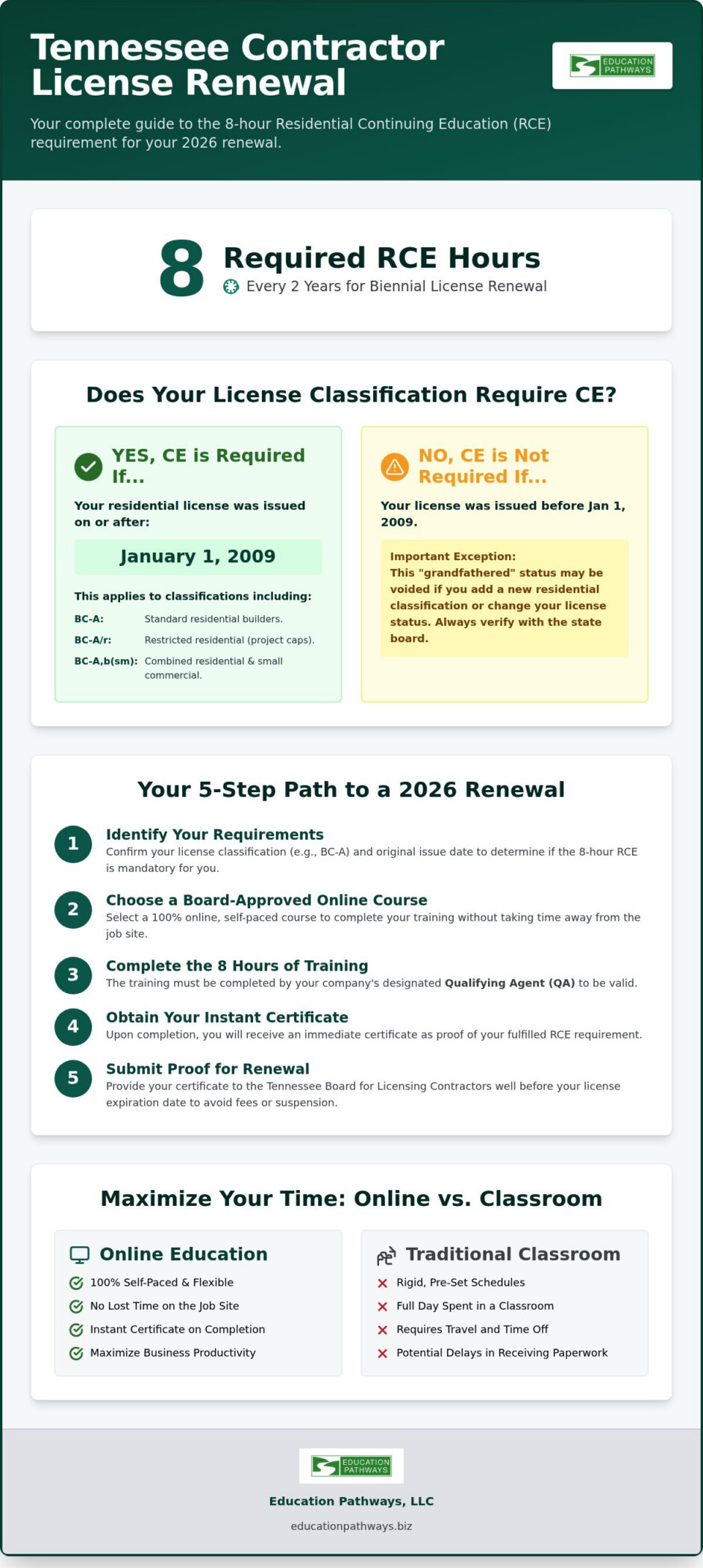
The Tennessee contractor continuing education requirement is straightforward but strict. You must complete eight hours of board-approved instruction every two years. This biennial cycle aligns with your license expiration date, which occurs on the last day of the month your license was originally issued. You can’t roll hours over from one period to the next; each renewal requires a fresh set of credits. Residential Continuing Education (RCE) is defined as the mandatory eight hours of board-approved instruction required for biennial license renewal under Tenn. Code Ann. §62-6-112(g). Failing to meet this deadline can result in fines or a temporary suspension of your right to pull permits.
The 2009 Cut-off Date Explained
Your original licensure date is the most important factor in determining your CE obligations. The Tennessee legislature introduced the RCE requirement to ensure newer contractors entered the market with a commitment to ongoing education. If the Board issued your residential license on or after January 1, 2009, these eight hours are mandatory for every renewal cycle. It’s a permanent part of your professional maintenance.
Contractors who held their licenses prior to January 1, 2009, generally fall under a grandfathering clause. These veterans aren’t required to complete the eight hours of RCE to renew their existing licenses. However, if a grandfathered contractor decides to add a new residential classification or change their license status, they may become subject to the current rules. Always verify your status on the state portal to ensure you don’t accidentally miss a requirement. Staying ahead of these rules ensures your business remains operational throughout 2026 and beyond.
Does Your License Classification Require Continuing Education?
Not every license holder in the state is subject to the same training rules. You must identify your specific classification to avoid completing unnecessary coursework or, conversely, missing a legal deadline. The Tennessee Board for Licensing Contractors maintains a comprehensive public portal where you can verify your exact status. While many commercial-only contractors are exempt, any license that grants residential authority typically carries a training obligation.
BC-A and BC-A/r: The Residential Core
The BC-A classification is the standard for residential builders. It allows you to construct, remodel, or repair any residential structure. If you hold this license and were licensed after 2009, the state considers you a primary target for mandatory hours. The BC-A/r classification is the “restricted” version. It’s designed for contractors focusing on smaller residential projects with specific monetary limits. Despite these project caps, BC-A/r holders must still complete the same 8-hour requirement. These courses focus on residential building codes and safety standards that protect Tennessee homeowners and your business interests.
BC-A,b(sm) and Combined Classifications
Complexity often arises when your business handles both commercial and residential work. The BC-A,b(sm) classification is a “small commercial” license that also covers residential construction projects. Because this classification includes residential authority, the Board requires you to complete your Tennessee contractor continuing education. If your license combines residential (BC-A) with full commercial (BC-B) or industrial (BC-C) classifications, the residential component still triggers the CE mandate. You cannot use your commercial status to bypass the residential training rules.
Managing multiple classifications doesn’t mean you need to double your training. You only need to fulfill the eight-hour requirement once per renewal cycle, regardless of how many residential-related codes appear on your license. If your license is strictly commercial (BC-B) or industrial (BC-C) and doesn’t include any residential authority, you’re currently off the hook for CE. However, most versatile firms find that keeping a residential classification is worth the small time commitment. You can quickly fulfill these requirements through streamlined online courses designed for your specific license type. Contractors licensed before 2009 also remain exempt, provided they don’t add new classifications that require a modern update. Keeping your classification current ensures your bids remain legal and your insurance stays valid throughout 2026.
The Role of the Qualifying Agent (QA) in Meeting CE Standards
The Qualifying Agent (QA) is the anchor of your Tennessee contractor license. This individual is the person who passed the state exam or qualified through years of experience to represent the business entity. While the license belongs to the company, the legal responsibility for education rests on the QA’s shoulders. This system ensures that the technical leadership of the firm stays current with modern building standards and safety protocols. Without a compliant QA, a company cannot legally perform work under its residential classification.
Tennessee law simplifies compliance for larger firms through the “One Agent” rule. Many companies employ multiple QAs to cover various classifications or branches. If your firm has three residential QAs, you don’t need all of them to sit through training. Only one individual is required to complete the eight hours of instruction to satisfy the requirement for the entire licensed entity. It’s a strategic move to select a QA who is likely to remain with the company long-term. This prevents administrative headaches during the biennial renewal process.
What happens if your designated QA leaves the company before your 2026 renewal? This is a high-risk scenario for any business. If the agent who completed the credits resigns, those credits often leave with them. The Board links credits to the individual’s record, not just the company’s file. Your business must ensure a remaining QA completes the hours or that a new QA is registered and compliant before the expiration date. Losing your only compliant QA can bring your permit applications to a sudden halt.
Who Should Take the Course?
Choosing the right person to handle your Tennessee contractor continuing education is a critical business decision. You should select a QA who is actively involved in site management and project oversight. This person will gain the most from the building code updates and can implement safety changes immediately. Many firms follow best practices from the Associated General Contractors of America by treating CE as a professional development opportunity rather than a chore. Keep a digital copy of the completion certificate in your main office. This ensures you can prove compliance even if the QA is off-site when an auditor calls or a permit is pending.
Reporting Credits for the Licensed Entity
The Board for Licensing Contractors tracks credits by the QA’s unique identification number or Social Security number. When your QA completes a course, the provider reports those hours directly to the state. However, the burden of proof remains with the business owner during the renewal application. The Qualifying Agent is the individual designated by the contractor to represent the company’s technical and administrative competence, and they are legally responsible for completing the mandatory Tennessee contractor continuing education on behalf of the licensed entity. Your company’s ability to sign contracts depends entirely on this individual’s verified credits. Always verify that your QA’s name on the course certificate matches the name registered with the Board exactly to avoid processing delays. If your business also manages residential communities in other states, understanding how automatic credit reporting works in those jurisdictions is equally important — professionals overseeing HOA properties in neighboring states should review the Florida CAM license renewal requirements to see how automatic reporting systems compare to Tennessee’s process.
Step-by-Step: Renewing Your Tennessee Contractor License in 2026
Waiting until the last minute to renew your license is a recipe for stress and potential downtime. The Tennessee Board for Licensing Contractors recommends filing your renewal application at least 30 days before your expiration date. This buffer allows for processing time and gives you a chance to correct any documentation errors. Your license expires on the last day of the month it was originally issued, every two years. Missing this window doesn’t just mean a late fee; it can halt your ability to pull permits or sign new contracts until the state processes your late filing.
To begin, you’ll use the Tennessee Department of Commerce & Insurance (TDCI) online portal, known as CORE. Most of the process is digital. You’ll need to navigate to the “Other-Disclosures and Additional Info” section. This specific area is where you upload your proof of Tennessee contractor continuing education. Once you’ve uploaded all required files and paid the renewal fee, always wait for a confirmation email. Saving a screenshot of your submission page is a smart way to protect your business if there’s a technical glitch in the state’s system.
Fulfilling the 8-Hour Requirement
Your first step is selecting a Board-approved provider for the 2026 cycle. Not all providers maintain their approval status indefinitely, so verify that your chosen school is current. The course must cover mandatory Tennessee-specific topics, including safety standards, legal updates, and business management. After finishing the eight hours, you’ll receive a digital certificate of completion. Keep this file accessible. While providers often report hours to the Board, the state still requires you to upload the certificate during the CORE renewal process to ensure no credits are missed.
Beyond CE: The Renewal Checklist
Renewal involves more than just your education credits. You must have several other documents ready to upload to avoid a “deficient” status on your application. Use this checklist to stay organized:
- Updated Financial Statement: Ensure it’s signed and matches the monetary limit of your license.
- Certificates of Insurance: Provide current proof of general liability insurance.
- Workers’ Comp Status: Upload your current policy or your verified exemption registration.
- Corporate Registration: Confirm your business is in “Good Standing” with the Tennessee Secretary of State.
For more details on these specific documents, see our guide on how to complete your Tennessee contractor license renewal in 2026. Handling these tasks simultaneously saves time and ensures a seamless transition into the next licensing period. If you’re ready to clear the biggest hurdle, you can start your state-approved course today and get your certificate in hours, not days.
Why Online Continuing Education is the Efficient Choice for Professionals
Project schedules are often at the mercy of the weather and supply chains. You shouldn’t have to add a rigid classroom schedule to that list of variables. Online learning adapts to your timeline. You can finish your Tennessee contractor continuing education during a long commute or after the crew heads home. This eliminates the need to block off a full business day for a seminar. You stay on the job site where you’re needed most. The same flexibility that benefits contractors also applies to other licensed professionals — those in human services fields can explore social work continuing education online to see how self-paced digital platforms are transforming license renewal across multiple industries in 2026.
The Education Pathways, LLC Advantage
We provide 100% online, state-approved courses specifically built for the Tennessee regulatory environment. Education Pathways, LLC understands the pressure of high-stakes renewals. Our platform is designed for speed and reliability. You can explore our Tennessee contractor CE courses online to see how we simplify the process. Since 2002, we’ve helped thousands of professionals maintain their credentials without the typical administrative friction.
Maximizing Your Time and Credits
Think of these hours as a way to sharpen your competitive edge. Staying current on building codes and business laws makes your firm more reliable. This knowledge also prepares you for future license expansions. Enrolling in your 8-hour package today is the fastest way to secure your 2026 renewal. It’s the most practical step you can take to protect your livelihood. Clear these requirements now so you can focus on your 2026 project pipeline without distraction.
Secure Your 2026 License Renewal Today
Your license represents years of hard work and professional reputation. You now have the essential roadmap to navigate the 2026 renewal cycle with confidence. From identifying your specific classification needs to understanding the legal responsibilities of your Qualifying Agent, you’re prepared to handle the state’s requirements efficiently. Choosing a structured path for your Tennessee contractor continuing education ensures that you remain compliant without sacrificing the productivity of your crew or the timeline of your projects.
Education Pathways, LLC offers 100% state-approved, self-paced training that removes the friction from the renewal process. With our instant digital certificates, you’ll have the verification required for the CORE portal the moment you finish your course. Enroll in Your Tennessee Contractor 8-Hour CE Package Now to protect your business standing. We’re here to help you finish your administrative tasks quickly so you can focus on building Tennessee’s future.
Frequently Asked Questions
Who is required to take Tennessee contractor continuing education in 2026?
Contractors with residential classifications like BC-A or BC-A/r who were licensed on or after January 1, 2009, must complete these hours. If you only hold a commercial license, you’re currently exempt. The state requires one Qualifying Agent per licensed entity to finish the training. This ensures the technical lead of the business stays current with modern building regulations and state safety standards.
How many hours of CE do Tennessee residential contractors need?
You’re required to complete eight hours of Board-approved instruction every two years. This biennial cycle matches your license expiration date. You cannot roll over extra hours to the next period, so focus on finishing exactly what’s needed for the 2026 cycle. These hours are designed to keep you updated on building codes and business practices without overwhelming your schedule.
Can I take my Tennessee contractor CE courses online?
Yes, online courses are a popular and state-approved method for fulfilling your Tennessee contractor continuing education. Online platforms allow you to study at your own pace from any location. This is often the best fit for contractors who need to stay on the job site during the day. You’ll get an instant certificate upon completion to use for your renewal.
What is the deadline to report my CE credits to the Tennessee Board?
The deadline is the same as your license expiration date, which is the last day of the month your license was issued. You should aim to finish your hours at least 30 days before this date. This gives the state time to process your renewal application through the CORE portal. Late submissions can lead to processing delays and temporary license inactivity.
Do I need CE if I have a commercial contractor license in Tennessee?
CE is only required if your license includes a residential classification. If you hold a BC-B (Commercial) or BC-C (Industrial) license with no residential authority, you don’t need these hours. However, if you have a BC-A,b(sm) license, you must complete the training. This classification includes small commercial and residential work, which triggers the mandatory eight-hour requirement.
What happens if I miss the continuing education deadline for my renewal?
Missing the deadline can result in financial penalties or the suspension of your license. You cannot legally pull permits or sign new contracts if your license isn’t active. To avoid this, complete your Tennessee contractor continuing education early. If you do miss the date, you’ll need to submit your credits and pay late fees to restore your standing with the Board.
Does the Board require specific topics to be covered in the 8 hours?
The Board requires the eight hours to cover specific professional topics. These include building codes, safety protocols, and business management laws relevant to the state. Approved providers design their curriculum to meet these exact requirements. This ensures every contractor receives uniform training that protects both their business and the homeowners they serve across Tennessee.
How do I verify if a CE provider is approved by the Tennessee Board?
You can verify a provider’s status by visiting the official Tennessee Board for Licensing Contractors website. They maintain a list of approved education providers. It’s important to check this list because Board approvals are time-sensitive. Some providers may lose their status in 2026. Choosing an established provider ensures your credits are accepted without any administrative issues during your renewal.