
How to Renew an Expired Professional License: A 2026 Reinstatement Guide

An expired professional license is a procedural delay, not a career end. Many practitioners fear that a missed deadline means retaking a grueling state exam or losing years of hard-earned seniority. Fortunately, the path to reinstatement is usually a matter of structured compliance rather than starting over. If you are wondering how to renew an expired professional license in 2026, the process is more streamlined than you might think.
We understand the frustration of staring at a delinquent status and worrying about the income lost during a professional lapse. It’s common to feel overwhelmed by state-specific terminology or new automated reporting mandates. This guide provides the exact steps to reinstate your credentials and fulfill catch-up requirements without unnecessary stress. You’ll learn the difference between grace periods and null and void status, how to use automated clearinghouses like CE Broker, and how to secure the instant certificates needed to prove your compliance. By the end of this article, you’ll have a clear, legal path to get back to work quickly and with total confidence.
Key Takeaways
- Differentiate between inactive and expired statuses to ensure you don’t accidentally engage in unauthorized practice.
- Identify which of the four expiration stages you’re in to determine if you need a standard late renewal or a full board reinstatement.
- Master the “look-back” rule to correctly calculate and fulfill the catch-up CE hours required for your specific renewal cycle.
- Follow a streamlined, step-by-step guide on how to renew an expired professional license while avoiding the need to re-test.
- Use instant completion certificates and automated board reporting to eliminate friction and speed up your legal return to work.
Understanding Your License Status: Expired vs. Inactive
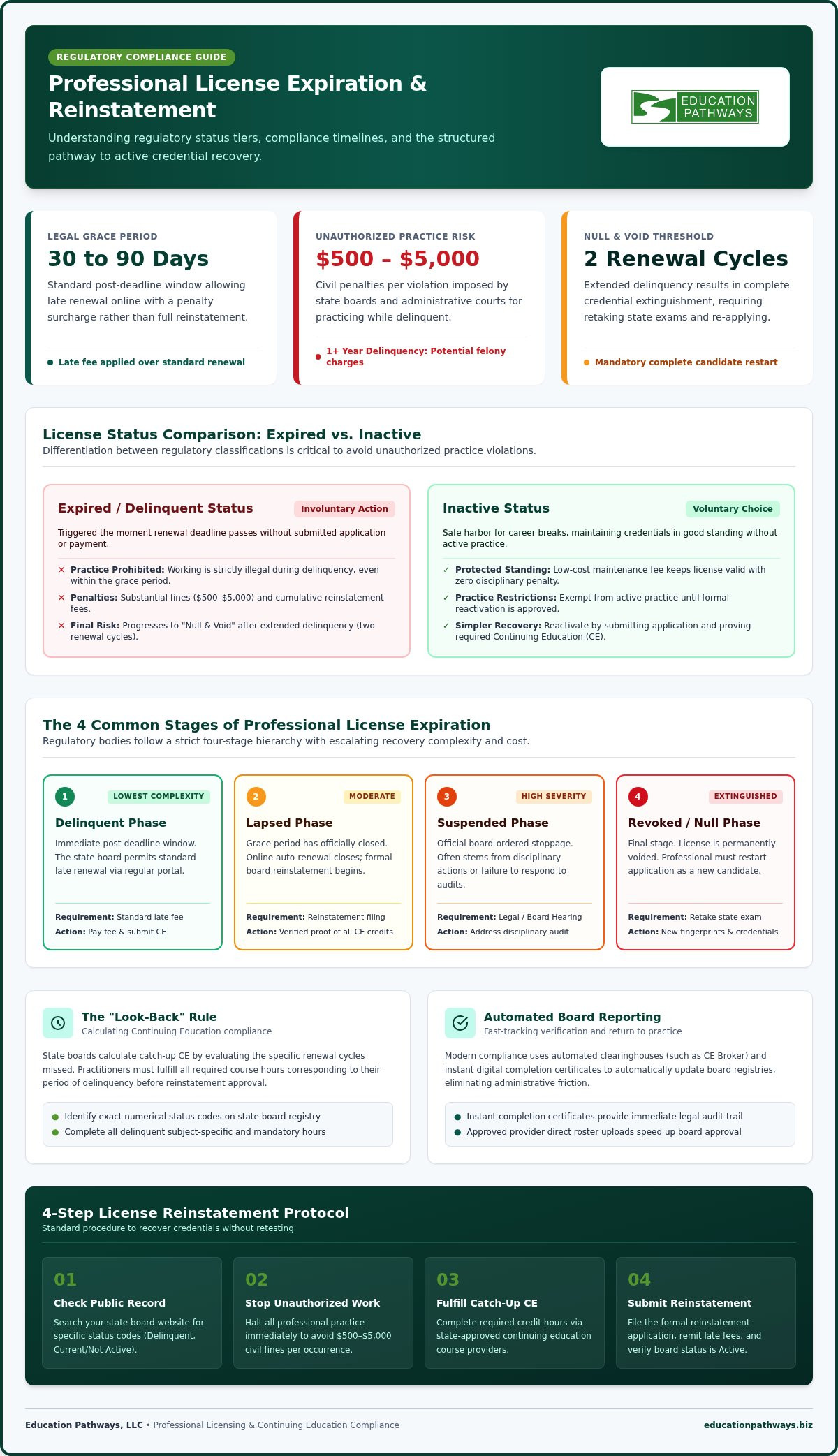
Before you begin the process of how to renew an expired professional license, you must identify your specific standing with the state board. Terms like delinquent, inactive, and expired aren’t interchangeable. They function within a broader occupational licensing regulatory framework designed to ensure public safety and professional accountability. An expired status is typically involuntary. It occurs the moment your renewal deadline passes without a submitted application or fee payment. Conversely, inactive status is usually a voluntary choice made by professionals who want to maintain their credentials while stepping away from active practice.
Working while your license is in an expired or delinquent state carries severe risks. Legally, this is classified as unauthorized practice. State boards and administrative courts often impose civil penalties ranging from $500 to $5,000 per violation. In some jurisdictions, practicing with a license that has been delinquent for more than a year can even lead to felony charges. The most critical status to avoid is “Null and Void.” This happens when a license remains delinquent for an extended period, usually two renewal cycles. Once a license is null and void, it’s extinguished. You’ll likely have to start over as a new applicant, which includes retaking state exams and submitting new fingerprints.
The Legal Grace Period
Most state licensing boards provide a 30 to 90 day grace period immediately following the expiration date. During this window, you can typically complete a late renewal online. You’ll face a late fee, which is a surcharge added to your standard renewal cost, rather than a more expensive reinstatement fee. However, don’t assume you can keep working. In most states, the grace period only applies to the renewal process. Practicing during this time is still illegal until the board officially updates your status to active. Stop all professional work immediately if you haven’t secured a renewal before the grace period ends.
When a License Becomes Inactive
An inactive license is a safe harbor for those taking a career break. You still pay a reduced fee to keep the credential in good standing, but you’re exempt from active practice. Reactivating this status is usually simpler than reinstating an expired one. You’ll need to submit a reactivation application and prove you’ve met specific Continuing Education (CE) requirements. Boards may automatically move a license to inactive if you fail to complete your CE but pay your fees on time. For example, if you’re managing Texas Real Estate CE requirements, failing to log your hours will trigger a status change that prevents you from closing deals until you’re compliant.
The 4 Common Stages of Professional License Expiration
An expired license isn’t a static event; it’s a ticking clock. Understanding the progression of your license status is vital for determining how to renew an expired professional license without losing your credentials permanently. Most regulatory bodies follow a four-stage hierarchy that dictates your path back to active practice. Each stage increases in complexity and cost.
- Stage 1: The Delinquent Phase. This is the immediate post-deadline window. You’ve missed the date, but the board still allows a standard late renewal with a penalty fee.
- Stage 2: The Lapsed Phase. The grace period has closed. Reinstatement now requires a formal application and verified proof of all missed Continuing Education (CE) credits.
- Stage 3: The Suspended Phase. This is a board-ordered stoppage. It often stems from disciplinary issues or a failure to respond to mandatory audits.
- Stage 4: The Revoked or Null Phase. This is the final stage. Your license is extinguished. You must re-apply as a brand-new candidate, which often involves retaking the state exam.
Securing your catch-up credits through a state-approved provider is the fastest way to halt the expiration clock before it moves to the next stage.
Identifying Your Current Stage
Start by visiting your state board’s website. Use their online license search tool to view your public record. Look for status codes like “Current/Not Active” or “Delinquent.” You might find that your board uses specific numerical codes to indicate how long the license has been inactive. Delinquent status is the primary window for easy recovery before the process becomes significantly more complex. If you’re unsure of the requirements for your specific field, reviewing IDFPR license reactivation and reinstatement guidelines provides a high-quality example of how these workflows typically function across different professions.
The Risk of Permanent Forfeiture
Waiting too long turns a simple administrative task into a career crisis. Most states have a strict timeline, often two biennial cycles, before a license becomes null and void. At this point, you face the high cost and effort of retaking state exams and repeating fingerprint background checks. Prompt action saves thousands in potential re-application fees and lost wages. If you are a community manager in Florida, for instance, staying on top of Florida CAM CE classes ensures you never reach the point of permanent forfeiture. Don’t let a minor oversight turn into a complete career reset.
Fulfilling Catch-Up Continuing Education (CE) Requirements
Calculating missed hours is the most complex part of learning how to renew an expired professional license. Boards don’t just require your current cycle’s credits; they often mandate that you fulfill every hour missed during the lapse. This is known as the “Look-Back” rule. You must identify which specific biennial or triennial cycles you missed and complete the curriculum that was active during those dates. For example, Virginia Administrative Code regulations on license reinstatement illustrate how boards review continuing competency credits to ensure a practitioner remains safe to practice after an extended absence.
State-approved online courses are the fastest way to bridge this gap. Choosing a provider that offers automated board reporting is vital. Without it, you’re stuck manually mailing certificates and waiting weeks for a clerk to update your file. When your provider reports directly to the state database, your status can often flip from delinquent to active within 24 to 48 hours of course completion. This speed is essential when you’re trying to minimize lost income from a license lapse.
Online vs. In-Person Catch-Up
Self-paced digital modules offer a flexibility that traditional classrooms can’t match. Busy professionals don’t have time for travel costs or rigid scheduling. You can complete your hours at midnight or during a lunch break. Most importantly, online platforms provide instant certificates of completion. These digital documents serve as your immediate proof of compliance if the board’s automated system experiences a delay. It’s the most efficient way to handle how to renew an expired professional license without disrupting your current daily responsibilities.
Specific Requirements for Key Industries
Different professions have unique “must-have” subjects that change over time. You can’t just take any course; you need board-approved topics that satisfy specific quotas.
- Contractor CE: Reinstatement usually requires a mix of safety, business practices, and workers’ compensation modules. You can find state-approved packages for Florida contractor license renewal that cover these exact bases.
- Real Estate CE: Boards prioritize ethics and legal updates. If you’re managing a Texas real estate license renewal, you’ll need specific TREC-approved hours to regain your active status.
- CAM CE: Community association managers must focus on management and financial reporting. Requirements for Florida CAM license renewal often include specific legal update hours that must be current to the year of reinstatement.
Step-by-Step Guide to Reinstating Your Professional License
Reinstating a credential requires a methodical approach to avoid board rejection. You’ve already identified your expiration stage and calculated your look-back CE hours. Now, you must execute the administrative workflow. This is how to renew an expired professional license without triggering a board audit or causing further delays to your career.
- Step 1: Verify status and fees. Log into your state licensing portal. Confirm the exact delinquency fees owed, as these often increase monthly.
- Step 2: Complete all required CE hours. Finish your catch-up modules. Ensure your provider has electronically reported these to the board database.
- Step 3: Submit the reinstatement application. Complete the formal late-renewal form. Pay the required penalties through the board’s secure payment portal.
- Step 4: Confirm the status update. Monitor the public registry daily. Your status should flip from “Delinquent” to “Active” once the board processes your payment and verifies your CE completion.
Following these steps ensures you remain in legal compliance throughout the transition. If you need to fulfill credits quickly, you can access state-approved online courses here to get your documentation ready for submission.
Preparing Your Documentation
Gather all digital certificates of completion from your education provider. While many boards use automated reporting, having physical or PDF copies is essential for manual audits. If your license has been expired for over a year, check for updated secondary requirements. Some boards now trigger a fresh federal background check or require updated proof of professional liability insurance for long-term lapses. If you had a significant hardship, you might need to draft a brief letter of explanation. Keep this letter professional, concise, and focused on your commitment to future compliance.
The Final Submission Process
Online portals are the gold standard for license reinstatement in 2026. Paper applications are slow, difficult to track, and prone to processing errors. Digital submissions offer real-time tracking and immediate payment confirmation. If your reinstatement is flagged or denied, it’s usually due to a mismatch in CE reporting. Don’t panic. Check your state’s clearinghouse portal to ensure your provider uploaded the correct credit types. If a mismatch exists, contact your provider to rectify the upload. Promptly resolving these flags prevents your application from being moved to a discretionary board review, which can add months to the process.
Streamlining Your Renewal with Education Pathways
Education Pathways specializes in removing the friction from regulatory compliance. If you’re stressed about how to renew an expired professional license, our platform provides a direct, state-approved path to active status. We’ve been operating since 2002; we understand exactly what boards require for a successful reinstatement. Our self-paced online model is specifically designed for busy professionals who need to catch up on missed cycles without attending a physical classroom.
You get instant certificates of completion the moment you finish a course. This is critical for urgent reinstatements where every day of delinquency counts. We also include automated reporting to state boards in our service. This means you don’t have to worry about the manual paperwork that often leads to processing errors. Our catalog stays current with 2026 compliance standards, ensuring your credits are accepted on the first submission. Learning how to renew an expired professional license shouldn’t be a logistical nightmare, and our system ensures it isn’t.
Our Course Catalog for Lapsed Licenses
We offer specialized packages tailored to the most common reinstatement needs. For those in the building trades, our Florida contractor CE hub provides the exact subject matter required to move from delinquent to active. Community managers can access comprehensive Florida CAM CE classes that meet biennial quotas. We also provide NMLS-approved ethics and elective courses for MLOs, along with AIA and PE approved credits for architects and engineers. Every course is 100% online, allowing you to fulfill your look-back requirements on your own schedule.
Get Started on Your Reinstatement Today
Finding the right course bundle for your specific state is simple. Our catalog is organized by profession and state, helping you identify exactly which credits you’ve missed. The peace of mind that comes with automated reporting can’t be overstated; it ensures your board’s database reflects your compliance status without you having to lift a finger. Don’t let your credentials remain in a lapsed state. Browse our state-approved CE courses to start your renewal and get back to work with total confidence.
Secure Your Professional Standing Today
A license lapse is a manageable hurdle, not a permanent career setback. By identifying your specific expiration stage and calculating your look-back hours, you’ve already completed the most difficult part of the process. Acting quickly prevents a delinquent status from turning into a permanent forfeiture. Understanding how to renew an expired professional license is simply a matter of following a structured path and choosing a partner that simplifies the paperwork.
You don’t have to navigate board reporting alone. Our 100% online, self-paced courses are designed to get you back to work without the stress of rigid schedules. We provide instant certificates the moment you finish and include automated state board reporting to ensure your records update fast. You’ve worked hard for your credentials; don’t let a simple administrative delay hold you back any longer.
Restore your professional standing with state-approved online CE courses from Education Pathways. It’s the most efficient way to achieve total legal compliance and focus on your career once again.
Frequently Asked Questions
Can I still work if my professional license is expired but I am in the process of renewing?
You cannot legally practice while your license is in an expired or delinquent status. Practicing during a lapse is classified as unauthorized practice, which carries civil penalties between $500 and $5,000 per violation. In some states, healthcare professionals practicing with a license expired for over 12 months can face felony charges. You must wait until your state board officially updates your status to active on their public registry before returning to work.
How much are the typical late fees for an expired professional license?
Late fees for an expired professional license vary significantly by state and profession. Most boards assess a standard renewal fee plus a late surcharge, which often ranges from a flat penalty to a 50% increase. Some jurisdictions, like the Texas Department of Insurance, charge per-credit fines for unfulfilled hours. It’s best to check your board’s 2026 fee schedule directly, as these administrative costs are separate from your continuing education course fees.
Will I have to retake the state exam if my license has been expired for over a year?
Most professionals don’t need to re-test after just one year of expiration. Boards typically allow reinstatement if you submit the required fees and proof of catch-up CE. However, if your license remains delinquent for more than one biennial cycle, it may become null and void. At that stage, you’ll likely forfeit your original credential and must re-apply as a brand-new candidate, which includes retaking national and state jurisprudence examinations to prove current competency.
How long does it take for the board to update my status after I finish my CE?
The update time depends on your state’s reporting system. If you use a provider that offers automated board reporting, your status can update within 24 to 48 hours. Many boards now mandate centralized electronic tracking through platforms like CE Broker to eliminate the honor system. If your state still uses manual self-attestation, it could take several weeks for a clerk to process your reinstatement application and verify your certificates of completion.
What happens if I completed my CE but forgot to pay the renewal fee?
Your status will remain delinquent or expired until both requirements are met. Completing your continuing education is only half the battle. If you don’t pay the renewal and delinquency fees, the board won’t issue an active credential. You’re still legally prohibited from practicing during this time. To fix this, log into your state portal, pay the outstanding balance, and confirm that your CE provider has successfully uploaded your credits to the board’s database.
Is there a difference between renewing and reinstating a license?
Renewing is the standard process completed before your deadline or during a short grace period. Reinstating is a more rigorous recovery process for licenses that have fully lapsed. When you learn how to renew an expired professional license that has passed the grace period, you’ll find that reinstatement often requires a formal application, higher delinquency fees, and a look-back at multiple cycles of missed continuing education hours to ensure your skills are current.
Can I use CE credits from a different state to renew my expired license?
You can only use credits from a different state if they’re approved by your specific licensing board. Many boards participate in interstate compacts, but they still require courses from providers with specific approval credentials. If you take a course that isn’t accredited by your state’s authority, board auditors will reject it during the reinstatement process. Always verify that your CE provider is state-approved for your specific license type before enrolling in catch-up modules.
What should I do if my license status says “Null and Void”?
You must usually begin the licensure process from scratch. A Null and Void status means your original license is extinguished and cannot be reinstated through simple fee payment. You’ll likely need to submit a new application, pay initial licensing fees, and pass all required state and national exams again. This status also frequently triggers a requirement for a fresh federal background check and fingerprinting, as your previous data is considered void by the state.