
How to Renew an Expired Texas Real Estate License: A 2026 Step-by-Step Guide

Missing your renewal deadline doesn’t mean your real estate career is over, but it does mean the clock is officially ticking. You’ve worked hard to build your business; realizing your license has lapsed is a major source of stress. It’s common to feel overwhelmed by the fear of retaking the state exam or the confusion of calculating how to renew an expired Texas real estate license after the deadline has passed. You aren’t alone in this, and the path to recovery is straightforward if you act within the statutory two-year window.
This 2026 guide provides the exact steps, updated fees, and specific education requirements you need to reactivate your license based on your specific expiration timeline. We’ll confirm whether you need to re-test, explain the 18-hour CE requirements for brokers and agents, and show you how to complete your credits quickly online. We will preview the recovery timeline, clarify the new 2026 Broker Responsibility mandates, and provide a clear map for moving from inactive back to active status without unnecessary complications.
Key Takeaways
- Identify the critical two-year window for reinstatement before your license is lost permanently.
- Learn why your license lapses to inactive status immediately upon expiration and how to avoid penalties for unlicensed activity.
- Master the 2026 education requirements, including the mandatory 18 hours of CE and the new Broker Responsibility course.
- Discover the specific fee structures and step-by-step procedures for how to renew an expired Texas real estate license based on your exact timeline.
- Find out how to use 100% online, self-paced courses to bridge your education gap and get back to work faster.
Understanding the Texas Real Estate License Expiration Timeline
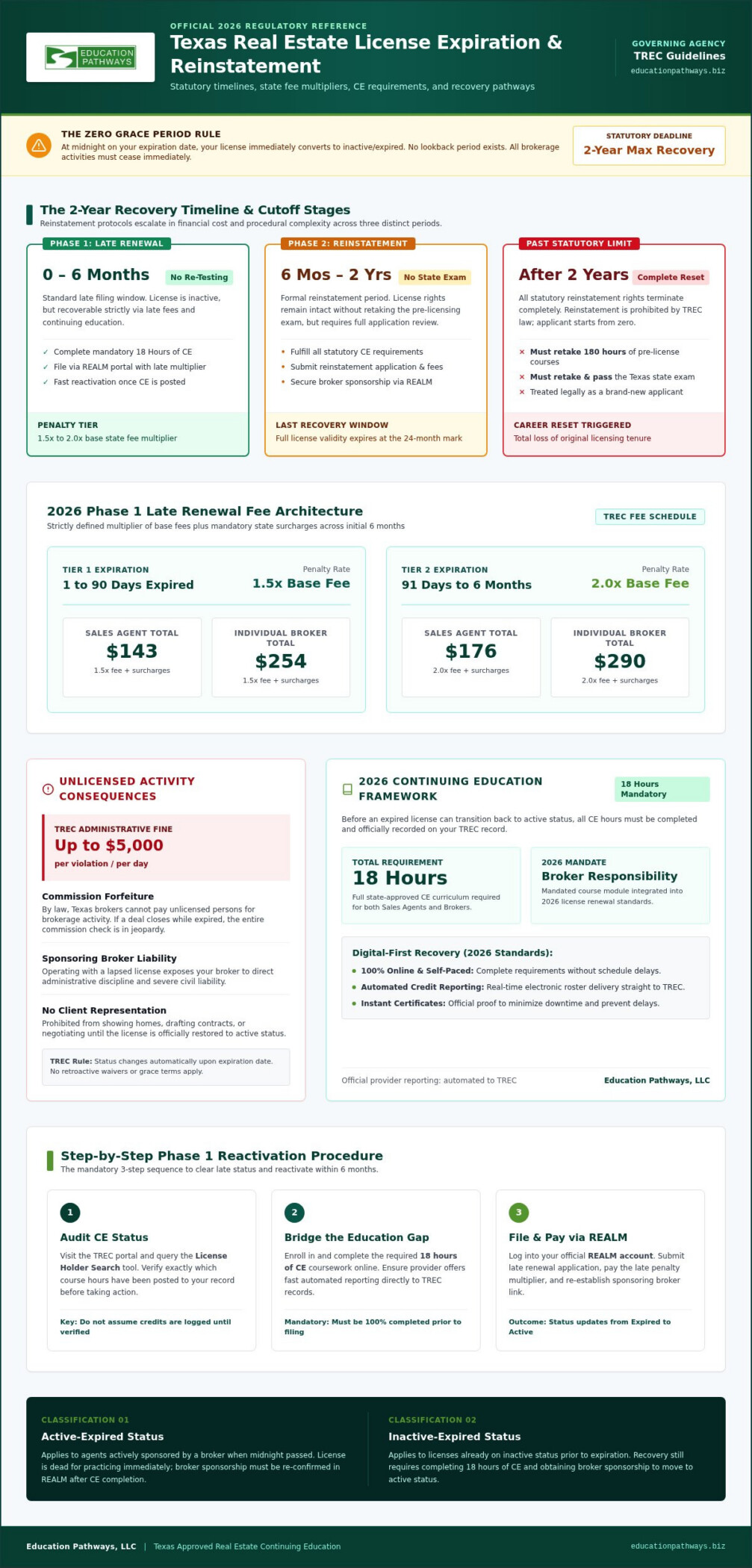
In Texas, your real estate license has a firm expiration date. If you fail to submit your renewal and pay the required fees by midnight on that date, your status immediately shifts to “expired.” According to the Texas Real Estate Commission (TREC), an expired license is no longer valid for any brokerage activity. You cannot represent clients, show properties, or negotiate contracts until you complete the process for how to renew an expired Texas real estate license. This transition happens automatically; there’s no longer a “lookback period” that allows for backdated activity.
There is a critical two-year window for license recovery that protects you from starting your career over. If your license has been expired for less than two years, you can typically reactivate it by fulfilling specific education requirements and paying reinstatement fees. You won’t have to retake the state licensing exam during this period. However, once you cross the two-year mark, your reinstatement rights terminate. At that point, you’re treated as a new applicant. This means you’d have to retake all 180 hours of pre-license qualifying courses and pass the state exam again.
It’s also vital to distinguish between active-expired and inactive-expired status. An active-expired license belongs to someone who was actively sponsored by a broker at the time of expiration. An inactive-expired status applies if you were already on inactive status when the deadline passed. In both cases, the license is legally dead for professional use. To return to “active” status, you’ll need to complete your CE and secure a broker’s sponsorship through the REALM portal.
The Consequences of Practicing with an Expired License
Working with a lapsed license is a serious regulatory violation that carries heavy penalties. TREC can assess administrative fines of up to $5,000 per violation per day. Beyond these fines, you risk losing your hard-earned commissions. Legally, a broker cannot pay an unlicensed person for brokerage services. If a deal closes while your license is expired, that commission check is in jeopardy. Your relationship with your sponsoring broker is also at risk, as they face significant liability for your unlicensed activity.
Why 2026 Regulations Matter for Your Renewal
As we move through 2026, TREC has fully transitioned to digital-first workflows. Speed is now the priority for recovery. To bridge the gap quickly, you need a state-approved provider that offers automated credit reporting. Choosing Texas Real Estate Continuing Education courses that are 100% online allows you to finish your requirements at your own pace. When you complete your CE, the data must move fast so you can transition back to active status. Understanding how to renew an expired Texas real estate license in this digital environment requires selecting partners that prioritize instant certificates and official compliance.
Phase 1: Late Renewal (Expired Less Than 6 Months)
Many agents believe there is a “grace period” for renewal. This is a myth. The moment midnight passes on your expiration date, your license is legally inactive. You cannot practice real estate. While you have six months to complete a late renewal before the process shifts to a more complex reinstatement, financial penalties start on day one. Understanding how to renew an expired Texas real estate license during this first phase is about speed and accuracy to minimize downtime and costs.
Follow these three steps to resolve a Phase 1 expiration:
- Check your CE status. Visit the TREC website and use the “License Holder Search” to see exactly which credits have been recorded. Don’t assume your records are current until you see them on the official portal.
- Bridge the gap. If you are short on hours, enroll in Texas Real Estate Continuing Education immediately. You must complete the full 18-hour requirement before you can move back to active status.
- Submit and pay. Once your CE is posted, log into your REALM account to file the application and pay the late fees.
Calculating Your Late Renewal Fees
The cost of waiting is high. For the first 90 days after expiration, the late renewal fee is 1.5 times the base renewal fee. If you wait between 91 days and six months, that penalty jumps to 2 times the base fee. For a sales agent in 2026, this means paying a total of $143 within the first 90 days or $176 after that point. Individual brokers face higher totals of $254 or $290 depending on the timing. In 2026, the late renewal fee structure is strictly defined as a multiplier of the base fee plus mandatory state surcharges.
Filing Your Application via the REALM Portal
TREC uses the REALM (Real Estate and Appraiser License Management) portal for all digital filings. You should follow the TREC sales agent renewal guidelines to ensure your submission is error-free. One common mistake is trying to pay for a CE deferral; this $200 option is only available for timely renewals, not late ones. Late renewals automatically renew on inactive status. Once you submit your application and pay, reactivation usually happens within 24 to 48 hours, provided your CE is already on file. If you need to get back to work quickly, choosing self-paced online courses ensures your credits are reported without delay.
Phase 2: License Reinstatement (Expired 6 Months to 2 Years)
Once your license has been expired for more than six months, you enter a more rigorous recovery phase. You are no longer performing a “late renewal”; you are now filing for reinstatement. This distinction is governed by Texas Occupations Code Chapter 1101, which dictates stricter requirements for those who have been out of the industry for extended periods. While you still avoid retaking the state exam, provided you act within two years, the paperwork and background scrutiny increase significantly. Understanding how to renew an expired Texas real estate license during this window requires a shift from simple digital clicks to a formal application process.
Reinstatement vs. Late Renewal: Key Differences
The primary difference in how to renew an expired Texas real estate license after six months is the application type and the level of review. Instead of a standard renewal, you must submit the “Reinstatement of Real Estate Sales Agent License or Broker License by Individual” form. This process is more expensive and involves a manual suitability review by TREC staff.
- Fees: Sales agent reinstatement costs $196 total, while brokers pay $298. These fees include the base application plus mandatory Texas Online and Research Center surcharges.
- Fitness Determination: If you’ve had legal issues or criminal convictions since your last renewal, TREC may require a Fitness Determination. This is a formal review to ensure you still meet the state’s standards for honesty and integrity.
- Sponsorship: Your license remains inactive post-approval until a sponsoring broker officially accepts your relationship through the REALM portal.
Fingerprinting and Background Check Procedures
TREC requires fresh digital fingerprints for any license holder whose license has been expired for more than six months. This ensures your background record is up to date before you return to professional practice. You must schedule an appointment with IdentoGO, the state’s authorized vendor, and pay the associated $37 fee. In 2026, background clearance typically takes five to ten business days to process and sync with TREC records.
It’s best to schedule your fingerprinting session as soon as you file your reinstatement application to avoid bottlenecks. TREC won’t issue an active license until your background is cleared and your Texas real estate CE requirements are fully reported. This secondary layer of verification is mandatory, regardless of how long you previously held an active license. Using a provider that offers 100% online, self-paced courses is the most efficient way to ensure your education doesn’t delay this already multi-step process.
Fulfilling Education Requirements for an Expired License
Education is often the primary bottleneck when you’re trying to figure out how to renew an expired Texas real estate license. You cannot return to active status until TREC receives your course completion data from an approved provider. Because late renewals and reinstatements automatically lapse into inactive status, completing your required hours is the only way to get back to representing clients and earning commissions. Choosing Texas Real Estate CE Classes that are 100% online allows you to bridge this gap at your own pace without waiting for a scheduled classroom session.
The 18-Hour Continuing Education Breakdown
For most agents and brokers who have already completed their very first renewal cycle, the requirement is 18 hours of approved CE. This curriculum is strictly defined for the 2026 renewal period. You must complete 4 hours of TREC Legal Update I and 4 hours of TREC Legal Update II, which cover recent legislative changes and ethics. Additionally, you need 3 hours of TREC-approved contract-related coursework. The remaining 7 hours are electives, which allow you to focus on topics that align with your specific 2026 career goals.
A major shift for 2026 is the universal mandate for brokers. Effective January 1, 2026, all renewing brokers must complete the 6-hour Broker Responsibility course as part of their 18 hours, regardless of whether they sponsor agents. If you’re a broker with an expired license, you must ensure this specific course is included in your recovery plan. Using a provider that offers instant certificate issuance is vital; it ensures you have immediate proof of completion for your records while the automated reporting system updates the TREC portal.
SAE vs. CE: Which One Do You Need?
If you’re an agent facing your very first renewal, your requirements are different and more intensive. You don’t take standard CE; instead, you must complete Sales Agent Apprentice Education (SAE). This involves 90 hours of qualifying courses plus the 8 hours of Legal Updates, totaling 98 hours. It’s a common point of confusion that can lead to rejected applications and further delays. You can find a detailed list of these specific credits on our Texas Real Estate CE Requirements page.
The stakes are higher for SAE holders because you cannot defer these hours by paying a fee. Your education must be 100% complete before you can successfully renew. To avoid further downtime and get your license reactivated as quickly as possible, enroll in our Texas Real Estate CE bundles today and benefit from automated reporting directly to the licensing board.
Streamlining Your Renewal with Education Pathways
When your professional career is on hold, every day counts. You don’t have the luxury of waiting for a weekend seminar or a scheduled classroom session to resolve a licensing lapse. Speed and reliability are the most important factors in how to renew an expired Texas real estate license. Education Pathways offers a state-approved, 100% online solution designed to get you back to work without unnecessary delays. We focus on removing the friction from the recovery process so you can focus on your clients.
Our platform provides an instant certificate of completion the moment you finish your final module. This immediate verification is a significant advantage for agents and brokers facing tight deadlines. While you wait for the official state records to update, you have a digital copy for your own compliance records. We’ve been a trusted resource for real estate professionals since 2002, positioning our courses as the premier choice for Texas Real Estate License Renewal.
Why Online CE is the Fastest Path to Reactivation
Digital learning modules are inherently faster than traditional classroom settings. You can move through familiar material quickly and spend more time on new 2026 regulations, such as the updated Broker Responsibility requirements. Our courses are accessible 24/7, allowing you to study on a smartphone, tablet, or laptop during gaps in your schedule. You aren’t tied to a specific location or a rigid timetable. This flexibility is essential for busy professionals who need to balance a licensing recovery with their daily responsibilities.
Ensuring Your Credits are Reported Correctly
The final step in reactivating your license is ensuring the Texas Real Estate Commission recognizes your hard work. Education Pathways uses an automated reporting system to notify the board of your completed credits. We report your progress directly to TREC, typically within 24 hours of course completion. This eliminates the manual errors that often plague paper-based reporting methods. Once you finish your hours, you should follow this final checklist:
- Download your certificate. Keep your instant certificate of completion as proof of your 2026 compliance.
- Verify on the TREC portal. Log into your profile to confirm the 18 hours (or SAE hours) have been officially posted.
- Complete the REALM filing. Pay your late fees or reinstatement fees through the online portal.
- Confirm sponsorship. Ensure your broker has accepted your sponsorship to move your license from inactive back to active status.
By choosing a partner that prioritizes speed and automated accuracy, you can navigate the complexities of an expired license with confidence and professional ease.
Get Back to Business with Confidence
Reactivating your career in 2026 requires moving quickly while you’re still within the two-year eligibility window. You’ve seen the difference between a late renewal and a formal reinstatement, as well as the specific 18-hour CE requirements for agents and brokers. Understanding how to renew an expired Texas real estate license is the first step; taking action to bridge the education gap is the second. By following the timeline and fulfilling your state-mandated hours, you can return to active brokerage without the stress of re-testing.
Education Pathways is here to simplify this transition. We provide state-approved courses that fit your schedule and professional needs. You’ll benefit from instant certificates upon completion and automated reporting to TREC, ensuring your credits are verified as fast as possible. We’ve been trusted by real estate professionals since 2002 to handle the heavy lifting of regulatory compliance.
Don’t let a lapsed license stall your career any longer. Browse State-Approved Texas Real Estate CE Courses and start your recovery today. We’re ready to help you get back to representing your clients.
Frequently Asked Questions
Can I renew my Texas real estate license after 2 years of expiration?
No, you cannot renew or reinstate a license that has been expired for more than two years. At this point, the Texas Real Estate Commission (TREC) requires you to start over as a new applicant. You must retake all 180 hours of qualifying education, pass the state and national licensing exams, and complete a new background check. Act quickly before this two-year statutory deadline passes to avoid restarting your career from scratch.
How much are the late fees for a Texas real estate license in 2026?
Late fees depend on how long your license has been expired. If you renew within 90 days, the fee is 1.5 times the base renewal rate. Between 91 days and six months, the penalty increases to 2 times the base fee. For those expired between six months and two years, you must pay a specific reinstatement fee of $150 plus mandatory state online and research center surcharges, totaling nearly $200 for agents.
Do I have to retake the Texas real estate exam if my license expired?
You don’t have to retake the state licensing exam if your license has been expired for less than two years. This is a major relief for many professionals learning how to renew an expired Texas real estate license. However, once you cross the two-year mark, your reinstatement rights expire. You will then be forced to pass both the national and state portions of the exam again to obtain a completely new license.
How long does it take TREC to process a reinstatement application?
Simple late renewals submitted through the REALM portal are often processed within 24 to 48 hours once your CE is on file. However, formal reinstatement applications for licenses expired over six months typically take five to ten business days. This longer window is due to the mandatory manual review and background clearance required by the state. Using an online provider for your education ensures your credits are reported immediately to prevent further processing delays.
What happens if I complete my CE but forget to pay the TREC renewal fee?
Your license is considered expired even if you’ve finished all required education. TREC requires both the completion of CE and the payment of renewal fees by midnight on your expiration date. If you miss the payment deadline, your license immediately lapses to inactive status. You will then need to follow the late renewal process, which includes paying the 1.5x or 2x multiplier penalties to reactivate your professional standing and return to work.
Can I still work while my reinstatement application is pending?
No, you cannot engage in any real estate brokerage activities while your application is pending. Performing brokerage services with an expired or inactive license is considered illegal unlicensed practice in Texas. TREC can assess administrative penalties of up to $5,000 per violation per day. It’s also illegal for a broker to pay commissions to an unlicensed person, so wait until your status shows as “Active” on the official TREC website.
Do I need a sponsoring broker to renew my license to an inactive status?
You don’t need a sponsoring broker to renew an expired license to an inactive status. You can complete your renewal application and pay the required fees independently. However, you cannot perform any real estate work or represent clients until you secure a broker’s sponsorship. Once you’re ready to return to active practice, your broker must officially sponsor you through the REALM portal after your mandatory CE requirements are fully met and reported.
What is the difference between Legal Update I and Legal Update II?
Legal Update I focuses on recent legislative changes, TREC rule updates, and fiduciary duties. Legal Update II covers specific topics like agency relationships, fair housing requirements, and consumer protection laws. Both four-hour courses are mandatory for every renewal cycle in 2026. These courses ensure you remain compliant with the latest state laws. Completing them through a state-approved online provider is the fastest way to satisfy these core requirements for your license recovery.