
Interesting PDH Courses for Civil Engineers: 2026 Guide

The most interesting PDH courses for civil engineers aren’t necessarily the ones covering the newest technology. They’re the ones that help you think through real problems in your work. When required learning feels repetitive or disconnected from your projects, a topic tied to your specialty can make professional development more useful and engaging.
From infrastructure resilience and sustainable materials to digital tools, construction methods, and project leadership, civil engineering offers plenty of directions to explore. The challenge is choosing a course that fits your interests and work while also meeting your licensing requirements. Because those requirements vary by jurisdiction, check the applicable rules as well as the course topic before enrolling.
This guide highlights PDH topic ideas across civil engineering disciplines and explains how to weigh course relevance, format, and license requirements. Education Pathways provides self-paced online continuing education for architects and engineers, giving busy professionals flexibility to fit learning around project schedules. Review your licensing jurisdiction’s current requirements to understand how course credits apply to your license.
Key Takeaways
- Choose interesting PDH courses for civil engineers by connecting course themes to real engineering questions and your professional interests.
- Explore topic ideas across civil engineering specialties, then narrow your options by the skills you want to build.
- Compare learning goals, course format, credit details, and completion records before enrolling.
- Start with your licensing jurisdiction’s requirements, since eligible credits and renewal rules can vary.
- Use a simple selection checklist to find learning that fits your work, schedule, and renewal needs.
What Makes a PDH Course Interesting and Useful for Civil Engineers?
A course can satisfy a requirement and still feel disconnected from your work. Relevance makes the difference: does the material help you consider a design decision, understand a changing tool, or strengthen a skill you use on the job? The most engaging interesting PDH courses for civil engineers connect professional learning to real engineering questions, not novelty alone.
PDH courses for civil engineers are continuing education activities that provide professional development hours and may count toward license renewal when accepted by the engineer’s licensing jurisdiction. PDHs are one form of continuing education, the broader practice of building knowledge beyond initial education. Their purpose is to support ongoing professional learning, while credit rules depend on the license and jurisdiction.
How civil engineers can connect PDH learning to daily work
Start with your current projects and responsibilities. A transportation engineer may want to explore traffic analysis, while a water resources engineer might focus on drainage or flood mitigation. These are starting points, not rules. Choose a topic that relates to your work, an upcoming challenge, or a skill you want to develop.
Look for course descriptions that state what you’ll learn and how the material applies. Case studies, worked examples, and problem-based learning can connect technical ideas to decisions engineers face. Curiosity matters, too. A topic outside your immediate assignment may deepen your understanding of a related discipline or support a longer-term career goal. Consider whether the course format will let you focus, such as self-paced online study that fits around project deadlines.
Interesting topic versus qualifying continuing education
Personal value and license eligibility are separate questions. A course may be useful and professionally relevant, but that alone doesn’t mean its credits count toward your renewal requirement. Licensing jurisdictions can set different rules for eligible subjects, credit types, documentation, and renewal periods. Requirements may also change, so don’t rely on an old course description or assumptions based on another state.
Before enrolling, review current guidance from the licensing board responsible for your professional engineer license. Check whether the course’s subject, format, and stated credits meet that jurisdiction’s rules, including any required topic areas. Keep the completion documentation with your renewal records.
Education Pathways provides self-paced online continuing education for licensed architects and engineers. The flexible format can make it easier to fit learning around project work. Confirm that the course credits apply to your license, then choose a topic with value beyond renewal.
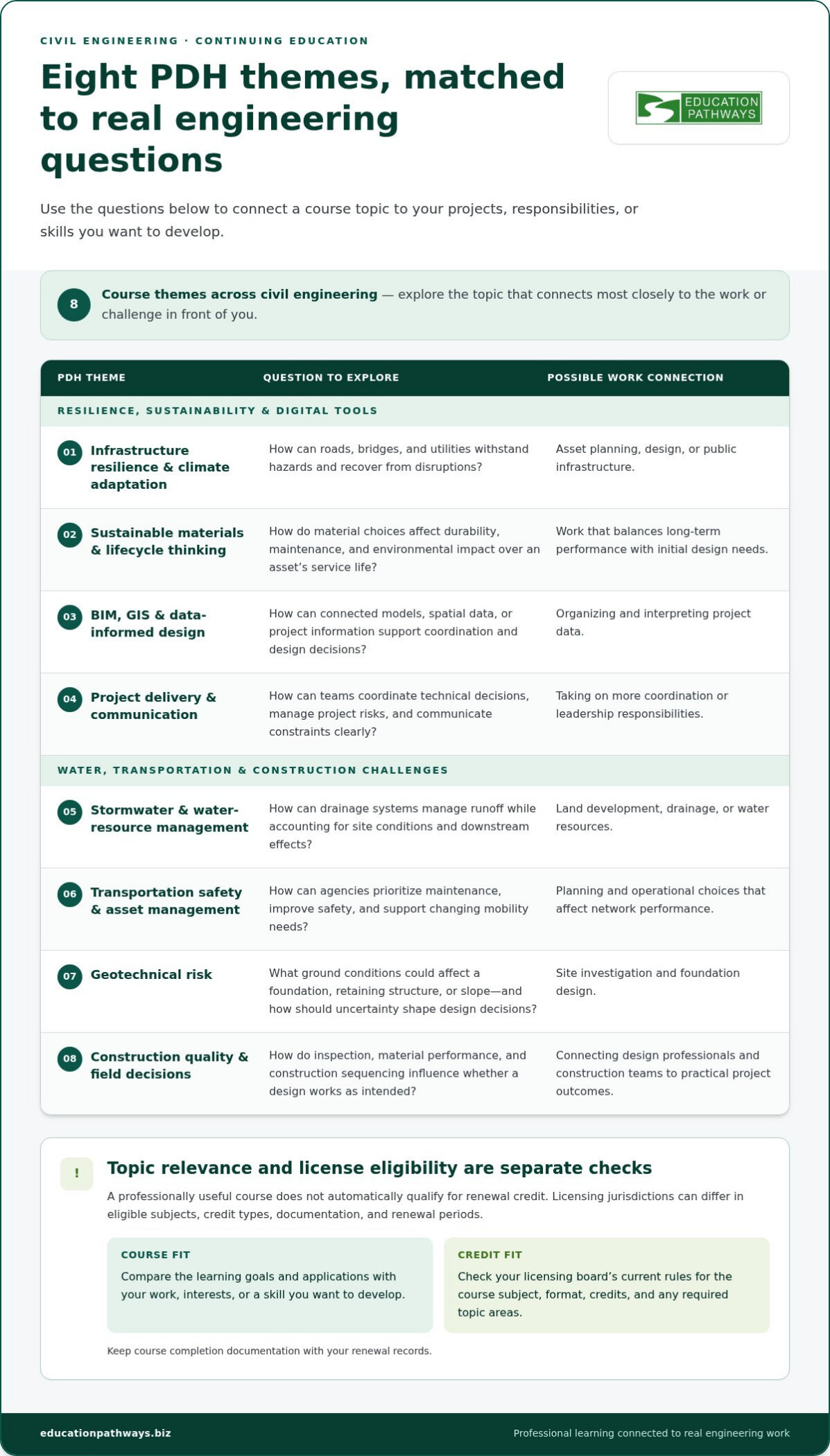
Eight Engaging PDH Course Themes Across Civil Engineering
The right topic depends on the problems you work on and the skills you want to strengthen. Use these themes as starting points for finding interesting PDH courses for civil engineers. As you compare courses, consider both the subject matter and your licensing jurisdiction’s rules for eligible credit.
Resilience, sustainability, and digital tools
- Infrastructure resilience and climate adaptation: How can roads, bridges, and utilities be planned to withstand hazards and recover from disruptions? This may interest engineers working on asset planning, design, or public infrastructure.
- Sustainable materials and lifecycle thinking: How do material choices affect durability, maintenance, and environmental impact over an asset’s service life? Consider this theme if you weigh long-term performance alongside initial design needs.
- BIM, GIS, and data-informed design: How can connected models, spatial data, or project information support coordination and design decisions? These topics may appeal to engineers looking for better ways to organize and interpret project data.
- Project delivery and communication: How can teams coordinate technical decisions, manage project risks, and communicate constraints clearly? This theme can suit engineers taking on more coordination or leadership responsibilities.
Water, transportation, and construction challenges
- Stormwater and water-resource management: How can drainage systems manage runoff while accounting for site conditions and downstream effects? This can be relevant to engineers involved in land development, drainage, or water resources.
- Transportation safety and asset management: How can agencies prioritize maintenance, improve safety, and support changing mobility needs? Transportation professionals may find value in examining how planning and operational choices affect network performance.
- Geotechnical risk: What ground conditions could affect a foundation, retaining structure, or slope, and how should uncertainty shape design decisions? This theme may interest engineers involved in site investigation and foundation design.
- Construction quality and field decisions: How do inspection, material performance, and construction sequencing influence whether a design works as intended? This can connect design professionals and construction teams to practical project outcomes.
Use these examples to identify learning directions, then compare actual course descriptions and credit details. For a broader selection of civil engineering education topics, explore ASCE’s continuing education programs. Education Pathways provides self-paced online continuing education for licensed architects and engineers, a format that can fit around project schedules. Learn more about architect and engineer continuing education and review your licensing jurisdiction’s requirements when assessing course credits.
How to Compare Civil Engineering PDH Topics Before Enrolling
A useful comparison looks beyond the course title. Match the subject to your work and development goals, then assess the learning format, credit information, and completion records. This helps you identify an option that is both engaging and relevant to your professional needs.
Match the topic to your discipline and development goals
Start with your current projects, specialty, and the skills you want to strengthen. A course exploring geotechnical risk may connect directly to foundation work, while project communication may support an engineer moving into a coordination role. Early-career engineers might prioritize building technical foundations; experienced professionals may focus on emerging methods, broader project oversight, or a new specialty. Look for clear learning outcomes and substantive examples, not a catchy title alone. Professional learning takes different forms, including programs designed to enhance expertise among engineering professionals.
Compare format, credit details, and completion records
Use this framework to compare options side by side. A course description explains the subject and learning goals, but it doesn’t establish whether the credit applies to your license. Compare the course details with current guidance from your licensing jurisdiction.
| What to compare | Questions to ask |
|---|---|
| Topic relevance | Does the subject connect to your discipline, current projects, or a skill you want to build? |
| Learning goals | Does the description explain what you’ll learn and how the material is applied? |
| Format | Will the learning approach fit your schedule and the time you can set aside? Self-paced online study can offer flexibility around project demands. |
| Credit details | Are the stated hours and subject information clear, and does the relevant board accept them for your license and renewal needs? |
| Completion documentation | Will you have a certificate or other record to save with your professional development documents? |
When comparing interesting PDH courses for civil engineers, weigh immediate usefulness against longer-term value. A directly relevant topic may help with a current assignment, while broader learning could prepare you for changing responsibilities. Education Pathways provides self-paced online continuing education for architects and engineers, with instant certificates of completion and reporting to appropriate licensing boards. Explore online continuing education and compare course details with your jurisdiction’s credit requirements.
A Practical Checklist for Choosing PDH Courses That Fit
A short process can help you balance renewal requirements with learning that supports your work. Use this checklist before enrolling. Verify the course’s eligibility first, then choose learning that fits your goals and schedule.
- Identify your licensing board and renewal timeline. Check current continuing education rules with the board responsible for your professional engineer license. Note your renewal deadline and any requirements specific to your jurisdiction.
- Confirm what counts. Review whether the course’s subject, credit type, and format meet the board’s current criteria. If your jurisdiction requires particular subject areas or limits certain learning formats, account for those rules before choosing a course.
- Work out your learning needs. Compare the credits you still need with the time available before renewal. Allow time to complete the course and organize your records instead of leaving all learning until the deadline is close.
- Choose a topic with a clear purpose. Decide whether you want knowledge that supports current project work or learning that helps with a future responsibility or career direction. Interesting PDH courses for civil engineers should offer substantive learning and a relevant goal, not just an appealing title.
- Review the format and completion steps. Check how the course is delivered, what you need to do to finish it, and what completion documentation is provided. Self-paced online study may be easier to fit around project schedules, but confirm that the format meets your licensing requirements.
- Complete the course and save your records. Follow the course instructions and any applicable board-reporting process. Keep your certificate of completion and related documentation with your renewal records.
This sequence keeps two decisions distinct: whether a course is useful to you and whether its credit applies to your license. A course description can explain its content, but it doesn’t replace the licensing board’s current rules. Revisit those rules if your renewal period or jurisdiction changes, and keep a copy of the guidance you used when selecting a course.
Education Pathways offers self-paced online continuing education for licensed architects and engineers, with instant certificates of completion and reporting to appropriate licensing boards. Compare course details with your jurisdiction’s current requirements, then explore online continuing education options.
Make Continuing Education a Useful Part of Your Civil Engineering Career
PDHs can do more than help you meet applicable renewal requirements. Chosen with care, they can support your work, deepen a technical interest, or prepare you for new responsibilities. Confirm that a course’s credit applies to your license, then select learning with practical value.
Build a repeatable professional development plan
Keep a simple record of completed topics, skills you want to develop, and upcoming license obligations. Before each renewal period, review your notes alongside current board guidance. This makes it easier to spot useful next steps, whether you want to build on a familiar subject or explore an area related to changing project needs.
Your priorities may shift over time. An engineer focused on current project demands might favor directly applicable technical learning. Someone preparing for broader responsibilities may look for courses that build skills beyond a current specialty, or turn to dedicated training providers like Trainetics Academy to develop organizational and workforce capabilities. There’s no single plan for every civil engineer or jurisdiction. Let your role, interests, and renewal requirements guide your choices.
Complete online learning with clear next steps
Education Pathways provides self-paced online continuing education for licensed architects and engineers. This format can help you fit learning around project schedules. Completed courses come with instant certificates of completion and are reported to appropriate licensing boards.
Reporting and documentation support a clear completion process, but they don’t establish that every course’s credits apply to every license. Compare course details with your jurisdiction’s current requirements, and keep your certificate with your own records.
Use a simple principle to guide each choice: verify eligibility, then choose learning with practical value. This connects professional development to both your career interests and the rules that apply to your license. The most interesting PDH courses for civil engineers are the ones that meet those needs without feeling disconnected from the work you want to do.
Ready to continue your professional development? Explore Education Pathways’ online continuing education for engineers and choose learning that fits your goals and schedule.
Choose PDHs That Move Your Career Forward
The right professional development can support license renewal and better-informed engineering work. Start by reviewing your licensing board’s current requirements, then choose a topic that connects to your projects, interests, or future goals. The most useful interesting PDH courses for civil engineers offer practical learning, not just an appealing title.
Keep a record of the subjects you complete and skills you want to build next. That habit can help you make more intentional choices from one renewal period to the next and keep eligibility and completion records organized.
Education Pathways has provided continuing education since 2002. Its self-paced online courses include instant certificates of completion and reporting to appropriate licensing boards. Credit applicability can vary, so review the requirements for your license.
Explore online continuing education options and choose learning that fits your schedule and professional goals. A thoughtful next step can make continuing education more relevant to the work ahead.
Frequently Asked Questions
What are the most interesting PDH courses for civil engineers?
The most interesting PDH courses for civil engineers connect useful technical learning with real project questions. Topics might include infrastructure resilience, sustainable materials, stormwater management, transportation safety, geotechnical risk, construction quality, or digital design tools. The best fit depends on your specialty, current responsibilities, and the skills you want to build. Before enrolling, confirm that the course credits apply to your license renewal requirements.
What topics can civil engineers study for professional development hours?
Civil engineers may explore technical subjects such as water resources, transportation, structural systems, geotechnical engineering, construction practices, sustainability, and infrastructure technology. Professional development can also include project management, communication, or leadership. Available subjects and credit eligibility vary by course and jurisdiction. To narrow your choices, consider which topic relates to your current work or a future career goal, then compare it with your licensing board’s requirements.
Do online PDH courses count toward civil engineering license renewal?
Online PDH courses may count toward renewal, but acceptance depends on the rules of the licensing jurisdiction and the specific course. Some boards may have requirements or limits related to course format, subject matter, or credit type. Before enrolling, review current guidance from the board responsible for your license. Online delivery alone doesn’t determine whether a course qualifies, even if its subject closely matches your engineering work.
How can I check whether a PDH course is accepted by my licensing board?
Start with the licensing board’s current continuing education rules. Check whether the course subject, format, credit type, and stated hours meet the requirements for your license and renewal period. A course description explains its content, but it doesn’t establish that the board will accept the credits. Keep a record of the guidance you relied on, and review it again if your jurisdiction or renewal requirements change.
Can civil engineers choose PDH courses related to their specialty?
Yes, engineers can look for learning connected to their specialty, current projects, or professional development goals. A transportation engineer might focus on safety or asset management, while a water resources engineer may explore drainage or stormwater approaches. These are examples, not universal recommendations. Specialty relevance doesn’t automatically establish credit eligibility, so compare the course topic with your board’s rules before relying on it for license renewal.
Are self-paced PDH courses useful for working civil engineers?
Self-paced courses can be practical for working engineers because they let learners schedule study around project responsibilities. Education Pathways offers online, self-paced continuing education for licensed professionals, including architect and engineer continuing education. Completed courses include instant certificates and are reported to appropriate licensing boards. Course-specific credit applicability varies, so review the relevant board’s requirements before enrolling or counting credits toward renewal.
What records should I keep after completing a civil engineering PDH course?
Keep your completion certificate and any course details that help document the learning, such as the course subject, completion date, and stated credits. Follow your licensing board’s instructions for reporting and record retention, since requirements may differ by jurisdiction. Store records where you can access them during renewal. Even when a course provider reports completion, retaining your own documentation gives you a clear reference for your professional development history.