
Managing Continuing Education for Multiple Licenses: 2026

You are likely juggling a Florida contractor license, an NMLS certification, and perhaps a real estate license in Texas. By the time you’ve tracked down the renewal date for one, another deadline has already slipped past your calendar. Managing continuing education for multiple licenses in 2026 often feels like a full-time job you didn’t sign up for. It is exhausting to deal with overlapping deadlines and the constant fear that a reporting error might lead to a license suspension.
We understand that your time is your most valuable asset. This article will help you master the art of tracking and fulfilling CE requirements without missing a single deadline. You will gain a streamlined workflow and the confidence that every credit is reported correctly to the right board. We will even show you how to maximize “double-dip” opportunities where a single course satisfies two separate state requirements.
We’ll examine how to navigate new 2026 mandates, such as Idaho’s shift to biennial renewals and Illinois’s specific implicit bias training requirements. You’ll learn to use automated reporting and self-paced online tools to turn a complex logistics hurdle into a simple, predictable routine. It’s time to stop worrying about compliance and get back to your professional work.
Key Takeaways
- Understand the specific regulatory risks associated with missed deadlines and how to avoid costly license suspensions or fines.
- Learn how to build a master calendar that inventories your specific requirements to streamline managing continuing education for multiple licenses.
- Discover how to identify “double-dip” course opportunities that allow one ethics or law credit to satisfy multiple state boards simultaneously.
- Find out why automated reporting and state-level approval are the most critical features to look for when choosing a 2026 CE provider.
- Explore how using a unified, self-paced platform for Florida, Texas, and NMLS requirements can eliminate manual data entry and reporting anxiety.
The Complexity of Multi-License Continuing Education in 2026
Success in a modern professional career often requires more than one credential. Multi-license continuing education management is the process of coordinating diverse educational mandates across different regulatory bodies. It’s a logistical challenge that demands precision. If you’re a Florida contractor who also holds a real estate license in Texas, you’re dealing with two different sets of rules, deadlines, and approved providers. Managing continuing education for multiple licenses isn’t just about sitting through a course; it’s about ensuring every hour is tracked and reported to the correct state board before your time runs out.
The risks of poor management are high. A single missed deadline can lead to heavy fines or an expired license, which immediately stops your ability to generate revenue. In 2026, regulatory boards are tightening digital reporting standards. Most boards no longer accept excuses for technical glitches or manual entry errors. This shift has made 100% online, self-paced learning the industry standard. It’s the most efficient way to maintain the flexibility needed to handle a heavy professional workload while staying compliant.
Common Multi-License Scenarios
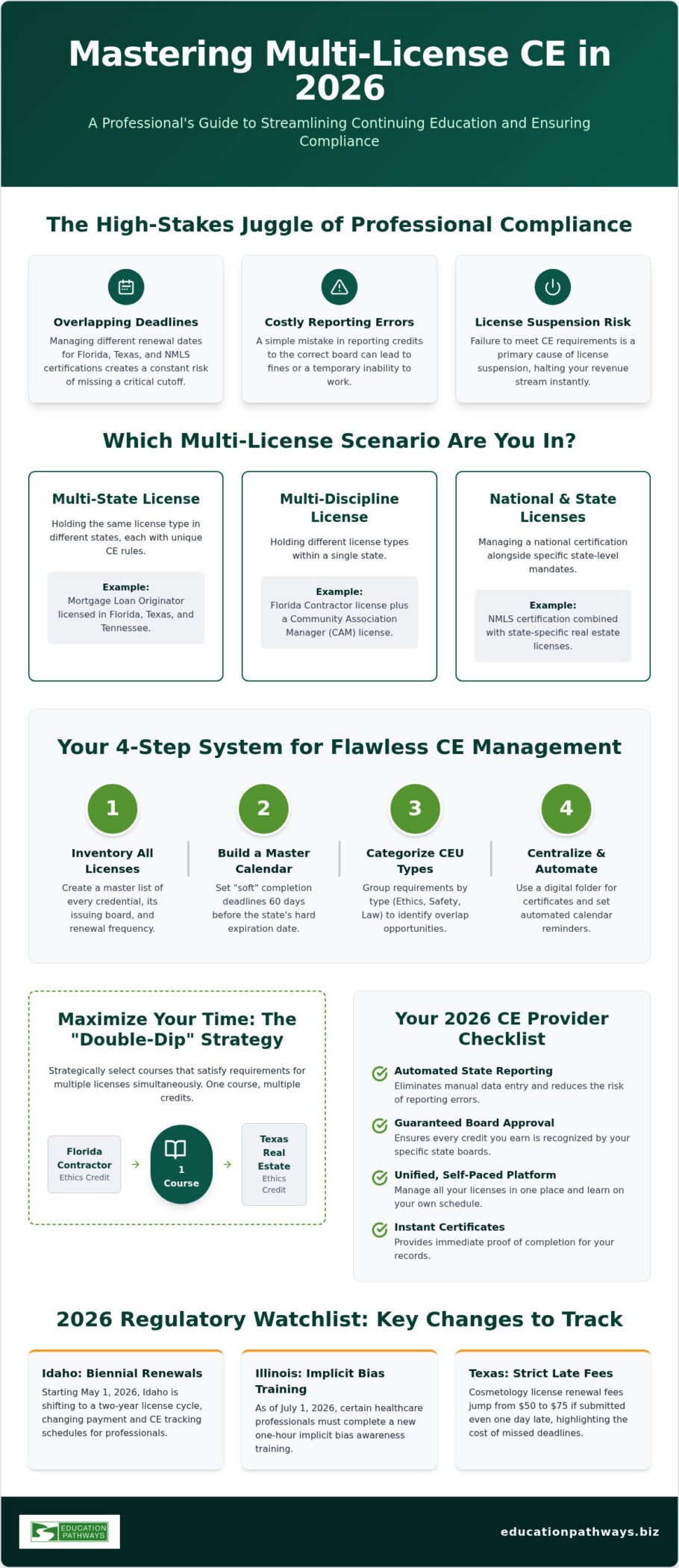
Professionals often find themselves in one of three complex situations. First, you might hold the same license type in multiple states. For example, a Mortgage Loan Originator (MLO) might be active in Florida, Texas, and Tennessee. Second, you could hold different license types within a single state. A professional might manage Florida contractor CE alongside a Community Association Manager (CAM) license. Finally, many experts manage national certifications that have their own requirements alongside state-specific mandates. Each scenario requires a unique approach to credit tracking to avoid redundant work.
The Burden of Differing Deadlines
Deadlines are rarely synchronized. You must distinguish between birth-month renewals and fixed-date state cycles. For instance, Idaho is transitioning to a biennial cycle starting May 1, 2026. If you have an even-numbered birth year, you’ll pay for a two-year license; odd-numbered years get a one-year license during this transition period. Other states, like Texas, have strict late fees. A Texas cosmetology license renewal costs $50 on time, but jumps to $75 if it’s even one day late. You also need to watch for new specific mandates. Illinois now requires a one-hour implicit bias training for certain healthcare professionals as of July 1, 2026. Understanding these nuances helps you identify grace periods versus hard expiration dates that could end your practice.
How to Build a Centralized CE Tracking System
Managing continuing education for multiple licenses requires a shift from reactive planning to a proactive, centralized system. You can’t rely on memory or scattered emails when your professional standing is at stake. Start by creating a comprehensive inventory of every license you hold. For each credential, identify the specific board-approved provider lists. This step ensures you don’t waste time or money on courses that your specific state board won’t recognize.
Next, map out a master calendar. You should establish a “soft” deadline for course completion at least 60 days before the “hard” state expiration date. This buffer protects you from unexpected reporting delays or technical issues. Categorize your required Continuing Education Units (CEUs) by type, such as Ethics, Safety, General, or Laws and Rules. Centralize all documentation in a dedicated digital folder and set automated reminders for 90, 60, and 30 days before each expiration. This methodical approach turns the stress of managing continuing education for multiple licenses into a predictable routine.
Tools for Effective Tracking
While basic spreadsheets are a starting point, they require manual updates that are prone to error. Many professionals now prefer specialized compliance apps that track progress in real time. Regardless of the tool you choose, always verify your status through official portals like the Florida DBPR. It’s the only way to confirm your credits are officially recorded. Choosing a platform with an “Instant Certificate” feature is also vital. It provides immediate proof of completion while you wait for automated state reporting to process. If you’re looking for a reliable way to stay compliant, you can explore DBPR-approved online classes to streamline your next renewal.
Maintaining Your Digital CE Audit Trail
Organization is your best defense against a state board audit. Use a consistent naming convention for every digital certificate, such as “2026_FL_Contractor_Ethics.pdf,” to ensure quick retrieval. Most regulatory bodies recommend keeping your CE records for at least five years. If you are audited, you should be able to produce a single documentation pack with one click. A well-maintained audit trail provides peace of mind and proves you’ve met every professional mandate with precision.
Strategic Course Selection: Maximizing Credit Utility
Strategic course selection is the most effective way to reduce your educational workload. When you’re managing continuing education for multiple licenses, you shouldn’t just pick the first class you see. You need to look for “overlapping” courses that satisfy different regulatory bodies at the same time. For example, a general safety course might be accepted by multiple contractor specialty boards. This approach allows you to earn credits for two or more licenses with a single effort, drastically cutting your time spent in a digital classroom.
The NMLS National program offers a perfect example of this efficiency. One core ethics course can often cover the requirements for several different state licenses simultaneously. This significantly cuts down on your total seat time. However, the challenges of mandatory continuing education often stem from poor planning rather than the difficulty of the material. By prioritizing comprehensive packages over individual classes, you ensure that every mandatory hour, from ethics to specific state laws, is fully accounted for without gaps.
Choosing the right format is just as important as the content itself. Self-paced online courses are the industry standard for 2026 because they respect your schedule. Unlike live webinars that force you to be present at a specific time, self-paced learning lets you complete modules whenever you have a break. This flexibility is essential for professionals who are balancing active projects with strict renewal deadlines. It turns a rigid requirement into a manageable task that fits your life.
The ‘Double-Dipping’ Myth vs. Reality
Many professionals wonder if they can truly “double-dip” on credits. The reality depends on the specific course approval numbers. Every approved course has a unique ID assigned by the state board. If two different boards approve the same course ID, you can often apply those hours to both licenses. You must verify these numbers before enrolling to ensure they count. Don’t fall into the trap of “non-approved” courses that promise general knowledge but offer zero credit toward your official total. Managing continuing education for multiple licenses requires this level of detail to avoid redundant work.
Focusing on Industry-Specific Bundles
Using pre-built bundles is the safest way to guarantee compliance. Florida contractor CE packages are designed to include every necessary topic, such as Florida Laws and Rules and Workers’ Compensation. This eliminates the risk of missing an obscure requirement that could delay your renewal. For those in property management, see our Florida CAM CE bundles for streamlined community manager compliance. These bundles are vetted to ensure they meet all DBPR standards, giving you peace of mind during the renewal season.
Choosing the Right CE Provider for Multiple Licenses
Selecting a provider is the final piece of managing continuing education for multiple licenses. It’s not just about the price. You must verify that the provider holds active state-level approval for every license you maintain. If you’re a Florida contractor, ensure they are DBPR-approved. If you’re in Texas real estate, check for TREC approval. Without official verification, your hours won’t count toward your renewal. This verification step is non-negotiable for anyone juggling several professional credentials.
Efficiency features are just as critical as approval. Look for automated reporting. This feature eliminates manual data entry errors that often lead to license suspensions. You also need mobile compatibility. Modern professionals often complete modules during downtime on a job site or while traveling. Finally, prioritize providers that offer instant digital certificates. Waiting for a mail-in document is a risk you can’t afford when a deadline is approaching. These tools turn a complex logistical hurdle into a simple, automated process.
The Importance of Board Reporting
Automated reporting saves hours of administrative work. Instead of you mailing or uploading certificates, the provider sends the data directly to the state board. There is often a slight reporting lag, especially during peak renewal seasons. If your credits don’t show up immediately, having your instant certificate as a backup is crucial. It provides the proof you need while the official systems sync. Review our NMLS ethics CE course guide to understand the specific reporting timelines for mortgage professionals. This level of detail is essential when managing continuing education for multiple licenses across different states.
User Experience and Technical Support
A 100% online, self-paced format is essential. It allows you to start your courses the moment you enroll. You don’t have to wait for a scheduled class or a specific start date. Evaluating a provider’s history is also vital. Education Pathways has been a trusted partner since 2002, providing state-approved education for multiple industries. This longevity ensures they understand the nuances of regulatory changes and technical requirements. You need a partner that values your time and provides a seamless, friction-free experience from enrollment to reporting.
You can simplify your compliance today by choosing DBPR-approved online contractor courses that offer automated reporting and instant access.
Streamlining Your 2026 Renewals with Education Pathways
Consolidating your requirements into a single platform is the ultimate strategy for managing continuing education for multiple licenses. Education Pathways, LLC provides a unified interface for professionals who hold credentials in different states or industries. Instead of jumping between multiple websites and login portals, you can track your progress for Florida, Texas, and national NMLS mandates in one place. This centralization eliminates the risk of missing a deadline due to fragmented information. It turns a month of stress into a few hours of focused, self-paced learning.
The platform provides peace of mind through automated reporting and instant digital verification. Once you complete a course, the data is sent directly to the relevant licensing board. For Florida DBPR requirements, this process is usually seamless; however, you should always allow a few days for the state system to reflect the update. Having an instant certificate allows you to maintain your own records and provides immediate proof of compliance if an audit occurs. You don’t have to worry about manual entry errors or lost mail.
Industry-Leading Solutions for Florida Professionals
Florida professionals often carry a diverse portfolio of licenses that require constant attention. You can explore Florida contractor license renewal options for 2026 that include all the necessary safety and law hours in a single package. If you’re also active in the property market, fulfilling Florida real estate CE classes alongside your other requirements becomes a simple task. You can even manage Community Association Manager (CAM) and Board Member certifications through the same portal. This prevents the need to vet different providers for every individual license you hold.
National and Multi-State Compliance
Compliance doesn’t stop at the state line, especially for those working in regional markets. You can navigate Texas real estate license renewal from anywhere in the country with our 100% online courses. For Mortgage Loan Originators, fulfilling SAFE Act requirements across multiple jurisdictions is straightforward with our NMLS-approved modules. Managing continuing education for multiple licenses is a heavy burden, but it doesn’t have to be a source of constant anxiety. Your next step is to audit your current licenses and select the 2026 course packages that fit your unique renewal cycle. Browse our full course catalog and start managing your CE more efficiently today.
Master Your 2026 Compliance Strategy
Managing continuing education for multiple licenses doesn’t have to be a source of professional burnout. By implementing a centralized tracking system and selecting industry-specific bundles, you can turn a logistical nightmare into a streamlined routine. You now have the tools to identify overlapping credits and understand the critical importance of choosing a provider that offers automated board reporting. These steps ensure you stay compliant without sacrificing your billable hours or personal time. Whether you are navigating Idaho’s new biennial cycles or Florida’s strict reporting timelines, an organized approach is your best defense against license expiration.
Reclaiming your personal time allows you to focus on hobbies that offer both physical and mental renewal. If you are a golfer looking to improve your swing and your spiritual journey, you can explore Program Registration and Instruction Fees to discover how to get involved with a community that values both.
Education Pathways has been a trusted, state-approved provider since 2002. We offer 100% online, self-paced learning specifically designed for the busy professional. Our platform features instant digital certificates and automated reporting to state boards to eliminate the anxiety of manual data entry. You can streamline your license renewals with Education Pathways online CE courses and regain your peace of mind today. Take control of your professional requirements and move forward with the confidence that your credentials are secure.
Frequently Asked Questions
Can one CE course count for two different professional licenses?
Yes, one course can often satisfy requirements for two different licenses if both state boards approve the same course ID number. This typically happens with general subjects like ethics, safety, or business practices. You must verify that the course is approved by each specific board before you enroll. Cross-referencing these approval codes is the best way to maximize your educational utility and reduce redundant seat time.
How do I know if my CE credits have been reported to my state board?
You can verify your credit status by logging into your official state board portal, such as the Florida DBPR account or the NMLS consumer access site. Most boards process provider reports within a few business days. Reliable providers will also send you a confirmation email once they have successfully transmitted your data. If your credits don’t appear after a week, contact your provider to check for reporting errors.
What happens if I complete my CE courses after the license renewal deadline?
Your license will move into a delinquent or expired status, and you will likely face late fees. For example, a Texas cosmetology operator license renewal fee increases from $50 to $75 if it’s even one day late. You cannot legally perform licensed work while your status is inactive. Completing your courses after the deadline requires you to pay these penalties before the board will reinstate your professional standing.
Are online continuing education courses as valid as in-person classes?
Online courses carry the same legal weight as in-person training as long as the provider is state-approved. Regulatory bodies across the country recognize 100% online learning as a valid method for fulfilling mandatory requirements. This digital format is a key advantage when managing continuing education for multiple licenses. It provides the flexibility to maintain compliance without the travel costs or rigid schedules associated with traditional classroom settings.
How long should I keep my CE certificates of completion?
You should maintain your certificates of completion for at least five years. Even if your state board uses automated reporting, you are responsible for providing proof of compliance during a random audit. Digital storage is the most efficient way to organize these records. Keeping a dedicated folder for each renewal cycle ensures you can produce the necessary documentation with a single click if a regulatory body requests verification.
Do I need to report my CE credits manually to the Florida DBPR?
No, you don’t need to report your credits manually if you use a board-approved provider like Education Pathways. Approved providers are required to report your completion data directly to the DBPR system. This automated process reduces administrative errors and ensures your records stay up to date. You should still monitor your online account to confirm that all hours are correctly posted before your specific renewal date arrives.
What is a ‘self-paced’ CE course and how does it benefit multi-license holders?
A self-paced course allows you to complete educational modules on your own schedule rather than attending a live webinar or class. You can start and stop the material whenever you have professional downtime. This format is the most effective tool for managing continuing education for multiple licenses. It lets you balance different state deadlines without the stress of conflicting class times, making it ideal for busy professionals with high workloads.
Can I take CE courses for a license in another state while I am traveling?
Yes, you can complete online CE courses from any location with a stable internet connection. You aren’t required to be physically present in the state where you hold the license to fulfill your educational requirements. This accessibility is a major benefit for professionals who manage remote projects or travel frequently. It ensures that your compliance stays on track regardless of your physical location or current job site requirements.