
Professional Development Hours vs. CEU: The 2026 Comparison Guide

Last Tuesday, a professional engineer named Mark discovered his license renewal was denied because he confused a 1.0 CEU for a single hour of credit. That simple math error cost him weeks of work and preventable stress. Most professionals find the debate of professional development hours vs CEU confusing, especially when different states use different terminology for the same cycle. With most states requiring between 15 and 30 PDHs per cycle, getting the math right is critical. It’s frustrating to deal with complex regulations when you’re just trying to stay compliant and get back to work.
This guide will clear the fog. You’ll learn exactly how to master the difference between PDHs and CEUs so your credits are always valid for renewal. We’ll break down the universal 1:10 conversion ratio, look at specific state requirements for 2026, and show you how to verify state-approval status before you spend a dime. By the end of this article, you’ll be able to purchase your next education package with total confidence and peace of mind.
Key Takeaways
- Understand the fundamental difference between a 60-minute contact hour and a standardized 10-hour CEU block.
- Learn the universal 1:10 conversion ratio to transform CEUs into PDHs and avoid falling short of your mandatory credit count.
- Navigate specific 2026 mandates for Florida contractors, Texas real estate agents, and other licensed professionals with ease.
- Simplify your license renewal by choosing state-approved providers that offer automated reporting and instant certificates.
- Master the nuances of professional development hours vs CEU to ensure your continuing education is valid for your specific industry and state.
Defining the Terms: What are CEUs and PDHs?
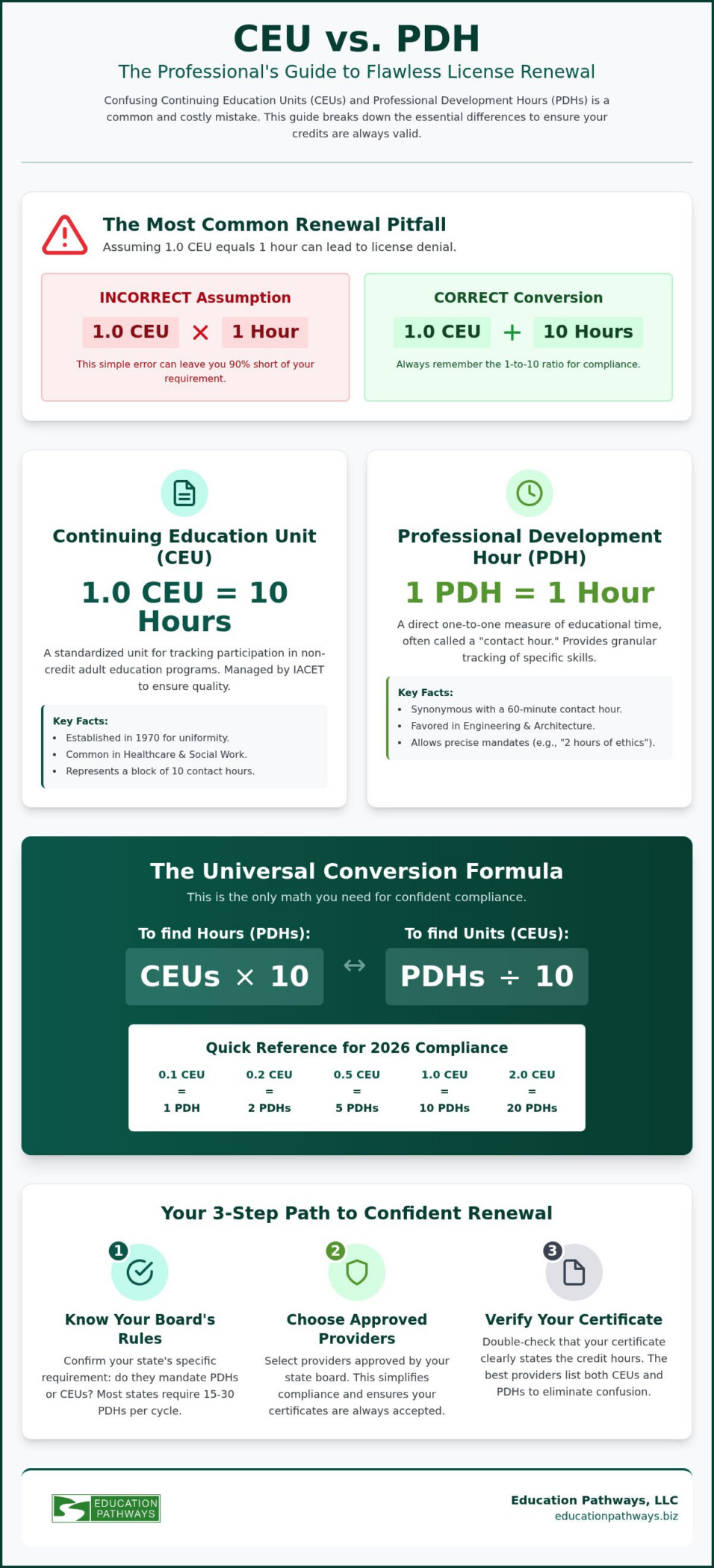
Defining these terms correctly is the foundation of a successful licensing strategy. While both units measure time spent learning, they operate on different scales. A Continuing Education Unit (CEU) is a standardized metric where 1.0 unit represents 10 contact hours of instruction. Conversely, a Professional Development Hour (PDH) is a one to one measurement. One PDH equals one 60 minute hour of learning. Confusion often arises because these terms are used interchangeably in casual conversation, but they carry distinct weights on a renewal application.
State licensing boards choose their preferred terminology based on industry history and specific regulatory standards. Some boards require a specific number of units, while others count individual hours. This is why understanding professional development hours vs CEU is essential. If you purchase a course measured in CEUs when your board requires PDHs, you must know how to convert them to avoid a rejected certificate.
The Origin of the Continuing Education Unit
The CEU was created in 1970. It was designed to provide a uniform system for non-credit adult education. Before its inception, there was no standard way to track learning across different states or providers. The International Accreditors for Continuing Education and Training (IACET) manages these standards today. The 10 hour rule remains the gold standard. Organizations following the ANSI/IACET 2018 Standard ensure that every unit awarded meets strict criteria for instructional quality and learner assessment. Boards in healthcare and social work frequently rely on this system because it guarantees a high level of vetting and quality control.
The Rise of Professional Development Hours (PDH)
Technical fields like engineering and architecture often favor the PDH. This term is synonymous with a “contact hour.” It allows for more granular tracking of specific skills. For example, Florida architecture license renewal requires specific hours dedicated to building codes and professional ethics. It is much easier for a board to mandate “2 hours” than “0.2 CEUs.”
PDHs track the literal time you spend engaged in an educational activity. This granularity helps professionals who earn credits through diverse activities like teaching or attending short seminars. Most engineering boards use the PDH to ensure professionals maintain competency in rapidly changing technical landscapes. Whether your board calls them credits, units, or hours, the goal is the same. They want to verify you are up to date in your field without the friction of complex math.
The Conversion Math: CEU to PDH Ratio
Most professionals feel a surge of anxiety when looking at their renewal dashboard. You might see a requirement for 14 hours, but the course you want is listed as 1.4 units. Understanding the math behind professional development hours vs CEU ensures you never under-buy or over-spend on your education. One simple calculation can save you from the stress of a rejected license application.
When Defining Continuing Education Units (CEUs), regulatory bodies rely on a decimal system. This system allows providers to quantify learning in a way that remains consistent across various state boards. It provides a universal language for education, even when industry terms vary.
Calculating Your Renewal Requirements
Converting your credits is straightforward. To find the number of hours, multiply the CEU value by 10. To find the CEU value, divide the total hours by 10. For example, if your state board mandates a 14-hour requirement, you need to complete 1.4 CEUs. The 10:1 ratio is the recognized national standard for converting CEUs to professional development hours.
Use this quick reference for 2026 compliance:
- 0.1 CEU = 1 Hour (PDH)
- 0.2 CEU = 2 Hours (PDHs)
- 0.5 CEU = 5 Hours (PDHs)
- 1.0 CEU = 10 Hours (PDHs)
- 2.0 CEU = 20 Hours (PDHs)
Why the Decimal Point Matters
Misreading a certificate is a common trap. A certificate stating “3.0 Units” represents 30 hours of work. If you only needed 3 hours, you’ve spent ten times more effort than required. Conversely, a “0.3 CEU” course provides only 3 hours of credit. If you submit that for a 30-hour requirement, your board will reject it immediately. This error often happens when professionals assume “1 unit” means “1 hour.”
Providers usually list both units on the certificate to avoid this confusion. However, some state boards only accept whole hours and will not recognize partial credits. You must ensure your provider reports the data in the specific format your board requires. If you’re approaching a deadline, you can browse state-approved courses that handle these calculations and reporting requirements for you. Always verify the decimal placement before you finalize your purchase to ensure your time is used efficiently.
Industry-Specific Requirements for 2026
Understanding the shift between professional development hours vs CEU depends entirely on your specific license. State boards and national accreditors don’t always use the same language. For some, a single hour is the only unit that matters. For others, standardized units are the mandatory reporting method. In 2026, staying compliant means knowing exactly which metric your board tracks to avoid a rejected renewal application.
Contractors and Community Association Managers
Florida contractors face a 14-hour continuing education requirement every two years. This cycle includes specific mandatory hours for topics like workers’ compensation, workplace safety, and business practices. The Florida Department of Business and Professional Regulation (DBPR) tracks these as contact hours. This makes the math simple for contractors. One hour of instruction equals one hour of credit toward your license.
Community Association Managers (CAMs) in Florida have a similar structure. They must complete 15 hours of biennial credits. Because these boards focus on the literal time spent in a course, you don’t usually need to worry about complex unit conversions. You can find comprehensive, state-approved packages at the Florida Contractor CE Hub to ensure every hour you spend is automatically reported.
Real Estate and Mortgage Professionals
The mortgage industry operates under the SAFE Act, which mandates a strict 8-hour annual requirement for Mortgage Loan Originators (MLOs). These credits must be NMLS-approved. If a provider offers a course in CEUs, you must ensure the conversion results in the full 8 hours required by the registry. Real estate professionals in Texas deal with the Texas Real Estate Commission (TREC). TREC has rigorous standards for both Sales Agent Education (SAE) and standard CE. They track education in hours. If you’re completing your Texas Real Estate Continuing Education, always verify that your course provider is TREC-approved and offers automated reporting to save you the hassle of manual entry.
Engineers and Architects
Professional engineers (PEs) and architects almost exclusively use the Professional Development Hour (PDH) as their gold standard. The National Council of Examiners for Engineering and Surveying (NCEES) currently recommends 15 PDHs per year for PEs. However, state-specific mandates vary significantly. For instance, New York requires 36 PDHs over a three-year period, while Florida requires 18 PDHs per cycle. Most states now require at least 1 PDH dedicated specifically to professional ethics.
Architects have an additional layer of complexity. They must often earn credits in Health, Safety, and Welfare (HSW) topics. While the American Institute of Architects (AIA) recognizes various forms of learning, state boards require these to be translated into contact hours. This is where the professional development hours vs CEU distinction is most vital. An architect taking a 1.2 CEU course must ensure their board recognizes it as the full 12 hours of HSW credit needed for their specific registration period.
How to Choose the Right CE Provider
Selecting a continuing education provider is a high-stakes decision for your career. If you choose a vendor without the proper credentials, your state board will reject your application. This leads to wasted money and a pending license status. You must look beyond the course title and verify that the provider understands the nuances of professional development hours vs CEU. A quality provider ensures your credits are calculated correctly, reported to the proper authorities, and valid for your specific industry.
The right provider acts as a partner in your professional growth. They take the heavy lifting out of compliance so you can focus on your work. This means offering courses that are not only informative but also legally recognized by your governing body. In 2026, the standard for excellence includes automated systems that bridge the gap between learning and official verification.
Verification of State Approval
Always verify a provider’s license or approval number before you enroll. Most state boards, such as the DBPR in Florida or TREC in Texas, maintain public databases of authorized education vendors. It’s a common mistake to assume that “National” approval covers state-specific mandates. For instance, an NMLS-approved provider for mortgage professionals must have a specific course ID for your state’s elective hours. Using a non-approved provider is a risk that can lead to fines, license suspension, or the requirement to retake courses at the last minute. Reliable providers will clearly display their board approval numbers on their homepage or course descriptions.
Technology and Reporting Features
Modern professionals need more than just a static PDF. Look for providers that offer automated reporting to licensing boards. This feature eliminates manual entry errors and ensures your record is updated within the board’s required timeline. Education Pathways has been operating since 2002 and prioritizes this seamless connection to licensing boards. You should also prioritize mobile-friendly, self-paced interfaces that allow you to learn between job sites or during your commute. Efficiently Managing CE Credits: From Enrollment to Reporting is the key to a stress-free renewal cycle.
Speed is a critical factor when a deadline approaches. Ensure your provider offers instant certificates of completion upon finishing the course. You shouldn’t have to wait days for a manual email when your license expires at midnight. Self-paced, 100% online courses offer the flexibility required for a busy schedule. If you are ready to secure your credits now, you can start your state-approved CE course today and receive your certificate immediately upon completion.
Simplifying Compliance with Education Pathways
Meeting mandatory requirements shouldn’t feel like a part-time job. Education Pathways removes the complexity of license renewal by providing a streamlined, user-friendly platform. Our courses are 100% online and self-paced. This allows you to complete your training during downtime, at home, or between site visits. You don’t have to worry about missing a local seminar or adjusting your work schedule for a rigid classroom session.
Every course in our catalog is state-approved and designed for maximum efficiency. We offer affordable packages that cover your entire renewal requirement in one purchase. This eliminates the need to hunt for individual classes across multiple vendors. Once you finish a course, we issue your certificate of completion instantly. You have immediate proof of your hard work for your own records or to show an employer.
Our Multi-State and Multi-Industry Catalog
We understand that many professionals hold licenses across different jurisdictions. Our catalog covers requirements for Florida, Texas, Tennessee, and several other states. We support a wide range of industries, including contractors, community association managers, real estate agents, and professional engineers. Our content is updated regularly to reflect the latest 2026 standards and board mandates.
If you are looking for a Florida Contractor License Renewal, our hub provides all 14 mandatory hours in a single, convenient bundle. This includes the required hours for safety, laws, and business practices. We manage the details so you can focus on your trade. Our goal is to provide a one-stop shop for all your continuing education needs.
Peace of Mind for Your Next Renewal
The biggest risk in the renewal process is a missed deadline or a reporting error. Our automated systems bridge the gap between your course completion and the state board’s records. We report your credits to boards like the DBPR, TREC, and NMLS automatically. This reduces the administrative burden on you and ensures your license status remains active and compliant.
Our team provides expert support for any licensing questions you might have. We stay updated on the latest regulatory changes so you don’t have to. Education Pathways has been providing reliable, state-approved online education for professionals since 2002. Whether you are calculating professional development hours vs CEU for a single state or managing a complex portfolio of licenses, we offer a dependable path to compliance. You can proceed with confidence, knowing your credits are accurate and your license is secure.
Secure Your Professional License with Confidence
Mastering the math of professional development hours vs CEU is the final step toward a stress-free renewal. You now understand that a single decimal point can be the difference between a valid certificate and a rejected application. By applying the 1:10 conversion ratio and verifying state-specific mandates for 2026, you’ve eliminated the risk of wasted effort. You’re ready to approach your next education package with the authority of a seasoned professional who values accuracy and compliance.
Your time is valuable; don’t spend it wrestling with manual reporting or vague board requirements. Choosing a partner that offers 100% online and self-paced courses ensures your education fits your professional schedule without compromise. With instant certificates and automated board reporting, you can focus on your career while the technology handles the compliance. We’ve built our systems to provide the satisfaction of a completed requirement without the friction of traditional classroom settings.
Find Your State-Approved CE Courses at Education Pathways today.
Take the first step toward a seamless renewal and enjoy the peace of mind that comes with expert-vetted compliance.
Frequently Asked Questions
Is 1 CEU the same as 1 PDH?
No, 1 CEU is not the same as 1 PDH. In the professional development hours vs CEU calculation, 1 CEU is equivalent to 10 PDHs. A single unit represents a ten-hour block of qualified instruction, whereas a PDH represents one sixty-minute contact hour. Confusing these units can lead to significant errors on your renewal application. Always check the decimal point on your certificate to ensure you’ve met the total hour requirement for your license.
How many PDHs are in a CEU?
There are exactly 10 Professional Development Hours (PDHs) in 1 Continuing Education Unit (CEU). This 10:1 ratio is the national standard used to translate standardized units into individual hours of learning. If your licensing board requires 15 hours of credit, you would need to complete 1.5 CEUs. Understanding this math ensures you don’t accidentally under-buy your education packages. It’s a simple calculation that protects your professional status and prevents renewal delays.
Does my state board accept CEUs if they require contact hours?
Most state boards accept CEUs as long as the provider is state-approved and the conversion math is accurate. Boards that mandate “contact hours” or “PDHs” will simply convert the CEU value by multiplying it by ten. However, you must verify that the course content meets your state’s specific curriculum requirements. Education Pathways ensures all courses are state-approved, meaning the units will be recognized regardless of the terminology your board prefers to use.
What happens if I earn more hours than I need for renewal?
Surplus hours generally don’t carry over to the next renewal cycle unless your specific state board has a “carryover” provision. Most boards, such as the Florida DBPR or Texas TREC, require you to earn the full amount within the current biennial or annual window. Any extra credits earned usually expire once your license is renewed. It’s best to plan your education to meet the exact requirement without overspending on unnecessary modules that won’t benefit your next cycle.
Can I use the same CEU course for multiple licenses?
You can often use a single course for multiple licenses if the content is approved by each respective board. This is common for professionals holding dual licenses in different states or related fields, like an engineer who is also a licensed contractor. You must ensure the provider reports the completion to every relevant board. Education Pathways simplifies this by offering automated reporting to multiple licensing bodies for many of our state-approved online courses.
How do I know if a course is state-approved?
You can verify approval by checking for a provider’s official state license or course approval number on their website. Most boards maintain a public database of authorized vendors. For instance, Florida contractors can search the DBPR portal for approved providers. Education Pathways has been a trusted, state-approved provider since 2002. We clearly list our approval status for every industry we serve to give you total peace of mind during your renewal process.
Will my credits be reported to the state board automatically?
Yes, when you choose a provider like Education Pathways, your credits are reported to the state board automatically. We handle the data transmission to boards such as the NMLS, TREC, and DBPR to ensure your record is updated without manual entry. This reduces the risk of administrative errors and missed deadlines. You’ll also receive an instant certificate of completion for your personal records or employer verification as soon as you finish the course.
What is the difference between a CEU and a Contact Hour?
The primary difference is the scale of measurement. A contact hour is a sixty-minute increment of instruction, while a CEU is a standardized unit representing ten contact hours. The term “Contact Hour” is often used interchangeably with “PDH” in technical fields. In the professional development hours vs CEU comparison, the CEU is the broader unit used by accrediting bodies to standardize adult education across various professional disciplines and multiple state jurisdictions.