
Professional License Renewal Grace Period Guide

Believing that a professional license renewal grace period gives you extra time to work is a dangerous misconception that could lead to legal penalties or permanent license forfeiture. While many state boards offer a window to submit late paperwork, they almost never grant a legal right to practice once the clock strikes midnight on your expiration date. It’s a stressful reality for busy contractors, real estate agents, and CAMs who are juggling client demands alongside mandatory continuing education (CE) requirements.
We understand the pressure of managing differing state board rules and the fear of losing your professional standing. This guide breaks down the complexities of 2026 renewal windows, late fees, and delinquency statuses to ensure you stay compliant. You’ll learn how to confirm if a recovery window exists for your specific license, what it will cost you in late penalties, and how to fast-track your CE credits to get back to work immediately.
Key Takeaways
- Distinguish between an administrative late filing window and your legal authorization to practice to avoid unauthorized activity.
- Identify the specific professional license renewal grace period rules for your state, such as Florida’s 24-month delinquency threshold before a license becomes “null and void.”
- Protect yourself from legal liability and insurance exclusions by halting all billable work immediately if your license status expires.
- Compare the cost of late renewal surcharges against the significant time and financial investment required to re-sit for board exams.
- Use fast-track, state-approved CE courses with instant reporting to restore your active status before your recovery window closes permanently.
What is a Professional License Renewal Grace Period?
A professional license renewal grace period is a specific timeframe following your license expiration date during which you can still renew your credentials without undergoing the full re-application process. It acts as a procedural buffer rather than an extension of your right to practice. Understanding this grace period definition is vital because it determines whether you can simply pay a late fee or if you must retake state exams. While boards offer these windows for administrative flexibility, they are not designed as a standard operating timeline. A grace period is the final opportunity to maintain licensure through late fees and CE completion.
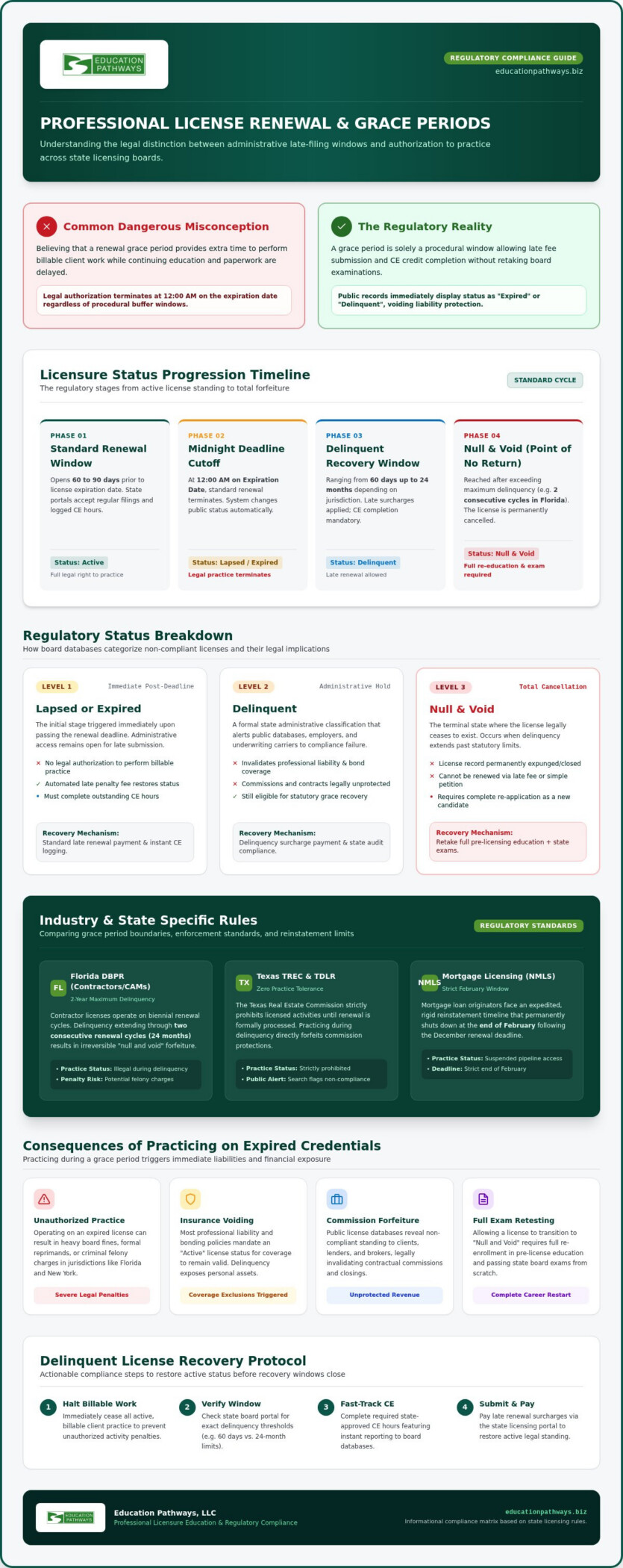
It is easy to confuse a “renewal window” with a grace period. A renewal window is the 60 to 90 day period before your license expires when the board opens the portal for standard submissions. A grace period only begins once that window closes and your license officially expires. These safety nets exist to prevent minor administrative errors from ending a career, but they come with significant restrictions.
Active vs. Inactive Status During the Grace Window
In almost every U.S. jurisdiction, your legal authorization to practice terminates at 12:00 AM on your expiration date. Even if your state board provides a recovery window, you cannot legally perform billable work during this time. For example, the Texas Real Estate Commission (TREC) prohibits all licensed activity until the renewal is processed. If you continue to work, you risk being charged with unauthorized practice. This can lead to hefty fines or even felony charges in states like Florida or New York. Public-facing license searches will typically display your status as “Expired” or “Delinquent,” which can immediately alert clients, lenders, and employers to your non-compliance. If you are a Texas real estate professional, maintaining an active status is the only way to ensure your commissions are legally protected.
Common Terminology Professionals Should Know
Navigating regulatory language is easier when you understand the specific status tiers used by boards like the Florida DBPR or Texas TDLR. Each term carries different weight for your career longevity.
- Lapsed or Expired: The initial stage after missing a deadline. You have no legal right to practice, but you can usually renew by paying a penalty.
- Delinquent: A formal administrative status. This often triggers immediate issues with professional liability insurance and bonding, as most policies require an “Active” license for coverage to remain valid.
- Null and Void: The point of no return. In Florida, if a license stays delinquent for two consecutive renewal cycles, it becomes null and void. This means the license no longer exists. You must restart the entire process, including pre-license education and exams.
Reinstatement is different from a late renewal. Reinstatement often requires a formal petition to the board and proof of why the deadline was missed. A late renewal is a standard, albeit expensive, automated process. For those managing a Florida contractor license renewal, staying within the late renewal window is the only way to avoid the “null and void” threshold.
How Grace Periods Differ Across States and Industries
State regulatory boards don’t follow a universal playbook for late renewals. A professional license renewal grace period in one industry might be a generous two-year window, while another gives you just 60 days to act. These differences exist because each board balances administrative flexibility with public safety and industry-specific risks. For instance, mortgage professionals under NMLS rules face a strict reinstatement window that closes at the end of February, whereas a Florida contractor might have up to 24 months before their license is permanently cancelled.
Your eligibility for these recovery windows often hinges on your Continuing Education (CE) status. If your hours aren’t logged in the state database, the system may automatically shift you into a delinquent status the moment the deadline passes. Reviewing licensing board renewal and late fee guidelines reveals that practicing during these intervals is a liability that many professionals underestimate. It’s not just a matter of paperwork; it’s a matter of legal authorization.
Contractor License Renewal Windows
For construction professionals, the biennial renewal cycle is a critical milestone. If you miss the deadline for a Florida contractor license renewal, the DBPR moves your status to “Delinquent.” You typically have until the end of the next renewal cycle to rectify this. Tennessee contractors face different timelines and reporting requirements that can be equally unforgiving. The ultimate risk is hitting the “Null and Void” threshold. Once this happens, you lose your right to practice entirely and must start your career over from scratch, including new exams and applications.
Real Estate and Property Management Timelines
Real estate agents face a different set of hurdles. A Texas real estate license renewal allows for a six-month late renewal period, but the financial sting is immediate. If CE is your only holdup, you can pay a $200 deferral fee for a 60-day extension, but you must do this before expiration to maintain an active status. Similarly, a Florida CAM license renewal requires precise CE tracking to avoid late penalties. You’ll often pay a significantly higher fee for the same credits if you wait until you’re in a delinquency window. To avoid these surcharges, it’s best to complete your requirements early through approved online courses that report your hours instantly to the board.
The Financial and Legal Risks of Relying on Grace Periods
Relying on a professional license renewal grace period is a high-stakes gamble. It isn’t just a minor administrative delay; it’s a direct risk to your financial and legal integrity. Late fees are often double the standard renewal cost. Beyond the immediate surcharge, you face the massive expense of a new application if you miss the window entirely. This includes testing fees, background checks, and weeks of lost billable hours while you wait for board approval.
Public registries don’t hide your status. When a client or employer sees “Delinquent” on a state portal, your professional reputation takes an immediate hit. It signals a lack of attention to detail that can kill a deal or lead to contract termination. Boards across the country use state continuing education requirements to ensure public safety. Failing to meet these timelines suggests you aren’t current with industry standards, which is a red flag for savvy consumers.
The Escalating Cost of Delinquency
State boards use tiered fee structures to penalize late filers. In California, real estate salespersons pay a 50% surcharge, while Texas licensees face a $200 deferral fee just to buy 60 extra days for CE completion. Florida contractors face statutory late fees that accumulate quickly. If you allow your license to hit the “Null and Void” threshold, you aren’t just paying a fine. You’re funding an entirely new career start. Administrative fines for practicing without a license can reach $1,000 per count in Florida for non-healthcare roles, plus potential jail time for first-degree misdemeanors.
Insurance and Contractual Implications
Your professional liability insurance is almost always contingent on maintaining an active license. If your status shifts to delinquent or expired, your carrier may deny indemnity and defense obligations for work performed during that period. This leaves you personally liable for malpractice or errors and omissions claims. In the construction and real estate sectors, contracts signed while your license is expired may be considered voidable. This means a client could legally refuse payment for completed work because you lacked the authority to enter the agreement. For those in mortgage lending, a lapsed state license triggers immediate federal compliance issues with the NMLS. Avoid these catastrophic risks by completing your Texas real estate CE or Florida contractor hours well before the clock runs out.
How to Successfully Renew During a Grace Period
Renewing your credentials within a professional license renewal grace period requires a methodical, fast-paced approach. You can’t afford administrative delays when your legal right to practice is on the line. Moving from a delinquent status back to active standing is a process of precise steps designed to satisfy board requirements quickly.
- Step 1: Verify your current status. Log into your state board’s portal immediately. Don’t assume you’re in a grace window based on old emails; check the registry for your specific expiration date.
- Step 2: Calculate exactly how many CE hours are missing. Review the board’s transcript of your credits. Identify specific mandatory topics like laws, rules, or safety that might be holding up your approval.
- Step 3: Complete CE credits. Use an online provider with instant reporting to bridge the gap. You need a platform that understands the urgency of a late window.
- Step 4: Pay all late fees. Submit the renewal application along with the delinquency surcharges. Ensure your payment is processed before the final recovery window closes.
- Step 5: Confirm the status change. Don’t resume work until the state registry officially updates your profile from ‘Delinquent’ to ‘Active’.
Accelerating Your Continuing Education
Self-paced online courses are the only viable option when you’re in a time crunch. You don’t have time for weekend seminars or rigid classroom schedules. Look for mobile-friendly modules that let you finish hours between client meetings or on the go. Instant certificates are vital; they serve as your immediate proof of compliance. It’s also critical to ensure your CE credits are reported automatically to the state board. Automated reporting eliminates the days of lag often associated with manual data entry by board staff, getting you back to work faster.
Documentation You Must Keep
A digital paper trail is your best defense against portal errors. Even if a system is automated, glitches happen. Keep copies of your completion certificates for at least two renewal cycles to provide immediate proof of compliance if you’re audited. Always save a PDF of your payment confirmation for late fees. This receipt proves you fulfilled your financial obligations within the allowed window. If the board portal lags, these documents are the only way to verify your standing with employers or insurance carriers. Start your fast-track renewal now to secure your professional standing.
Streamlining Your Renewal with Education Pathways
Education Pathways eliminates the friction of mandatory licensing requirements. When you’re stuck in a professional license renewal grace period, speed is your top priority. Our platform is 100% online and self-paced. We’ve designed every module to help you move from a delinquent status to an active one without unnecessary delay. You don’t need to hunt for individual classes or worry about missing a specific board requirement. We provide comprehensive packages that cover every state-mandated hour in a single location, ensuring you meet the exact standards of your regulatory board.
Reliability is at the core of our service. Every course we offer is state-approved and board-vetted. For professionals in Florida and Texas, we provide the critical benefit of instant reporting. The moment you finish your last module, our system begins the process of notifying your state board. This automated reporting is the fastest way to update your public registry status and protect your legal right to practice. It provides the peace of mind you need to focus on your clients rather than paperwork.
Why 20,000+ Professionals Trust Our Courses
We’ve been a leader in regulatory compliance since 2002. Our long history of expertise helps you navigate complex board rules with total confidence. We know your time is valuable and often limited. That’s why our learning modules are mobile-friendly. You can complete your hours on the job site, during a commute, or between client meetings. We support a wide range of industries, providing specialized, high-quality content for Florida contractors, CAMs, and Architects. We act as your dependable guide through the maze of CE mandates.
Get Started Before Your Window Closes
Don’t let a missed deadline jeopardize your career. You can enroll and start your courses in under five minutes. Our automated assessment system provides immediate feedback, ensuring you stay on track throughout the process. Once you finish, our reporting system takes over the heavy lifting of data transmission to the state. It’s a no-nonsense, efficient solution for a high-pressure situation. Take control of your professional compliance before your recovery window expires. Browse our professional CE course catalog and renew today.
Protect Your Career and Resume Practice
Maintaining your professional standing requires constant vigilance and a clear understanding of regulatory deadlines. A professional license renewal grace period provides a vital administrative safety net, but it’s never an authorization to continue billable work without an active status. By acting immediately, you avoid the steep financial penalties of delinquency and the permanent risk of license forfeiture. Your legal authority is your most valuable asset; don’t leave it to chance.
Education Pathways is here to streamline your compliance and restore your peace of mind. We’ve provided state-approved courses and automated board reporting since 2002, helping thousands of professionals navigate their renewal windows with ease. Our self-paced, mobile-friendly modules and instant certificates ensure you can satisfy your requirements without disrupting your busy schedule. Take the first step toward securing your professional future today. You’ve worked hard for your license, and we’re here to help you keep it.
Finish Your CE Credits Now and Secure Your License
Frequently Asked Questions
Is there a universal grace period for all professional licenses?
No, there is no universal grace period for all professional licenses. Every state regulatory board and industry operates under its own specific set of rules and timelines. A Florida contractor might have a two-year delinquency window, while a mortgage professional faces much tighter limits. Similarly, federally regulated careers follow distinct standards; for example, aspiring commercial pilots training with Flight School USA navigate FAA flight currency and medical certification rules rather than state CE schedules. You must check your specific board’s registry to confirm if a recovery window exists for your credential and what the exact deadlines are for 2026.
Can I still work if my license is in a grace period?
You cannot legally work once your license expires, even during an administrative grace window. Operating on an expired license constitutes unauthorized practice, which can lead to felony charges in states like Florida or New York. A professional license renewal grace period is a recovery time for paperwork and fees, not an extension of your legal right to practice. Always verify your status is “Active” before resuming billable work.
How much are typical late fees for professional license renewal in 2026?
Late fees vary by state and profession, but they often represent a substantial surcharge over the standard renewal cost. For instance, California real estate licensees typically pay a 50% penalty, while Texas real estate professionals may face specific deferral fees around $200. These costs are statutory. They must be paid in full alongside your standard renewal fee to move your license from a delinquent status back to an active standing.
What happens if I miss the grace period deadline entirely?
If you miss the final deadline of your recovery window, your license typically becomes “Null and Void” or permanently expired. At this stage, the license no longer exists in the state’s registry. You’ll likely be required to restart the entire licensing process from scratch. This includes completing new pre-license education, passing state exams again, and submitting a fresh application with all associated background checks and fees. For those who choose to pivot toward a new regulated career path rather than rebuild a lapsed credential, institutions like Aero Global Aviation Academy provide structured, career-oriented training programs to help students earn professional certifications from the ground up.
Do I need to retake my licensing exam if I miss the renewal window?
You usually only need to retake your licensing exam if your license has passed the delinquency phase and become null and void. During a standard professional license renewal grace period, you can typically restore your status by completing missing CE credits and paying late fees. However, once the board’s final cutoff date passes, most states require you to requalify as a new applicant, which involves passing the current state board examination.
How long does it take for CE credits to show up on my state board profile?
The timeframe depends on your education provider’s reporting method. While some manual systems can take several weeks, platforms like Education Pathways offer automated reporting that transmits your data to state boards almost immediately. Using a provider with instant certificates and automated reporting is the most efficient way to ensure your credits appear on your profile before a critical delinquency deadline expires. This speed is vital when you’re in a late window.
Can I use a grace period every renewal cycle?
While most boards allow you to renew late if you pay the required penalties, relying on a grace period every cycle is a high-risk strategy. Repeatedly missing deadlines can flag your profile for administrative audits and increases your total licensing costs. It also leaves you vulnerable to legal liability and insurance gaps during the days your license is technically expired. It’s always safer and more cost-effective to complete your renewal early during the standard window.
What is the difference between an inactive license and a delinquent license?
An inactive license is a voluntary status you choose when you aren’t currently practicing but want to keep your credential valid. A delinquent license is an involuntary status caused by missing a renewal deadline or failing to complete mandatory CE hours. While an inactive license is easy to reactivate, a delinquent license carries late fees, legal restrictions on practicing, and the risk of becoming null and void if not corrected quickly by the board’s deadline.