
Social Work Continuing Education Online: The 2026 Professional Guide

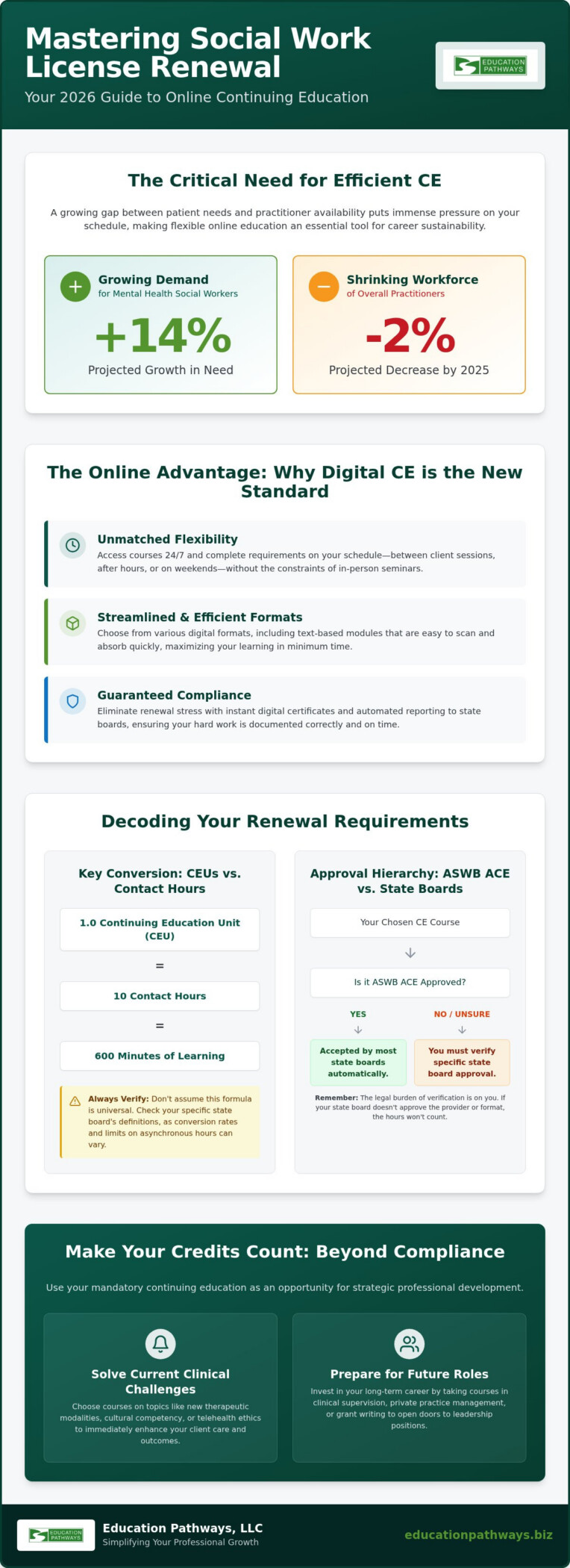
Did you know that while the need for mental health social workers is projected to grow by 14%, the overall number of practitioners is expected to decrease by 2% through 2025? This gap puts immense pressure on your daily schedule, leaving almost no time for traditional, in-person seminars. Finding reliable social work continuing education online shouldn’t add to that professional burden. You need a straightforward way to maintain your license without the fear of a board audit or the frustration of hidden fees buried in CE packages.
We agree that your focus should remain on your clients, not on decoding complex state mandates that change every cycle. This comprehensive 2026 guide is designed to help you master your license renewal requirements with total confidence. We will walk you through the latest state-specific regulations, including new 2026 mandates for Vermont and South Carolina, and show you how to access self-paced, verified courses. You’ll discover how to secure instant digital certificates and automated board reporting, ensuring your compliance is handled quickly and correctly.
Key Takeaways
- Learn how to distinguish between national ACE approval and specific state board requirements to ensure your credits are legally valid.
- Discover why social work continuing education online is now the most efficient way to maintain compliance while managing a growing clinical caseload.
- Evaluate different digital formats to find the most streamlined, text-based modules that fit into your busy professional schedule.
- Use your mandatory credits strategically by choosing topics that solve current clinical challenges or prepare you for supervisory roles.
- Eliminate renewal stress with a no-fluff approach that provides instant digital certificates and automated reporting to state boards.
Navigating the Requirements for Social Work Continuing Education Online
Professional license maintenance has evolved into a digital-first process. In 2026, staying current with your credentials requires more than just attending an occasional workshop. Online learning is now the primary vehicle for modern license renewal. This shift from traditional classroom settings to flexible digital modules reflects the reality of a busy clinical practice. You need training that moves at your pace, not the pace of a scheduled seminar.
Adopting a compliance-first mindset is essential for career longevity. This approach ensures you meet ethical standards while avoiding the stress of renewal delays. High-quality professional development strengthens your clinical skills and protects your standing with regulatory bodies. By prioritizing verified, state-approved courses, you can focus on client outcomes rather than paperwork hurdles.
Why Online CE is the Standard for Modern Social Workers
Flexibility is the greatest advantage of digital learning. Accessing social work continuing education online allows you to complete requirements 24/7, fitting your studies between client sessions or after hours. This model removes the logistical barriers of traditional education. You no longer need to worry about travel expenses, hotel bookings, or time away from your practice. Online continuing education is a state-approved method for maintaining professional licensure via digital platforms. It provides a streamlined path to compliance that respects your time and your budget.
Understanding CEUs vs. Contact Hours
One of the most common points of confusion during renewal is the difference between units and hours. Most state boards define a “contact hour” as 60 minutes of actual instruction. However, many accredited providers use the Continuing Education Unit (CEU) as their standard measurement. It’s a critical distinction that can impact your final tally.
In most jurisdictions, the math is standardized:
- 1 Contact Hour equals 60 minutes of learning.
- 0.1 CEU typically equals 1 contact hour.
- 1.0 CEU usually represents 10 full contact hours.
Don’t assume your state follows this exact formula. Some boards have unique conversion rates or specific limits on how many hours you can earn through asynchronous modules. Always check your specific state board definitions before enrolling in a course. Under-earning by even a small margin can lead to a rejected renewal or a stressful board audit. Choosing a provider that understands these nuances is the best way to ensure your social work continuing education online counts toward your 2026 goals.
Approval Standards: ASWB ACE and State Board Requirements
Understanding the alphabet soup of regulatory bodies is the most critical step in your renewal process. You’ll frequently see acronyms like ASWB, ACE, and NASW, but their relevance depends entirely on your specific jurisdiction. While a course might be “nationally recognized,” that doesn’t always mean it’s locally accepted. The legal burden of verification sits with you, the practitioner. If your state board hasn’t approved a specific provider or format, those completed hours won’t count toward your license maintenance.
The vetting process for approved providers is rigorous for a reason. It protects the public and reduces your professional liability. Organizations like the National Association of Social Workers (NASW) emphasize that high-quality professional development is a cornerstone of ethical practice. When you choose vetted social work continuing education online, you’re ensuring the content meets evidence-based standards and regulatory scrutiny. For a streamlined experience, you can find state-approved modules that have already undergone this heavy lifting.
The Role of the ASWB ACE Program
The Association of Social Work Boards (ASWB) created the Approved Continuing Education (ACE) program to standardize quality across North America. ACE status is widely considered the gold standard for providers. Most state boards accept ACE-approved courses automatically, which simplifies the renewal process for multi-state practitioners. However, exceptions exist. For example, New York maintains its own strict provider approval system and does not accept ASWB ACE approval. Always verify if your state is one of the few outliers before purchasing a large package.
State-Specific Mandates: Ethics, Cultural Competence, and More
Modern requirements are shifting toward specific, mandatory topics. In 2026, we’re seeing a significant increase in mandates for suicide prevention, telehealth ethics, and implicit bias. Vermont now requires one hour in systematic oppression or anti-oppressive practice starting with the 2026 renewal. South Carolina has introduced a new requirement for suicide assessment and management. You must also track how you earn these hours. Michigan requires at least 22.5 of your 45 hours to be live or synchronous, while Georgia mandates 20 live hours. Completing your social work continuing education online through asynchronous, self-paced modules is efficient, but only if you stay within your state’s digital caps.
Use this checklist to verify a provider’s credentials before you buy:
- Confirm the provider’s active ASWB ACE number or state-specific provider ID.
- Check if the course title matches your state’s mandatory topic definitions (e.g., “Professional Boundaries” for New York).
- Verify if the board limits the number of distance-learning or non-interactive hours.
- Ensure the provider offers automated reporting to systems like CE Broker if required by your board.
Comparing Online CE Formats: Text-Based vs. Multimedia Courses
Not all digital platforms provide the same experience. When you select social work continuing education online, you must decide between reading-intensive modules and video-based instruction. This choice often determines whether you finish your renewal requirements in a single afternoon or over several days. Your learning environment also plays a significant role. An office setting usually favors silent, text-based work, while a home office might allow for interactive video sessions with audio. Understanding these differences helps you select the format that maximizes your limited time.
Efficiency is the primary driver for most modern practitioners. While some enjoy the narrative flow of a video, others find the linear nature of multimedia courses frustrating. You can’t scan a video for the specific regulatory updates you need. Text-based learning empowers you to move at your own speed, focusing on complex sections while moving quickly through familiar topics. This flexibility reduces the friction of mandatory compliance and allows for a more integrated professional development experience.
Self-Paced Text Courses: Maximum Efficiency
Text-based modules prioritize speed and retention. These courses allow you to pause and resume according to your professional availability. Many practitioners find that reading technical regulations leads to better long-term retention compared to passive listening. This format is the best option for those who need to complete their social work continuing education online quickly. The Association of Social Work Boards (ASWB) ACE program ensures these text-based offerings meet rigorous educational standards. You can handle a client crisis and return to your studies without losing your place or missing a scheduled live session.
Webinars and Video Modules: Interactive Learning
Video formats offer a different level of engagement. Hearing from subject matter experts in real-time can provide clinical nuances that text sometimes misses. However, this interactivity comes with specific logistical requirements. You need high-speed internet and a quiet space for audio. Some states mandate a percentage of “live” or synchronous hours, making webinars a necessity rather than a choice. If your state allows asynchronous learning, text-based courses often prove more practical for a packed clinical schedule. Consider these factors before committing to a format:
- Technical Stability: Text courses work on almost any device or connection speed. Videos require consistent bandwidth.
- Time Commitment: Videos run for a fixed duration. Text allows you to finish as fast as you can read and comprehend the material.
- Environment: Text is discreet for office use. Video requires headphones or a private room.
- State Mandates: Verify if your state requires “interactive” hours before bypassing webinars entirely.
Choosing the right format isn’t just about personal preference. It’s about matching your education to your current professional reality. If you’re balancing a full caseload in 2026, the “no-fluff” approach of text-based modules often provides the fastest path to a verified certificate.
Strategic Career Growth: Choosing Courses Beyond Compliance
Compliance is the baseline for your professional standing, but it shouldn’t be the ceiling. Your license renewal is a prime opportunity for a strategic career pivot. Choosing the right social work continuing education online can position you for higher billing rates or a transition into a specialized private practice. If you’re eyeing a move into management, prioritize Supervision credits. These modules prepare you to oversee clinical associates and often command a higher hourly rate in the professional market. Specialized education transforms a mandatory task into a competitive advantage.
Balance is the key to an efficient renewal cycle. You can mix high-value clinical modules with general credits to meet your total hour requirements without burning out. If you find yourself struggling with a specific diagnosis or a challenging population, use your CE hours to bridge that knowledge gap. This approach ensures your professional development solves real-world clinical problems. It moves you beyond “checking a box” and toward becoming a recognized expert in your niche.
Specialized Topics: Clinical Practice and Trauma-Informed Care
Trauma-Informed Care (TIC) remains one of the most in-demand specialties in 2026. With the need for mental health social workers projected to grow by 14%, practitioners with specialized TIC training are better equipped for complex caseloads. Current practice trends are shifting toward neuro-informed interventions that focus on brain-body regulation. Look for courses that provide practical tools you can implement in your very next session. These specialized modules enhance your clinical efficacy while reducing the risk of secondary traumatic stress.
Tracking Your Credits and Preparing for Audits
A state board audit is a routine part of professional oversight, not a reason for anxiety. Preparation is simply a matter of organized record keeping. When an audit occurs, the board typically requests your certificates of completion, course descriptions, and proof of provider approval. You should follow a clear plan to stay ready:
- Digital Storage: Save all certificates in a dedicated folder labeled by renewal year.
- Retention Period: Keep your records for at least 4 to 6 years, depending on your specific state board requirements.
- Verification: Ensure your certificates clearly show the provider’s approval number and the date of completion.
Organizing your social work continuing education online ensures you can respond to board inquiries within the standard 30-day window. For a reliable way to manage your compliance and maintain your records, you can enroll in social work continuing education that provides instant digital certificates. This simple step provides peace of mind and ensures you are always ready for regulatory scrutiny.
Streamlining Your License Renewal with Education Pathways
Professional compliance shouldn’t be a source of stress or a drain on your clinical time. Education Pathways offers a “no-fluff” philosophy designed specifically for the modern social worker. Our approach is simple: enroll, complete your modules, and receive your certificate. We’ve eliminated the unnecessary narrative elements and technical hurdles that often plague association-heavy platforms. Since 2002, we’ve focused on providing a direct path to board-accepted results through a 100% online format accessible from any digital device.
Maintaining your credentials shouldn’t require a complex user manual. Whether you’re at your office desk or using a tablet at home, our platform remains fully functional and intuitive. We understand that your priority is your caseload. Our role is to act as your dependable guide, ensuring the regulatory heavy lifting is already done. This allows you to secure your social work continuing education online without the typical friction of license maintenance.
Why Professionals Trust Our State-Approved Modules
Stability is a core component of professional trust. Education Pathways serves a wide range of licensed individuals, including Florida contractors, Texas real estate professionals, and architects. This breadth of experience across different regulatory environments proves our institutional stability and expertise in compliance. When you choose our modules, you’re partnering with a seasoned veteran that understands the nuances of state board requirements. We’ve spent over two decades refining our process to ensure it meets the highest standards of official verification.
Speed is often a necessity, not just a preference. Our instant certificate feature is the ideal solution for last-minute renewals or practitioners who prefer to finish their credits in a single block of time. There’s no waiting for an administrator to review your results or for a physical copy to arrive in the mail. You get immediate proof of completion the moment you finish. Our self-paced structure respects your schedule, allowing you to move through the material as quickly as your comprehension allows. It’s the most efficient way to handle social work continuing education online while managing a full-time practice.
Ready to Renew? Your Next Steps
Your first step is to verify your current cycle requirements. State mandates for 2026 can vary significantly, as we’ve discussed regarding new rules in Vermont and South Carolina. Our platform provides clear guidance on which courses meet your specific board’s criteria. Once you’ve identified your needs, you can move directly to our social work course catalog to begin your progress. Don’t let your renewal deadline become a crisis. Browse our state-approved social work CE courses and get your instant certificate today.
Secure Your Professional Standing for 2026
Maintaining your license shouldn’t feel like a second job. You now have the essential tools to distinguish between national standards and local mandates while choosing formats that prioritize your limited time. By focusing on state-approved modules and strategic clinical topics, you turn a mandatory requirement into a genuine career asset. Completing your social work continuing education online provides the flexibility needed to balance a heavy caseload with the necessity of professional compliance.
Education Pathways has supported licensed professionals since 2002, providing a reliable bridge between complex regulations and simple execution. Our platform delivers peace of mind through instant digital certificates of completion and automated reporting to state licensing boards. This ensures your records are always audit-ready without the need for manual paperwork. Enroll in state-approved social work CE courses now to eliminate the stress of your next renewal cycle. You’ve dedicated your career to serving others; we’re here to make sure your professional credentials stay as strong as your clinical practice.
Frequently Asked Questions
How many hours of social work continuing education do I need for renewal?
Requirements vary significantly by state, typically ranging from 30 to 45 hours every two years. For example, California requires 36 hours, while Florida and Illinois mandate 30. You should check your specific board’s 2026 renewal cycle rules to confirm the exact number of credits required for your license type.
Will my state board accept online CE courses from Education Pathways?
Yes, Education Pathways provides state-approved courses that meet the strict regulatory standards of individual licensing boards. Since 2002, we’ve focused on delivering social work continuing education online that aligns with current mandates. You should always verify your state’s specific provider list to ensure current approval status for your jurisdiction.
What happens if I am audited by the social work licensing board?
If you’re audited, the board will request copies of your certificates of completion and proof of course approval. You’ll typically have 30 days to submit this documentation to the regulatory body. Using a provider that offers instant digital certificates and automated board reporting makes responding to an audit a fast and stress-free process.
Can I complete all of my CE credits online in 2026?
Many states allow 100% online completion, but several still limit asynchronous or distance learning hours. Alaska and Washington have removed limits on distance learning for 2026. However, states like Michigan and Georgia require a specific percentage of “live” or synchronous credits. Always verify your local caps before enrolling in a full curriculum.
Do I get my certificate of completion immediately after finishing a course?
Yes, you receive an instant digital certificate the moment you finish your module. This feature is a core part of our social work continuing education online experience, designed for professionals who need immediate proof of compliance. You can download, print, or save your certificate directly from our platform for your permanent records.
Are these courses ASWB ACE approved?
Our courses are designed to meet the standards set by state boards, including those that recognize the Association of Social Work Boards (ASWB) ACE program. You can find specific approval numbers in each course description. Note that some states, such as New York, maintain independent approval systems and don’t utilize the ACE standard.
What is the difference between a live webinar and a self-paced online course?
A live webinar occurs in real-time with an instructor, while a self-paced course allows you to review material on your own schedule. Self-paced modules offer the most flexibility for clinicians with unpredictable caseloads. Live webinars are often required by states that mandate a portion of your hours be “interactive” or synchronous.
How long should I keep my CE certificates after my license is renewed?
You should keep your CE certificates for at least 4 to 6 years, depending on your state’s specific laws. Florida practitioners must retain records for 4 years, while other jurisdictions may require longer periods. Digital storage is the most efficient way to organize these documents and ensure you’re prepared for any future board inquiries.