
Tracking CE Credits: A 2026 Guide for Professionals

Imagine it’s 48 hours before your license expires. You’re certain you finished that mandatory ethics course last spring, but the certificate is nowhere to be found. This frantic search for digital files or paper records is a scenario many licensed professionals face every renewal cycle. You’ve worked hard for your credentials; you shouldn’t have to risk them because of a lost email or a disorganized folder. Learning how to keep track of continuing education credits efficiently is the only way to avoid this last-minute panic. With the U.S. continuing education market projected to reach nearly $96 billion by 2030, the sheer volume of available courses makes staying organized more difficult than ever.
Mastering your professional license renewal is about more than just compliance. It’s about protecting your career and gaining peace of mind. This guide provides a clear roadmap for 2026 to help you centralize your certificates and automate your reporting. We’ll examine the top digital tracking tools, discuss new state mandates like the 2026 Texas requirements, and share a hybrid system that ensures you’re always audit-ready. You’ll learn how to transform a stressful chore into a streamlined, automated process that works in the background of your busy professional life.
Key Takeaways
- Identify the high risks of poor credit management, including potential fines and license suspensions that can derail your professional career.
- Compare the pros and cons of manual, app-based, and provider-led systems to determine how to keep track of continuing education credits most effectively.
- Implement a hybrid tracking strategy that combines automated reporting with a personal digital backup to ensure you are always audit-ready.
- Follow a streamlined 5-step system to inventory your 2026 requirements and organize your professional development portfolio into a single, accessible hub.
- Leverage automated board reporting and instant certificates to eliminate manual data entry and gain immediate peace of mind during renewal seasons.
The Risks of Poor CE Credit Management
Professional development is a career-long journey. CE credit tracking is the systematic recording of these hours to ensure compliance. What is Continuing Education? It’s the proof that you’ve maintained your expertise. Understanding how to keep track of continuing education credits effectively protects your reputation and your livelihood. Without a reliable system, you’re essentially gambling with your professional standing.
In 2026, state boards are moving toward stricter digital verification. For example, Texas now mandates the use of CE Broker for behavioral health licensees. For real estate professionals, staying compliant with Texas real estate CE requirements is equally critical. This shift means manual reporting is becoming obsolete. If your records aren’t digital and verifiable, they might as well not exist. This is why learning how to keep track of continuing education credits is no longer a luxury; it’s a professional necessity.
Audit anxiety is a real phenomenon. It’s that sinking feeling when a board notice arrives and you can’t find your certificates. Disorganized portfolios increase stress and consume billable hours. A single missing hour can trigger a full investigation into your professional history.
Common Consequences of Missing Credits
Missing a single credit can trigger a domino effect of professional setbacks. Boards rarely offer grace periods for administrative errors. If you fail to provide proof during an audit, the penalties are swift and severe.
- Immediate license expiration: Your license may be suspended the day after the deadline. This prevents you from legally pulling permits or signing off on professional documents. For those in the building trades, checking your Florida contractor license renewal status early is vital to avoid work stoppages.
- Loss of insurance coverage: Professional liability and workers’ compensation coverage often depend on an active license. If your license lapses, your insurance carrier might deny claims or cancel your policy entirely.
- Retesting requirements: Some jurisdictions require you to sit for the initial licensing exam again if your license lapses for too long. This is a massive drain on time and resources that most professionals can’t afford.
Why Manual Filing Often Fails
The “Shoebox Method” of keeping physical folders is a significant liability. Paper records are fragile and easily misplaced. Relying on physical artifacts in a digital-first regulatory environment creates unnecessary friction.
- Fading ink: Thermal paper receipts from in-person seminars often turn blank within a year. By the time an audit occurs, your proof of attendance may be a literal blank page.
- Lost email attachments: Digital certificates can disappear in spam filters or be deleted during inbox cleanups. Searching through thousands of emails for one specific PDF is an inefficient use of your time.
- Calculation errors: Manually tracking multi-year cycles is complex. It’s easy to miscount hours or miss specific topic mandates, such as ethics or safety, which are often required as a subset of your total hours.
Comparing the Best CE Credit Trackers for Professionals
Choosing the right system depends on your specific industry and state requirements. Professionals generally use three main methods: manual spreadsheets, specialized apps, or provider-led dashboards. Understanding CEU Credits is the first step in evaluating these options. You must know exactly what counts as a credit before you can track it effectively. The best systems offer high board integration and mobile accessibility for professionals working in the field.
Mobile access is critical for contractors and field workers. You should be able to snap a photo of a physical certificate and upload it to your tracker immediately. Waiting until you get back to a desktop computer often leads to lost paperwork. Before committing to a platform, verify if your state board mandates a specific tracker. For example, Texas now requires certain professionals to use specific digital platforms to maintain their license status. Learning how to keep track of continuing education credits on the go ensures nothing slips through the cracks.
Specialized Tracking Platforms
Platforms like CE Broker are becoming the industry standard. In 2026, some states have even made these platforms mandatory for specific license types. These tools perform the “compliance math” for you, identifying exactly which hours you still need to complete. This is a highly reliable way to manage your records without manual errors. This trend toward niche-specific automation is visible across many sectors; for instance, automotive finance professionals looking to streamline their own operational compliance can check out Verifacto for specialized dealer and loan management tools.
- Pros: Direct board links, automated reporting, and real-time compliance status updates.
- Cons: Basic accounts are free, but premium features like document storage often require a subscription, with professional tiers starting at $39.99 per year.
- Best for: Healthcare workers and Florida-based contractors with complex, multi-topic requirements.
Digital Manual Systems
If you want to avoid subscription fees, building a custom dashboard is a practical choice. Using Google Sheets or Excel allows you to categorize your credits exactly how you want. This method works well for professionals with straightforward requirements who are comfortable managing their own archives.
- Searchable Archives: Store all certificates in a dedicated cloud folder like Google Drive or Dropbox. Label files by date and course name for easy retrieval.
- Custom Dashboards: Create a simple spreadsheet to track the date, course provider, and category of every credit earned.
- Proactive Alerts: Use your digital calendar to set automatic reminders six months before your renewal deadline.
Manual tracking requires discipline. It’s easy to miscalculate hours or forget a mandatory topic when you handle the data yourself. To simplify your process, consider Texas real estate CE classes that offer automated reporting. This ensures your credits are logged correctly without the need for manual entry, giving you one less thing to worry about. Knowing how to keep track of continuing education credits is easier when the provider does the heavy lifting for you.
Manual vs. Automated Tracking: Finding Your Ideal Workflow
Deciding how to keep track of continuing education credits often comes down to a choice between automation and manual control. While automated systems offer significant ease, they shouldn’t be your only line of defense. A hybrid approach is the most reliable way to manage multiple state licenses with varying deadlines. By combining the speed of automated reporting with a personal backup, you eliminate the risk of technical failures during a renewal cycle.
Managing credits across multiple states requires a high level of organization. Each board may have different reporting requirements and expiration dates. For example, some states require providers to report hours directly, while others place the burden entirely on the licensee. Understanding these nuances is the first step in building a workflow that prevents license lapses and reduces administrative stress.
The “Set and Forget” Automated Model
Automation has revolutionized professional compliance. Many industry-specific tools, such as the CPE Monitor tracking service for pharmacists, provide a direct link between educational providers and licensing boards. When you use a provider like Education Pathways, LLC, your credits are reported directly to the state board. This “provider-reported” model significantly reduces the risk of manual data entry errors and ensures your hours are logged officially without extra effort.
However, the validity of this automation depends entirely on the provider’s status. Always verify that your course provider is “State-Approved” for your specific license type. For instance, Florida CAM CE requirements specify that courses must be DBPR-approved to count toward your license. Once a course is completed, credits typically appear on your official state transcript within 7 to 14 business days. Checking this timeline ensures your automated system is functioning as expected.
Building a Redundant Backup System
Relying 100% on third-party automated systems is a hidden danger. Technical glitches or reporting delays can happen. This is why “Instant Certificates” are the gold standard for personal record-keeping. They provide immediate, tangible proof of completion. If an automated report fails to reach the board, you have the documentation necessary to resolve the issue quickly. Knowing how to keep track of continuing education credits means always having a secondary source of truth.
Create a standardized naming convention for your digital files to keep your archive organized. Use a format like “YYYY-MM-DD_CourseName_Provider.pdf”. This makes your searchable archive functional and easy to navigate during an audit. Additionally, establish an “Annual Review” habit. Check your official board transcript at least 90 days before your renewal deadline. This window gives you enough time to resolve any reporting discrepancies. If you hold licenses in multiple states, this review is even more critical to ensure every board has received the correct documentation.
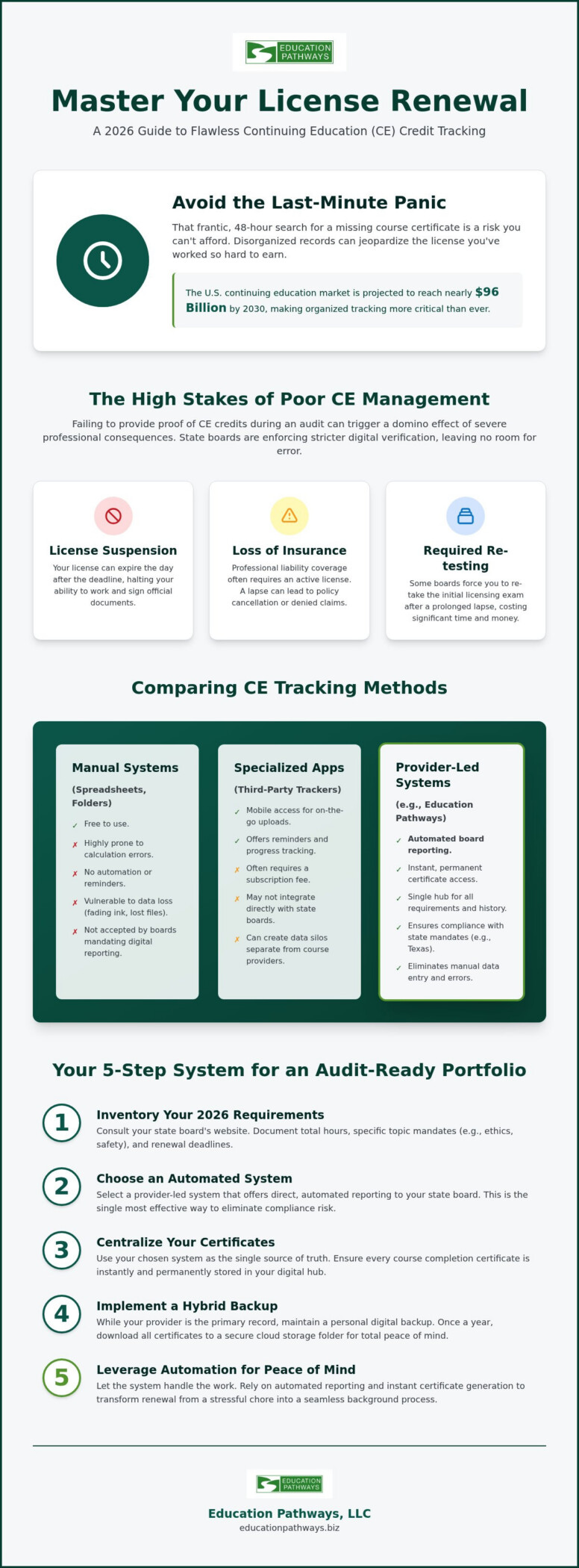
A 5-Step System to Organize Your Continuing Education Portfolio
Organizing your professional portfolio is the only way to eliminate “renewal dread” for good. This 5-step system provides a repeatable framework for how to keep track of continuing education credits without wasting valuable billable time. First, inventory your specific state and board requirements for the 2026 cycle. Regulatory rules change frequently. For example, New York dentists must complete specific mandated reporter training by November 17, 2026. Second, choose your primary tracking hub. Whether you prefer a specialized digital app or a custom spreadsheet, you must commit to one central source of truth.
The middle steps focus on accessibility and foresight. Third, centralize all past certificates into a single searchable cloud folder. Use clear labels so you can pull up a PDF in seconds during a site visit or audit. Fourth, schedule “Gap Analysis” check-ins every six months. These mini-audits help you identify missing hours early, preventing a frantic scramble in the final weeks of your cycle. Finally, verify your completion with the licensing board at least 30 days before your expiration date. This buffer allows you to resolve any reporting discrepancies before they impact your license status.
Audit-Proofing Your Documentation
State board auditors look for precision above all else. They verify that your name, license number, and course approval code match their internal records perfectly. Even a small typo can lead to a rejected credit. If your board allows “Carry-Over” hours, track them in a separate column in your spreadsheet to avoid confusion in the next cycle. This level of detail turns a potential audit into a minor administrative check rather than a career-threatening event. It’s the ultimate way to maintain professional peace of mind.
Managing Multi-State Requirements
Tracking credits across state lines requires managing different “buckets” such as Ethics, Core, and Electives. Some states offer reciprocal courses that count for multiple licenses simultaneously, but you must verify this before assuming credit. For instance, staying on top of the Florida Contractor CE Guide helps you navigate complex multi-hour breakdowns required by the DBPR. Mastering how to keep track of continuing education credits across these categories prevents you from over-earning in one area while neglecting a mandatory topic in another.
Ready to simplify your next renewal cycle? Explore our Florida Contractor CE Hub for a streamlined, state-approved solution that handles the heavy lifting for you.
Streamlining Your Renewal with Education Pathways’ Automated Reporting
The most effective way to eliminate the administrative burden of license renewal is to choose an education provider that handles the data for you. Education Pathways removes the friction of manual entry by acting as your compliance partner. When you complete a course, the primary challenge of how to keep track of continuing education credits is solved through our integrated reporting systems. Since 2002, we’ve refined our process to ensure that your professional development hours move seamlessly from our classroom to your official state record.
Our 100% online, self-paced courses are built specifically to meet modern compliance standards while respecting your busy schedule. This “set it and forget it” approach allows you to focus on your work rather than your paperwork. By leveraging state-approved reporting, you gain the highest level of security for your professional credentials. It’s the most reliable method to protect your license from accidental lapses or reporting delays.
Direct Board Reporting Explained
Direct reporting acts as a digital bridge between your course completion and the state licensing database. When you finish a module, our system initiates a secure data transfer to the relevant board, such as the DBPR in Florida or TREC in Texas. This automated verification significantly reduces the risk of human error, such as mistyping a license number or course code. Explore the Florida CAM CE requirements to see how automated reporting works for community association managers. This system ensures your official transcript is updated accurately without requiring you to log into multiple state portals.
Course Packages Designed for Easy Tracking
Bundle packages offer a distinct advantage for professionals who want to simplify their record-keeping. Tracking a single “All-in-One” package is much easier than managing ten individual certificates from different sources. Our pre-bundled solutions are curated to meet every specific state requirement, including mandatory topics like ethics or safety. Check out the Texas Real Estate CE Hub for pre-bundled tracking solutions that cover your entire renewal cycle in one place.
Beyond automation, Education Pathways provides “Instant Certificates” the moment you finish a course. These documents serve as your immediate, tangible proof of completion. Even if you rely on automated board reporting, having these PDFs in your personal student portal provides a critical backup for your own tracking system. You can access your lifetime course history through our portal at any time, ensuring you’re always prepared for an audit or a multi-state license verification. Mastering how to keep track of continuing education credits is simple when your provider does the heavy lifting for you.
Secure Your Professional Standing for 2026
Your professional license is the foundation of your career. Staying organized is the only way to protect it. By implementing a hybrid system that combines automated reporting with a personal digital archive, you eliminate the risk of missing a critical deadline. You now have the tools to build a searchable portfolio that withstands any state audit. Mastering how to keep track of continuing education credits isn’t just a regulatory requirement; it’s a smart strategy for long-term professional success. Don’t let a disorganized folder or a lost email put your credentials at risk during your next renewal cycle.
Education Pathways is here to simplify your compliance journey. Since 2002, we’ve provided direct reporting to state boards, ensuring your hours are logged officially and accurately. Our 100% online, self-paced learning environment includes instant digital certificates with every course to serve as your personal backup. Browse State-Approved CE Courses with Automated Reporting today to streamline your next renewal. You’ve worked hard for your license; let’s work together to keep it active and secure.
Frequently Asked Questions
Do CE credits get reported automatically to the state board?
Automated reporting depends on your specific course provider and state regulations. While many state-approved providers handle this for you, some boards require you to self-report your hours. For instance, Education Pathways has provided automated reporting to state databases since 2002. Always check your provider’s status to confirm if they transfer data directly. Knowing how to keep track of continuing education credits involves verifying this step before you enroll in any course.
How long should I keep copies of my CE certificates?
Most state boards recommend keeping records for at least four years. For example, California requires licensees to maintain CE documentation for four years in case of a random audit. Even if your credits are reported automatically, having a digital backup protects you against technical glitches or reporting errors. Store these in a searchable cloud folder for easy retrieval during future renewal cycles or when applying for multi-state licensure.
Is there a free CE credit tracker for professionals?
Yes, several free options exist for tracking your professional development hours. Basic accounts on platforms like CE Broker are free, though they may charge for premium features like compliance alerts. Alternatively, you can use a simple Google Sheet or Excel spreadsheet to build a custom dashboard. This manual method is effective if you stay disciplined with your data entry and maintain a consistent file organization system for your certificates.
What happens if my CE credits are not reported before the deadline?
Failing to report credits before the deadline typically results in an immediate license suspension. You might also face significant fines or be required to pay late renewal fees to reinstate your credentials. In some jurisdictions, a lapsed license can lead to the loss of professional liability insurance coverage. To avoid these risks, complete your courses at least 30 days before the expiration date to allow ample time for board processing.
Can I track credits for multiple states in one system?
Yes, you can manage multiple state licenses using a centralized digital hub. Specialized apps often allow you to add various licenses and track specific “buckets” like ethics or core requirements for each state simultaneously. If you prefer a manual approach, create separate tabs in a master spreadsheet for each jurisdiction. This level of organization is vital for professionals practicing under interstate compacts who must fulfill different state-specific mandates.
How do I verify if a CE course is state-approved for 2026?
Check the official website of your state licensing board for a list of approved providers and courses. Most boards provide a searchable database where you can enter a provider’s name or a specific course ID. For the 2026 cycle, ensure the course covers new mandates, such as the Mandated Reporter training required in New York. Reputable providers will clearly display their state approval codes on their course description pages.
What is the best way to organize digital CE certificates?
The most efficient method is using a searchable cloud folder with a standardized naming convention. Label every PDF with the completion date, course name, and provider, such as “2026-05-15_Ethics_EducationPathways.pdf”. This system makes finding specific documents easy during a surprise audit. Learning how to keep track of continuing education credits digitally ensures your proof of completion is never more than a few clicks away, regardless of your location.
How do I find out how many CE credits I still need?
Log into your official state licensing portal or transcript service to see your current credit balance. Many boards now use digital platforms to provide real-time updates on your compliance status. If your state doesn’t offer a live transcript, compare your personal certificates against the board’s published requirements for the 2026 cycle. Performing a personal “Gap Analysis” early in your renewal period prevents last-minute stress and ensures you meet all mandates.