Complete Guide to Mortgage Loan Originator License Renewal in 2026

Your 2026 mortgage loan originator license renewal shouldn’t be a source of year-end stress that pulls you away from closing loans. You’re likely managing a heavy pipeline while trying to track fluctuating state deadlines and the updated $35 NMLS system fees. It’s frustrating when mandatory compliance feels like a second job, especially when every state has its own set of rules. We understand that your time is your most valuable asset, and missing a Smart CE deadline like December 4 can put your entire career on hold.
This guide provides a clear roadmap to master the renewal process. You’ll learn how to manage the NMLS requirements and state-specific compliance with total confidence. We’ll break down the mandatory 8 to 12-hour education requirements, highlight the critical dates you can’t afford to miss, and show you how to automate your credit reporting. By the end of this article, you’ll have a streamlined plan to secure your license for 2027 so you can focus on what you do best: funding mortgages.
Key Takeaways
- Learn how the NMLS centralizes the 2026 renewal cycle and why tracking federal deadlines is critical for maintaining your active status.
- Identify the exact breakdown of the 8-hour SAFE Act core and how state-specific requirements impact your mortgage loan originator license renewal.
- Compare self-paced online learning with live formats to find the most efficient path for completing mandatory hours while managing your loan volume.
- Follow a step-by-step roadmap to audit your current NMLS credits and enroll in the correct courses to close any compliance gaps.
- Discover how to leverage automated reporting and instant certificates to remove the administrative burden of annual licensing.
Understanding the 2026 MLO License Renewal Cycle
Completing your mortgage loan originator license renewal is a non-negotiable part of maintaining your professional standing. This annual requirement stems from the SAFE Act, which ensures that every licensed professional meets high standards of competency and ethics. The process isn’t just a suggestion; it’s a statutory mandate that keeps the industry transparent and protects consumers. By centralizing everything through the Nationwide Multi-State Licensing System and Registry, regulators can track your compliance in real time. It’s a streamlined system, but it requires your active participation to keep your career moving forward.
The Role of the SAFE Act in Your Career
The SAFE Act changed the mortgage landscape by establishing national minimum standards for all originators. It replaced a fragmented state-by-state system with a cohesive framework. Continuing education stands as the cornerstone of this legislation. Some professionals mistakenly believe renewals are biennial, but the law is clear: you must renew every single year. This consistent oversight ensures you stay updated on federal laws and shifting market regulations. It’s not just about keeping a piece of paper; it’s about proving your expertise to your clients and your peers annually.
NMLS Account Management and Deadlines
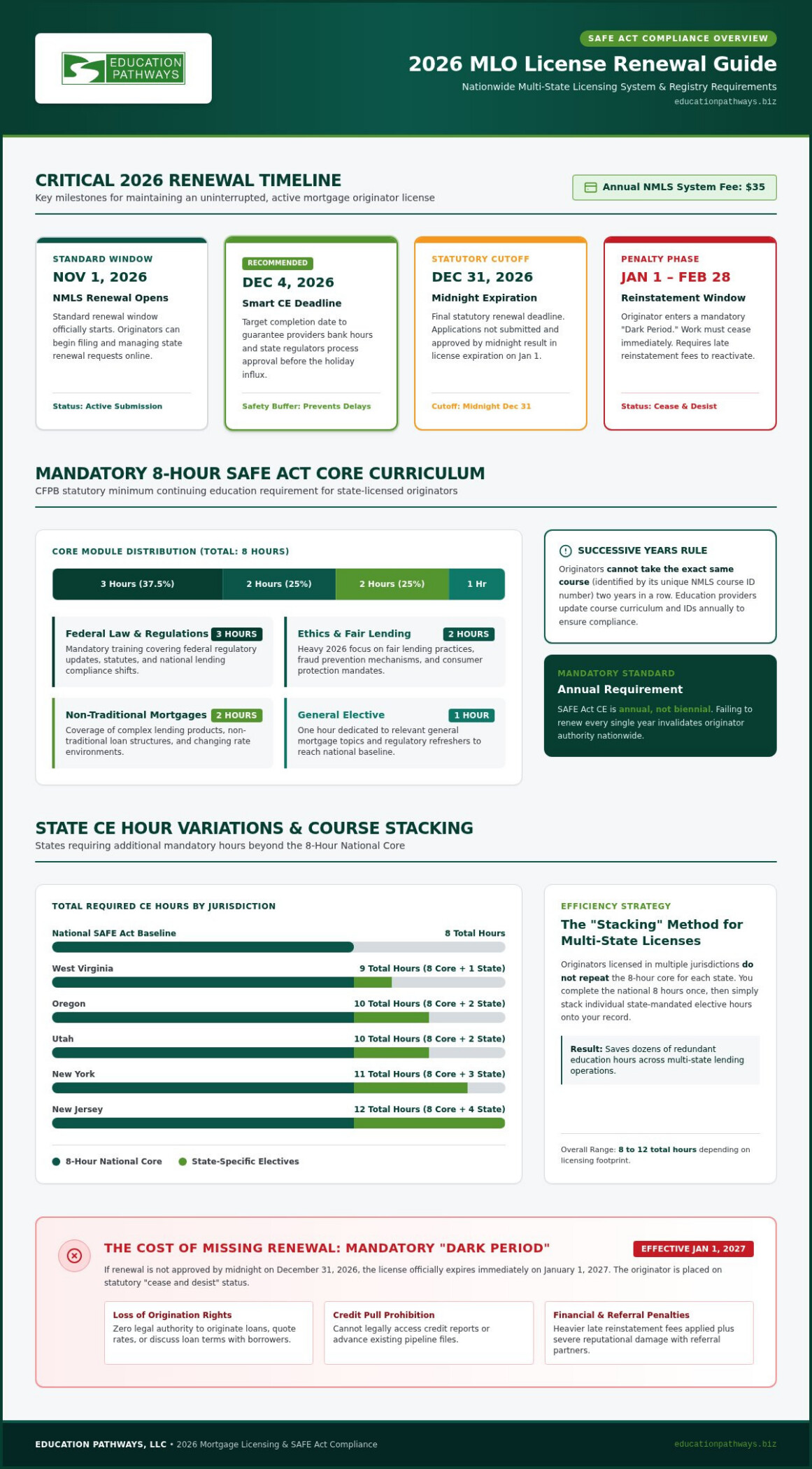
Success starts with active management of your NMLS portal. You should regularly audit your record to ensure your contact information and employment history are current. For 2026, the standard renewal window opens on November 1st and runs through December 31st. However, waiting until the final week is a significant risk. Most experts recommend the “Smart CE” deadline of December 4, 2026. This date ensures your education provider has enough time to bank your hours and the state regulator can process your filing before the holiday rush. You can find more detail on specific requirements in our NMLS Approved MLO Continuing Education: Your 2026 Ethics Compliance Guide.
Consequences of Missing the Deadline
Missing the window for your mortgage loan originator license renewal doesn’t just result in a late fee. If your renewal isn’t approved by midnight on December 31st, your license officially expires on January 1, 2027. You’ll immediately lose the legal authority to originate, pull credit, or even discuss loan terms with clients. This “cease and desist” status can paralyze your business and damage your reputation with referral partners. While a reinstatement period exists from January 1st through February 28th in many states, you’ll face higher fees and a mandatory “dark period” where you cannot work. Planning ahead is the only way to ensure your business remains uninterrupted.
Mandatory CE Requirements: National vs. State Hours
For professionals licensed in multiple jurisdictions, managing education requirements is often the most complex part of the mortgage loan originator license renewal process. You must balance the federal baseline with specific mandates from state regulators. Failing to account for these variations can lead to a rejected renewal application, even if you’ve finished your national hours. Success requires a methodical approach to tracking both the 8-hour core and any state-specific electives.
Breaking Down the 8-Hour National Requirement
The SAFE Act establishes the CFPB minimum annual license renewal requirements that apply to every state-licensed originator. This 8-hour core consists of specific modules designed to keep your skills sharp. You’ll complete three hours of federal law and regulations, two hours of ethics, and two hours of training on non-traditional mortgage products. The final hour is a general elective. In 2026, ethics training focuses heavily on fair lending and fraud prevention, while non-traditional modules cover complex products in a shifting interest rate environment.
One critical regulation to remember is the “Successive Years” rule. You cannot take the exact same course, identified by its NMLS course ID number, two years in a row. Education providers update their curriculum annually to ensure you receive fresh, relevant information while staying compliant. This prevents originators from simply repeating the same material to check a box.
Navigating State-Specific Electives
While the 8-hour core is the national baseline, several states require additional hours. If you’re licensed in New Jersey, you must complete 12 total hours. New York requires 11 hours, while Oregon and Utah mandate 10. West Virginia requires 9 total hours. If you hold licenses in multiple states, you don’t have to start from scratch for each one. You can take the 8-hour national core once and then “stack” the specific state modules required by your other jurisdictions.
- New Jersey: 4 additional NJ-specific hours
- New York: 3 additional NY-specific hours
- Oregon and Utah: 2 additional state-specific hours
- West Virginia: 1 additional state-specific hour
You can simplify this process by using NMLS Approved MLO Continuing Education packages that bundle these requirements together. This prevents redundant work and ensures every hour counts toward your total. Always verify your specific needs against the NMLS state-specific education chart before enrolling. Checking this early in the fourth quarter prevents last-minute surprises during your mortgage loan originator license renewal.
Choosing the Right MLO Continuing Education Provider
Selecting a provider for your mortgage loan originator license renewal is a decision that impacts your professional peace of mind. While many vendors offer courses, not all provide the same level of administrative support or technical reliability. Your primary goal is to find an NMLS-approved partner that respects your schedule and guarantees the accuracy of your reported hours. Efficiency is key; you don’t want to spend your time chasing down certificates or debating with a support team about a reporting delay.
NMLS approval is the non-negotiable foundation of your search. Without it, your time and money are wasted. Beyond approval, consider the delivery format. Live webinars require you to be stationary at a specific time, which is often impossible during high-volume loan periods. 100% online, self-paced courses offer the flexibility to study at 2 a.m. or during a lunch break. This format removes the friction of scheduling and lets you move through the material at your own speed. According to the Conference of State Bank Supervisors renewal guidance, preparing early is the best way to avoid system bottlenecks. Choosing a provider with a proven track record ensures that your credits move seamlessly into the NMLS database.
Automated reporting is another critical feature. You shouldn’t have to manually upload hours or worry if your provider has banked your credits. Reputable providers handle the reporting within a few days of completion, often much faster. Instant certificates are also essential. They provide an immediate paper trail for your employer and your own records, serving as a backup while you wait for the NMLS system to update. This documentation is your first line of defense if any questions arise about your compliance status.
Benefits of 100% Online, Self-Paced Courses
User-friendly interfaces and mobile-friendly platforms significantly reduce compliance stress. You can access materials 24/7 from any device, making it easier to fit education into a busy work week. This convenience is vital when you’re managing multiple files and tight closing dates. It turns a mandatory task into a manageable part of your routine. You can pause when a client calls and resume exactly where you left off without missing a beat. If you are exploring broader digital learning platforms and certified course materials, discover NAVO to see how modern providers structure flexible online education.
Verifying Course Credibility and Support
Look for a provider with a long-standing history, such as one operating since 2002. Experience matters because these veterans understand the nuances of regulatory changes and reporting quirks. Robust customer support is another factor. If there’s a technical glitch or a reporting delay, you need a responsive team to resolve it quickly. While our focus here is mortgage licensing, we apply these same high standards of reliability across all our programs, as detailed in our Social Work Continuing Education Online: The 2026 Professional Guide. A trusted facilitator does the heavy lifting of vetting information so you can proceed with confidence.
Step-by-Step Guide to Completing Your Renewal
Completing your mortgage loan originator license renewal requires more than just finishing your hours. You need a tactical approach to navigate the NMLS portal without getting stuck in the end-of-year bottleneck. By following a structured timeline, you can avoid late fees and the risk of a license lapse on January 1st. The most successful professionals treat the renewal window as a business process rather than a last-minute chore.
- Step 1: Audit your current NMLS credits. Log in to your portal in October to identify any gaps. Don’t assume your previous year’s hours carry over or that your records are automatically perfect.
- Step 2: Enroll in an NMLS-approved course. Choose a provider that offers the 8-hour core plus any state-specific electives you need. Ensure they have a history of fast, accurate reporting.
- Step 3: Complete the course and download your certificate. Finish your hours by the “Smart CE” deadline of December 4, 2026. Always keep a copy of your instant certificate for your personal compliance files.
- Step 4: Confirm your “Ready to Renew” status. Monitor your NMLS account to ensure your provider has banked your hours. This status is the green light to proceed with your filing.
- Step 5: Pay fees and submit your attestation. Submit your renewal application through the NMLS and pay the required processing and state fees.
The “Ready to Renew” Status Explained
You cannot submit your renewal application until the NMLS system updates your status to “Ready to Renew.” This change only occurs after your education provider banks your credits in the system. While regulations allow providers up to seven days to report, efficient partners often complete this much faster. If your credits don’t appear after a week, contact your provider immediately. You can find specific troubleshooting tips in the NMLS Renewal Handbook to ensure your portal updates before the December 31st cutoff.
Managing Renewal Fees and Attestations
The final phase of your mortgage loan originator license renewal involves the attestation and payment. For 2026, the NMLS processing fee is $35 per license, plus any specific fees mandated by your state regulators. Remember that credit card payments include a 2.5% surcharge, while ACH payments do not. Your attestation is a legal statement confirming that your MU4 record is accurate and complete. Treat this with the same professional care as a loan application. For more information on the logistics of credit banking, see our guide on Managing CE Credits: From Enrollment to Reporting.
Ready to secure your license for next year? You can enroll in NMLS-approved CE courses today and beat the December rush with total confidence.
Our Commitment to Mortgage Professionals
We’re dedicated to providing content that is clear, concise, and fully compliant with current regulations. You won’t find unnecessary fluff in our curriculum. We focus on the essential updates you need to remain an authoritative expert in your field. For professionals licensed in multiple jurisdictions, our stackable modules prevent redundant work. You can satisfy multiple state requirements without repeating the national 8-hour core. This methodical structure ensures that every minute you spend on our platform contributes directly to your professional standing.
Getting Started Today
Your 2026 mortgage loan originator license renewal is easier when you have the right tools. You can select your 2026 MLO CE course package today and gain instant access to all materials. Whether you need the standard national core or a complex multi-state bundle, we have the resources to help you succeed. Don’t let the December rush compromise your peace of mind. Renew your MLO license with ease at Education Pathways and experience a streamlined path to compliance.
Secure Your Professional Future for 2027
Your mortgage loan originator license renewal doesn’t have to be a source of year-end anxiety. By tracking the 2026 deadlines and understanding your specific state-hour requirements, you can navigate the NMLS portal with total confidence. We’ve provided a clear roadmap for auditing your credits, completing your education, and submitting your final attestation before the system bottlenecks occur. It’s about moving from compliance stress to professional peace of mind.
Education Pathways is here to remove the administrative burden from your plate. As an NMLS Approved Provider reporting credits since 2002, we offer a 100% online and self-paced environment that fits your busy loan schedule. You’ll receive instant certificates and benefit from automated reporting directly to the licensing boards. We’ve performed the heavy lifting of vetting regulatory changes so you can focus on funding loans. Don’t wait for the December rush to jeopardize your active status.
Start Your NMLS Approved MLO CE Course Now
We’re ready to help you maintain your professional standing with speed, reliability, and ease.
Frequently Asked Questions
When is the deadline to complete MLO continuing education for 2026?
The official deadline to complete your mortgage loan originator license renewal for 2026 is December 31 at 11:59 PM ET. However, you should aim to finish your hours by the “Smart CE” deadline of December 4, 2026. This ensures your provider has enough time to bank your credits before the holiday rush. Waiting until the final week of the year puts your active status at risk due to potential system bottlenecks.
Do I need to take the same CE course every year for my MLO license?
No, you cannot take the exact same NMLS-approved course two years in a row. Under the SAFE Act “Successive Years” rule, the NMLS won’t grant credit if the course ID number matches a module you completed in the previous year. We update our curriculum annually with fresh content and new course IDs. This variety ensures you stay informed on the latest federal regulations while maintaining your compliance status.
How long does it take for CE credits to show up in my NMLS account?
NMLS-approved providers have up to seven calendar days to report and bank your completed hours. At Education Pathways, we prioritize speed to help you meet tight deadlines, often reporting much faster than the regulatory maximum. Once your hours are banked, your account status updates to “Ready to Renew.” You can then log in to the NMLS portal to submit your final attestation and pay your renewal fees.
What happens if I miss the December 31st MLO renewal deadline?
If you miss the deadline, your license officially expires on January 1, 2027. You must immediately stop all loan origination activities, including discussing loan terms or pulling credit for clients. Most states allow a late reinstatement period from January 1 through February 28. However, you’ll face additional late fees and a mandatory “dark period” where you cannot work until the state regulator formally approves your reinstated license.
Can I use credits from a different state to satisfy my MLO requirements?
You can use the 8-hour SAFE Act core credits to satisfy the national requirement for any state license you hold. However, many states mandate additional elective hours specific to their own laws. If you’re licensed in multiple jurisdictions, you’ll take the 8-hour national core once and then “stack” the unique state-specific modules for each state. This methodical approach prevents you from repeating the general education requirements across different licenses.
Is the 8-hour NMLS course entirely online and self-paced?
Yes, our NMLS-approved continuing education is 100% online and self-paced to fit your professional schedule. You can access the materials 24/7 from any device, allowing you to study when it’s most convenient for you. This format eliminates the need for live webinars or physical classroom attendance. You can pause your progress at any time and resume exactly where you left off, making it easy to manage high-volume loan periods.
Do I need a separate certificate for each state I am licensed in?
You will receive a certificate of completion for every course module you finish, including individual state-specific electives. While the NMLS database is the official system of record for state regulators, you should download and save your instant certificates for your own files. These documents serve as immediate proof of compliance for your employer or in the event of a system audit. We provide these certificates immediately upon completion of each course.
How do I know if a CE provider is officially NMLS-approved?
You can verify a provider’s status by checking the official NMLS Master Provider List on the NMLS Resource Center website. Every approved provider carries a unique NMLS ID number that must appear on all course materials. Education Pathways has been a trusted, approved provider since 2002. Choosing a veteran provider ensures your hours are reported accurately and your curriculum meets the strict standards required by state and federal regulators for mortgage loan originator license renewal.