
Online Continuing Education for Engineers: 2026 Guide

Would you risk your professional standing on a credit hour that might not count? With 88% of professional education now shifting toward micro-credentials in 2026, the margin for error in license renewal has never been thinner. Finding reliable online continuing education for professional engineers shouldn’t feel like a high-stakes gamble against state board audits. You already face enough pressure meeting project deadlines and managing complex designs. Tracking complex updates to biennial renewal systems or deciphering diverse professional development mandates shouldn’t be what keeps you up at night.
Education Pathways, LLC understands that your time is your most valuable asset. This comprehensive guide is designed to help you master the complexities of PE license renewal with total confidence. We’ve vetted the latest 2026 mandates to provide a clear, stress-free path toward compliance. You’ll learn how to identify state-approved courses, manage the shift to two-year renewal cycles across various jurisdictions, and secure instant certificates of completion. From ethics requirements to building code specifics, we provide the regulatory clarity you need to fulfill every PDH requirement well before your deadline.
Key Takeaways
- Understand the 1 PDH standard unit and how to calculate your credit requirements accurately for the 2026 renewal cycle.
- Navigate varying state mandates and reciprocity rules for online continuing education for professional engineers to ensure every credit is board-approved.
- Evaluate different learning formats, including flexible on-demand text and interactive webinars, to find the best fit for your professional schedule.
- Learn a reliable two-step process for vetting education providers to protect your license from potential audit risks.
- Streamline your compliance with self-paced courses that offer instant digital certificates and automated reporting to licensing boards.
Understanding Professional Development Hours (PDH) in 2026
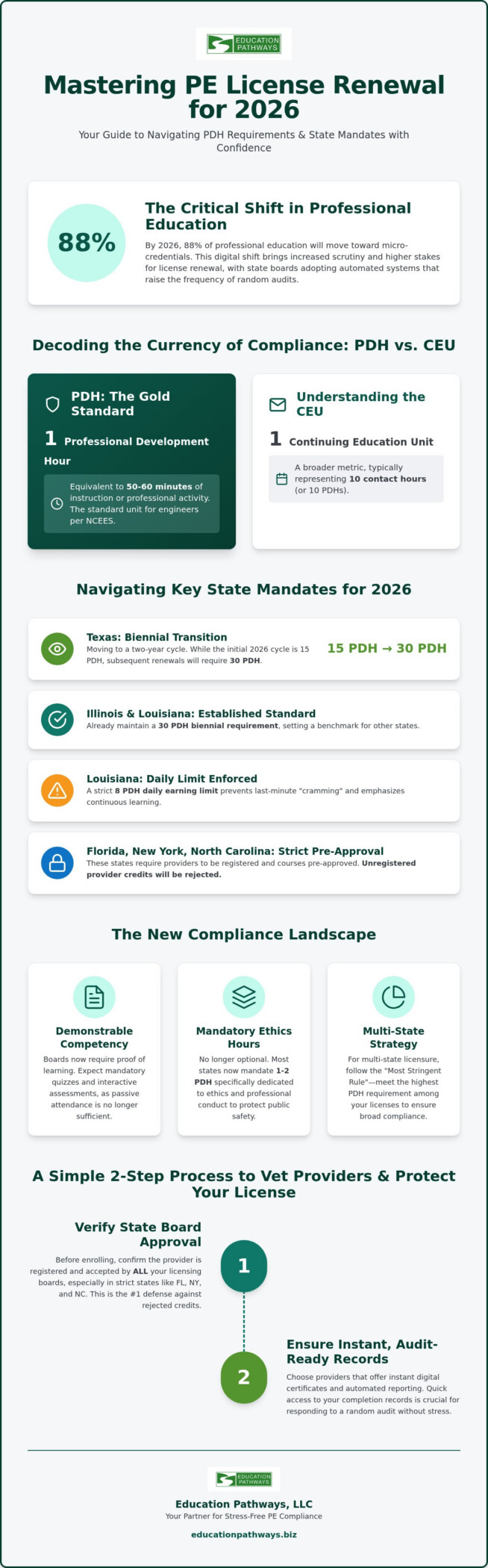
The Professional Development Hour (PDH) is the fundamental currency of licensure maintenance. Most state boards define 1 PDH as at least 50 minutes of instruction or participation in a technical or professional activity. While often used interchangeably with the Continuing Education Unit (CEU), they aren’t identical. Understanding the nuances between these terms is the first step toward compliance:
- PDH: The standard unit, typically representing 50 to 60 minutes of instruction.
- CEU: A broader metric where one unit usually represents 10 contact hours.
- CPC/CPD: The overall competency programs that require you to earn PDHs.
According to NCEES standards for 2026, a PDH is defined as a contact hour of instruction or presentation with a minimum of 50 minutes of actual instruction.
The Evolution of CPC Standards
NCEES model rules serve as the blueprint for state legislatures. In 2026, we see a clear shift toward demonstrable competency. Boards no longer accept passive attendance as proof of learning. They want evidence that the material was actually mastered. This is why many online continuing education for professional engineers programs now include mandatory assessment components, such as end-of-course quizzes or interactive case studies. Additionally, ethics and professional conduct hours are no longer optional bonus topics. Most states now require at least one or two hours dedicated specifically to these areas to ensure public safety remains the top priority. This transition ensures that your education directly translates to safer, more efficient engineering practices while protecting your professional standing.
Why 2026 is a Critical Year for PE Compliance
This year marks a major shift in how boards monitor compliance. State boards like Texas are transitioning to biennial renewal cycles in 2026. While the requirement remains 15 PDH for this initial cycle, subsequent two-year periods will require 30 PDH. Illinois and Louisiana already maintain 30-hour biennial standards. Louisiana even enforces a strict 8-PDH daily limit, meaning you can’t cram a 30-hour requirement into a single weekend. Many states have launched new digital portals that require real-time credit reporting. The days of keeping paper certificates in a desk drawer are fading. With this digital shift, the frequency of random audits for online-only credit submissions has increased. Boards now use automated systems to flag inconsistencies instantly. Staying ahead of the last-minute renewal rush is essential to avoid the stress of a potential license suspension. Choosing a reliable partner for online continuing education for professional engineers ensures your certificates are ready the moment you need them. Having an instant digital certificate available for download provides the peace of mind necessary to meet tight deadlines without administrative friction.
State-Specific Requirements and Reciprocity Rules
Engineers licensed in multiple jurisdictions face a complex patchwork of regulations. While one state might accept any technical course, another might demand specific state-approved modules. This lack of uniformity is the biggest hurdle for busy professionals. For example, Texas is transitioning to a biennial renewal system in 2026. This means the 15 PDH requirement for this cycle will double to 30 PDH for the next. Meanwhile, Louisiana enforces a strict 8-hour daily limit on earned credits. To stay compliant, many utilize the NCEES CPC Tracking system. It’s a central hub that helps you organize credits across different boards without losing track of varying deadlines. It’s a vital tool for those managing online continuing education for professional engineers across multiple states.
Some states require “pre-approval” for providers. Florida, New York, and North Carolina are notably strict about which companies can offer courses. If your provider isn’t registered with these specific boards, your credits won’t count during an audit. This registration process ensures the material meets the state’s educational standards. Always verify that your chosen provider holds the necessary credentials for your specific licensing board before you begin a course.
Managing Multi-State Licensure
If you’re licensed in several states, the “Most Stringent” rule is your best defense. By meeting the highest PDH requirement among your licenses, you usually cover the others by default. You should also look for reciprocity agreements between neighboring boards. Understanding how regional requirements overlap can save you hours of redundant study. Compliance complexity isn’t unique to engineering. Professionals in adjacent fields often face similar hurdles, as seen in our guide to Tennessee contractor continuing education. Using a structured approach helps you avoid the fear of an audit due to unapproved credits.
The Ethics and Law Mandate
General technical credits can’t replace mandatory state-specific law and ethics courses. Most jurisdictions now require 1 to 2 hours of ethics training. These aren’t just “feel-good” sessions. They cover the legal boundaries of your specific state’s practice act and professional conduct rules. The National Society of Professional Engineers (NSPE) often highlights the importance of these standards in maintaining public trust. Finding board-approved ethics modules is critical. You don’t want to realize on renewal day that your general ethics course doesn’t meet your state’s particular legal definitions. To simplify your next renewal, consider using state-approved online bundles that include all required ethics and law hours.
Comparing Online Continuing Education Formats
Professionals have several choices when selecting online continuing education for professional engineers. The right format depends on your learning style and your state’s specific rules. Text-based On-Demand courses are the gold standard for flexibility. You can read at your own pace and easily search for specific technical details. Live Webinars offer real-time interaction but require you to be online at a fixed time. This can be difficult for engineers managing field operations. Video-on-Demand provides a balanced approach. It offers visual engagement while allowing you to pause when a project call interrupts your study.
Boards are increasingly favoring interactive learning over passive observation. The NCEES Continuing Professional Competency (CPC) Standard encourages activities that involve active participation and verifiable learning outcomes. This trend ensures that the time you spend studying actually translates into improved professional skills rather than just checking a box.
The Benefits of Self-Paced Online Learning
Self-paced learning fits into the natural gaps of a high-pressure career. You can complete hours during travel or project downtime. Modern platforms ensure accessibility across mobile devices and tablets. This allows for on-site learning between inspections or meetings. If you are also licensed in related fields, you can find similar Florida architecture ce online options that offer the same mobility. Reviewing complex technical material multiple times is another huge advantage. You don’t have to worry about missing a detail in a fast-paced live lecture. You control the speed of the information.
Technical Requirements for Online CE
Not all online courses are treated equally by state boards. Some states, like Ohio and New York, have “Timed and Monitored” requirements. These rules ensure that you actually spend the required amount of time on the material. Systems may use timers that pause if the window is inactive or if you stop scrolling. Automated assessments and quizzes have also become the norm. They verify professional competency by testing your knowledge immediately after a module. This replaces the old attendance-based model with a results-oriented approach. It provides a clear record that you understood the technical data presented.
An instant certificate is a digital document issued immediately upon course completion that allows you to prove compliance to your board without waiting for manual processing. This speed is essential for meeting tight deadlines with zero stress.
How to Choose a Board-Approved Provider
Selecting a provider for online continuing education for professional engineers requires a methodical approach. Don’t just pick the first result on a search engine. Your license is too valuable to risk on unverified credits. Follow these steps to ensure your provider meets the necessary standards:
- Step 1: Check the “Approved Provider” list on your specific state board website to guarantee credit acceptance.
- Step 2: Verify the provider’s history and reputation. Look for companies with at least 10 years in business; longevity indicates they understand complex regulatory shifts.
- Step 3: Ensure the course content is authored by qualified PEs. Technical material must be accurate and current.
- Step 4: Confirm the reporting process. Determine if they offer automatic reporting or if you must handle the manual upload yourself.
- Step 5: Test the customer support responsiveness. Send an email or call before you buy to see how quickly they assist you.
Quality matters more than a bargain price. If a provider can’t answer basic questions about your state’s 2026 mandates, they aren’t the right partner for your career.
Red Flags in Online CE Providers
Watch out for extremely low prices. If a course is significantly cheaper than the industry average, it often suggests outdated or unverified content. High-quality technical training requires regular updates to reflect current codes and safety standards. Another warning sign is the lack of a money-back guarantee. A reputable provider stands behind their courses if a board rejects your credits. Avoid websites with no clear contact information or technical support. Professional compliance is too important to trust to an anonymous entity with no accountability.
The Importance of Instant Verification
You should never wait more than 24 hours for your certificate. In a high-pressure engineering career, delays create unnecessary risk. Instant digital certificates are the standard for modern online continuing education for professional engineers. These documents often include digital signatures or verification codes to prevent board rejection. This level of security ensures your compliance record is beyond reproach and ready for any audit.
Reliability isn’t limited to the engineering field. Other licensed professionals face similar high-stakes requirements, which we cover in our guide to social work continuing education online. For engineers, the goal is a streamlined process that removes administrative friction. You need a partner that has already done the heavy lifting of vetting board rules. Start your renewal today with state-approved engineering courses that guarantee acceptance and total peace of mind.
Streamlining Your PE License Renewal with Education Pathways
Education Pathways, LLC provides a no-nonsense approach to professional compliance. We aren’t just another course provider; we act as a reassuring partner for busy professionals. Since our establishment in 2002, we’ve helped thousands of individuals navigate complex licensing cycles. This longevity is a distinct advantage for your long-term license safety. We’ve already performed the heavy lifting of vetting board rules so you can proceed with confidence. Our platform minimizes friction at every step. You can move from enrollment to instant certificate generation without administrative delays. This efficiency is critical for those managing high-pressure careers. We also support multi-disciplinary professionals by offering online continuing education for professional engineers and architects in one convenient location.
The Education Pathways, LLC Experience
Our 100% online, self-paced format is designed for the modern engineer. You don’t have to sacrifice project time for classroom attendance. Our courses are specifically updated to meet 2026 standards for professional competency. We provide robust support for Florida-specific mandates and ensure our credits align with national reciprocity rules. We understand the unique pressures of finding reliable online continuing education for professional engineers while managing a full project load. Our system reports to appropriate licensing boards automatically where applicable. This reduces the risk of an audit due to missing or unapproved credits. You get the satisfaction of completing a requirement without complication.
Ready to Secure Your License Renewal?
The 2026 renewal cycle brings significant changes, including the Texas transition to biennial reporting and stricter digital tracking in many states. Don’t wait until the deadline to find out your credits don’t count. The best practice for 2026 is to verify board approval early and choose a provider with a proven track record. You can start fulfilling your PDH requirements today with zero stress. Our platform provides the technical register appropriate for licensed individuals while remaining approachable and functional. Protecting your professional standing is a simple, methodical process when you have the right guide. Enroll in Engineering Continuing Education now and secure your license with total peace of mind.
Secure Your Professional Standing for 2026
Maintaining your PE license is a critical responsibility that demands precision and foresight. You now have the tools to navigate the shift toward biennial renewals and stricter digital reporting requirements. Remember that choosing state-approved online continuing education for professional engineers is about more than just checking a box; it’s about protecting your career from the risks of an audit. By focusing on board-approved providers and prioritizing self-paced formats, you can fulfill your requirements without disrupting your project schedule.
Education Pathways has been a dedicated partner for licensed professionals since 2002. Our platform offers 100% online, self-paced learning that fits into your high-pressure career. You’ll receive instant digital certificates of completion the moment you finish a course. This ensures you’re always ready for renewal deadlines. Don’t let administrative friction or confusing state mandates slow down your professional progress. We’ve vetted the regulations so you can focus on your next major project.
Browse State-Approved Engineering CE Courses and complete your PDH requirements with total confidence today. Your future compliance is just a few clicks away.
Frequently Asked Questions
What is the difference between PDH and CEU for engineers?
A Professional Development Hour (PDH) represents at least 50 minutes of instruction. In contrast, a Continuing Education Unit (CEU) typically equals 10 contact hours. While some providers use CEUs, most state engineering boards require you to report your credits in PDHs. Understanding this conversion is vital for accurate reporting. Our platform ensures that all courses are clearly labeled with the correct PDH value to simplify your license renewal process.
How many PDH hours do I need to renew my PE license in 2026?
Your required hours depend entirely on your state of licensure. For 2026, Texas PEs need 15 PDH as the board transitions to a biennial cycle. States like Louisiana and Illinois require 30 PDH every two years. It’s essential to verify your specific board’s mandate before enrolling in online continuing education for professional engineers. We update our course bundles regularly to reflect these changing state requirements for maximum compliance safety.
Can I carry over excess PDH credits to the next renewal cycle?
Many jurisdictions allow you to carry over a maximum of 15 excess PDH credits to the next renewal period. However, this isn’t a universal rule. For instance, Illinois currently doesn’t permit any carryover of credits. You should always confirm the “rollover” limit with your specific state board to avoid losing hard-earned hours. Keeping organized digital records helps you track which credits apply to your current or future cycles.
Do all states accept online continuing education for professional engineers?
Most states accept online formats, but technical requirements vary significantly. Some boards, such as Ohio and New York, demand “timed and monitored” courses to ensure you spend the full required time on the material. Other states are more flexible with self-paced, text-based options. We’ve provided state-approved online continuing education for professional engineers since 2002, ensuring our platform meets the diverse technical standards required by different state engineering boards across the country.
How do I know if an online course is board-approved?
You should first consult the “Approved Provider” list on your state board’s official website. While some boards don’t pre-approve specific courses, they do set strict standards for technical content and professional ethics. Look for providers with a long-standing reputation and courses authored by qualified PEs. Choosing a veteran provider that offers instant certificates and board reporting is the most reliable way to ensure your credits are accepted.
What happens if I am audited by my state engineering board?
If audited, you’ll need to submit official certificates of completion for every PDH reported during that cycle. The board will verify the provider’s status and the course’s technical relevance. If your credits are rejected, you could face administrative fines or even license suspension. Using a provider that offers instant digital certificates and verifiable signatures provides the documentation you need to resolve an audit quickly and without unnecessary stress.
Are ethics courses mandatory for all professional engineers?
Ethics training is becoming a mandatory requirement in an increasing number of states. In 2026, jurisdictions like Texas, Louisiana, and Illinois require at least one to two hours of professional conduct or ethics training. Even if your state hasn’t made it mandatory yet, these courses are highly recommended for overall professional competency. We include these essential modules in our engineering bundles to ensure you meet all possible state mandates.
How long should I keep my PDH certificates of completion?
You should generally maintain your PDH records for a period of three to six years, depending on your state’s specific rules. Boards often conduct random audits long after a renewal cycle has ended. Storing digital copies of your certificates in a secure cloud environment is the most efficient way to manage this. Our platform provides permanent access to your completion records, so you can download them whenever a board request arises.