
The 2026 License Renewal Checklist for Professionals

The biggest renewal task isn’t always the coursework. It’s knowing which rules apply to your license. Requirements differ by license, state, and renewal cycle, so a useful license renewal checklist for professionals starts with the current rules for your specific license. Then it turns each requirement into a task you can track.
This checklist lays out what to verify and complete before you submit. Confirm your deadline and requirements with the licensing authority, plan any continuing education (CE), organize certificates and documentation, and review your application before filing. Course completion and confirmation of your renewal status are separate steps. Self-paced online CE fits coursework around a busy schedule, and saved completion records document what you’ve finished. Work through the steps in order to catch missing items early and know what to check after submission.
Key Takeaways
- Use a license renewal checklist for professionals to track tasks, then follow current instructions from the authority that regulates your specific license.
- Separate renewal tasks by license and category so CE, ethics topics, reporting, and applications stay distinct across professions.
- Record the source and due date for each requirement, and save course certificates and completion dates where you can find them.
- Treat course completion and renewal approval as distinct milestones, then check your status after submitting.
- Save regulator links and renewal records together so the next cycle is easier to organize.
Start Your Professional License Renewal Checklist with the Right Requirements
Organize renewal work without assuming every license follows the same rules. A license renewal checklist for professionals is a tracking tool, and your licensing board’s current instructions remain the source for what you must do. Renewal rules depend on the profession, credential, and jurisdiction. The overview Understanding Occupational Licensing and Renewal provides background on why licensing requirements vary. Use your regulator’s current guidance to plan your own renewal.
Before adding coursework or forms to your plan, identify the exact license and authority involved. Then create a tracker with a separate row for each task and columns for the requirement, official source, due date, status, and proof of completion. This shows what applies, what you’ve done, and what still needs attention.
Identify the license and authority that control your renewal
Start with your license record and the issuing authority’s official website or account. Capture the credential details exactly as they appear. If you hold more than one license, check each separately. Different credentials may have different renewal schedules, education requirements, forms, or reporting steps, even within the same profession.
- License: Record the exact license name and number.
- Authority: Note the issuing board or regulator and the jurisdiction.
- Source: Save the official renewal page or account location, along with the date you reviewed its instructions.
Matching requirements to the specific license matters because a rule for one credential, board, or jurisdiction may not apply to another. Fill every field from official sources, and confirm that a colleague’s checklist matches your license details before you borrow from it.
Build a renewal calendar before the deadline approaches
Once you’ve found the official instructions, record the published deadline and set an earlier personal target. Work backward from that target, allowing time to complete applicable education, gather documentation, submit the application, and review your renewal status. If one task depends on another, schedule them in that order.
- Enter the official deadline and your personal completion target.
- Schedule reminders for coursework and any required documentation.
- Set a submission reminder, then a separate reminder to check your status.
Add each item to the tracker with its source, due date, status, and proof. A coursework row, for example, can identify the regulator’s requirement, show your planned completion date, and later link to the certificate or reporting record. If the official instructions leave a detail unclear, mark it for confirmation. This keeps verified requirements distinct from open questions and gives each task a clear next action.
Check Renewal Deadlines, Continuing Education, and Eligibility
Once you’ve identified the license, verify the conditions for its current renewal cycle. Deadlines, renewal windows, CE requirements, required subject areas, and eligibility rules vary by profession and jurisdiction. Use the current instructions in your regulator’s official account or renewal notice, and compare them with your license record.
A reliable license renewal checklist for professionals separates confirmed requirements from questions that still need an official answer. It also distinguishes required CE from optional professional development. A course that supports your growth counts toward mandatory renewal only when it meets the regulator’s requirements. Keep those categories separate in your tracker so useful learning and qualifying credit don’t blur together.
Verify the deadline and renewal window
Review your latest renewal notice and official license portal for the applicable dates. Confirm whether CE completion, application submission, and payment have separate cutoffs, and record each date separately when the regulator lists them separately. Include a grace period or late-renewal option in your plan only when the authority’s current rules confirm it. For more on that topic, see the professional license renewal grace period guide.
Match continuing education to the specific license
Check the regulator’s current instructions for required hours, subject areas, accepted formats, and course restrictions. Confirm that completed courses fall within the accepted reporting period. For a license-specific example, the Florida CAM CE requirements page addresses Florida community association manager continuing education. It speaks to that credential and jurisdiction.
Before marking CE complete, compare each course record with the requirement it is meant to satisfy. Note the course title, completion date, subject, and any certificate or reporting confirmation. If the regulator uses a course-completion reporting process, follow its current instructions to learn what evidence to retain and whether you need an additional step.
Review eligibility separately from coursework. Your license record may show a status or condition that affects renewal, and the authority may set additional requirements for particular circumstances. If you have a question about disciplinary status, an inactive credential, or another eligibility issue, consult the regulator’s official rules or account instructions before submitting. CE addresses the education requirement, and eligibility is its own item.
- Deadline: Confirm the renewal window and each listed cutoff.
- CE: Match required hours and topics to the correct license and reporting period.
- Eligibility: Review your license record and applicable official rules for any conditions.
- Open questions: Record what needs confirmation and the official source to consult.
Course completion is evidence of learning, not proof that every renewal condition has been met. Track it as one completed item, then review the application, eligibility requirements, and submission instructions before treating renewal as complete. If you plan to take online CE, first verify that the course format and content meet the rules for your license.
Compare Your Renewal Tasks Without Mixing Rules Across Professions
A license renewal checklist for professionals works best when it separates repeatable tasks from rules tied to a specific credential. You can use the same tracking structure across licenses, but the details must come from each license’s current regulator instructions. One profession’s checklist cannot stand in for another’s, because required subjects, credit limits, reporting processes, and application steps differ.
The comparison below shows what to organize. Treat each row as a prompt for checking your own authority’s requirements.
| Task category | What may vary |
|---|---|
| Continuing education | Required subjects, accepted course formats, credit limits, and the period in which courses must be completed. |
| Ethics or other mandated topics | Whether a topic is required, how it is defined, and whether it must be completed separately from general CE. |
| Reporting and records | Whether completion is reported by a course provider, entered by the licensee, or supported by records retained for review. |
| Renewal application | Forms, attestations, eligibility questions, and submission steps specified by the licensing authority. |
Separate shared checklist steps from license-specific rules
Keep the framework consistent: identify the regulator, track applicable dates, save records, submit what’s required, and check your license status. Then record the variable details separately for each credential. If you hold licenses in different professions or jurisdictions, give each its own requirement notes and source links. Similarly, practitioners expanding into program management or facility oversight face distinct regulatory steps; for those establishing treatment programs, Consult Pros Inc supports operators through launching and running behavioral health facilities.
Texas real estate licensees, for example, can use the Texas real estate CE requirements page as a profession-and-state reference. Social work continuing education is a separate license context, with its own regulator instructions. Each example applies to its own credential and jurisdiction.
Example: New Jersey real estate CE requirements for 2025–2027
New Jersey real estate licensees renewing for the 2025–2027 period can use the same structure. Give the New Jersey real estate license its own row set in your tracker, and build it from the New Jersey Real Estate Commission’s current renewal instructions.
- License and authority: Record your New Jersey license type, number, and the commission as the issuing authority.
- Cycle: Label every entry with the 2025–2027 renewal period so records from earlier cycles stay separate.
- CE requirements: Copy the required hours, mandated subjects, and accepted course formats from the commission’s official page, and note the date you reviewed it.
- Proof: Save each certificate, completion date, and reporting confirmation under the New Jersey folder.
- Status check: After you submit, confirm the renewal in your official license record.
Keep New Jersey details out of your other licenses’ rows. A Florida, Texas, or other state license renews on its own terms, so each one gets its own source links and notes. If you hold a New Jersey license alongside another credential, a single course or application doesn’t automatically cover both.
Use profession-specific guides as examples, not substitutes
A focused guide helps you identify questions about a particular license, such as which CE topics to track or where reporting fits into renewal. Use it to organize your research, then compare its guidance with your regulator’s current rules and your license record. For each credential, note the official source, applicable requirements, and details that still need verification. Copy credit totals, ethics topics, and forms only from the regulator that governs that license.
Once you’ve confirmed which education applies, self-paced online CE helps you fit coursework into your renewal plan. Review online continuing education options and match your course selection to the requirements for your license.
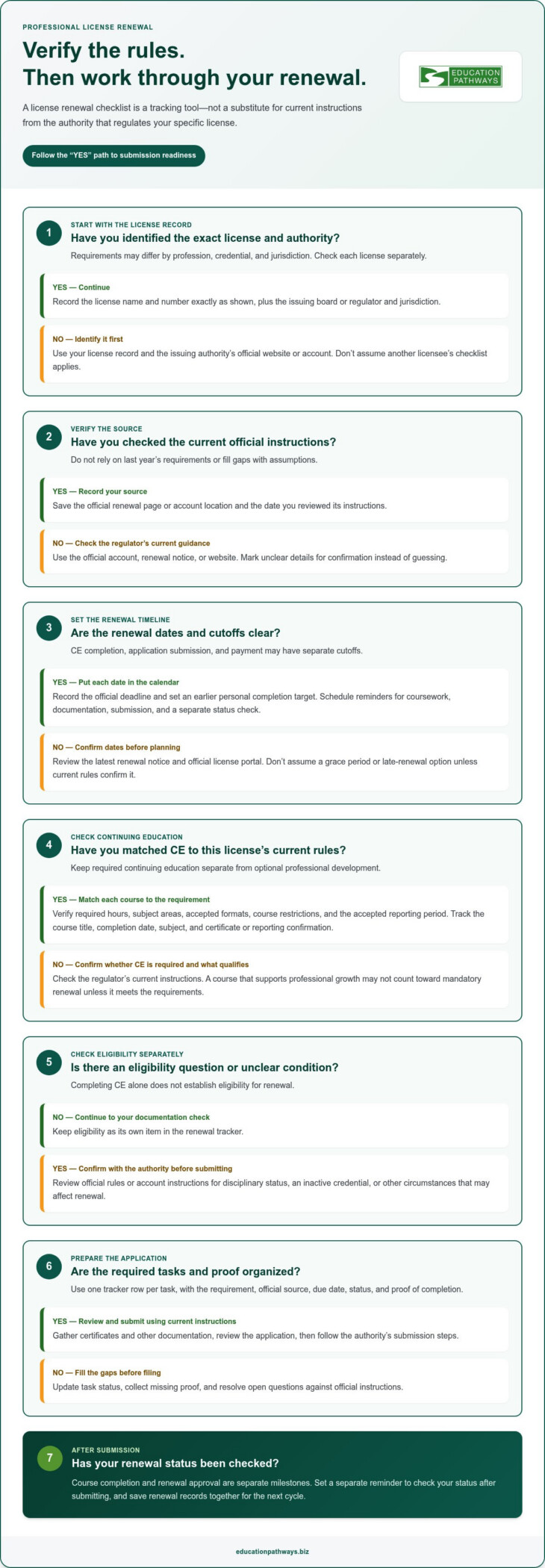
Work Through the License Renewal Checklist and Save Your Proof
With the applicable requirements identified, work through each task in sequence and save evidence as you go. A license renewal checklist for professionals should show both what you’ve completed and how you can document it. Store records in one secure, accessible location, such as a digital folder organized by license and renewal cycle. Use consistent filenames that include the course or task and completion date, so you can find evidence quickly.
- Confirm the current rules. Review the licensing authority’s instructions and your license record before acting. Note required forms, education, attestations, and supporting materials.
- Complete applicable CE. Enroll after matching the course content and format to your license requirements. Keep optional professional development separate from required education.
- Save your evidence. Store certificates, completion dates, course details, and any reporting confirmation together.
- Submit the renewal. Follow the authority’s current application and submission steps. Keep copies of materials and confirmation records.
- Verify your license status. Check the official license record after processing, and use the regulator’s process if the status is unclear.
Complete and document required education
Online CE fits required coursework into a busy renewal plan once you’ve confirmed that the content and format apply. Education Pathways, LLC provides self-paced online CE, instant certificates after course completion, and reporting to the appropriate licensing boards. Keep your certificate and any reporting record even when completion is reported for you. A certificate documents completion, board reporting is a separate record, and the regulator’s instructions determine what evidence you’re expected to retain.
For each course, save its title, completion date, certificate, and any available reporting confirmation. If you complete multiple courses, record each separately rather than relying on a single total. This shows which learning activity corresponds to which requirement and makes recordkeeping questions easy to resolve later.
Submit the renewal and confirm the outcome
Use the licensing authority’s official instructions to complete and submit the application. Save the submission confirmation, receipt, confirmation number, and a copy of submitted materials when available. These records show what you sent and when, while the license record shows the outcome.
After submission, check the official license record for your current status. If it hasn’t changed or the result is unclear, follow the regulator’s stated process for checking on an application. A completed course, submitted form, or confirmation screen is a milestone along the way. The checklist’s final step is verifying your official license status in the regulator’s record.
To plan coursework around verified requirements, explore self-paced online continuing education for applicable professional licenses.
Make Your Next Renewal Easier with a Repeatable System
A completed renewal becomes the starting point for the next one. Keep the tracker and records you’ve built as a framework. Renewal instructions can change between cycles, so refresh the details against the licensing authority’s current guidance before scheduling education or preparing an application.
A reusable license renewal checklist for professionals makes it easy to find what applied, what you completed, and what you’ll verify again. Keep a separate record for each credential so every license’s dates and documents stay distinct.
Create a record system you can reuse
Store regulator links, renewal dates, course records, certificates, and submission confirmations together in a secure, accessible folder. Organize files by license and cycle, and use clear names that include the record type and date. Keep records for the period and in the format required by the relevant authority.
At the start of each cycle, revisit saved links and update your tracker with current instructions. Mark older notes as historical so each cycle starts from confirmed requirements.
- Keep: Official regulator pages, notices, and instructions.
- Track: Due dates, course completion, application submission, and status checks.
- Save: Certificates, completion dates, reporting details, and renewal confirmations.
Choose a clear next step for your license
Start the next cycle by returning to the official licensing authority for the rules that apply to your credential. Identify your next action, such as reviewing the renewal notice, checking your record, or planning required CE. If education is part of the renewal, verify the applicable subjects, format, and reporting instructions before choosing a course.
Online, self-paced CE helps you schedule applicable learning around work and other commitments. Education Pathways, LLC offers online CE with instant certificates after course completion and reporting to the appropriate licensing boards. Keep the certificate and any reporting record with your other renewal documents, then check your license status separately.
Use precise status labels in your tracker: “course completed,” “reported,” “application submitted,” and “status verified” describe different steps. Each cycle, compare your records with the regulator’s instructions and confirm the official license record reflects the outcome.
Explore online continuing education options to plan applicable coursework for your next renewal cycle.
Set Up Your Next Renewal Before It Sneaks Up
Choose a clear trigger for restarting the process, such as a new notice from your licensing authority or the opening of its renewal window. Add that trigger to your calendar now. When it arrives, revisit your tracker and update it against the rules for that cycle.
A license renewal checklist for professionals works best as a living tool. Keep it clear enough to use when work gets busy and flexible enough to reflect changes to your license requirements. You don’t need to solve every future detail today. Make the next action easy to find.
If continuing education applies to your license, explore online continuing education courses for your license as you plan your next steps. A little preparation now gives your next renewal a calmer start.
Frequently Asked Questions
What should be included in a professional license renewal checklist?
Include the license details, applicable requirements, deadlines, application tasks, and records needed to show completion. A useful license renewal checklist for professionals also notes when each rule was verified and whether an item is confirmed, complete, or awaiting clarification. If a regulator’s page and your renewal notice appear to differ, flag the mismatch and resolve it through official guidance.
How far in advance should I start renewing my professional license?
Start as soon as the licensing authority publishes the renewal instructions or you receive a renewal notice. Lead time varies by license: required coursework, reporting steps, application processing, and your schedule all affect planning. Starting early gives you time to follow the regulator’s process if you find a missing record or an unclear eligibility detail.
Do all professionals need continuing education to renew a license?
No. Continuing education requirements depend on the profession, license, and jurisdiction, and some credentials have other renewal conditions instead. Check the current rules for your specific license. If CE applies, verify the required subject matter and eligibility before choosing a course. A regulator’s renewal notice or license portal is a practical place to begin.
Where do I find New Jersey real estate CE requirements for 2025–2027?
Go to the New Jersey Real Estate Commission’s official renewal instructions and your license account. Record the required hours, mandated subjects, and accepted course formats for the 2025–2027 period in a dedicated New Jersey section of your tracker, with the date you reviewed them. Save certificates and completion dates there as you go.
How can I check whether my continuing education credits were reported?
Check your license account or official regulator portal for the course or credit record, then compare it with your certificate and completion details. Reporting procedures differ: a provider may report completion, or the regulator may require another step from you. If the credit doesn’t appear, review the authority’s instructions and use its stated process to resolve the discrepancy. Keep the certificate available in the meantime.
What happens if I miss my professional license renewal deadline?
The effect depends on the licensing authority’s rules and your license status. A missed deadline may require additional renewal steps, so check the regulator’s current late-renewal instructions promptly. Confirm whether your license is active, expired, or restricted, and follow the official process before relying on it for work. The expired license reinstatement guide walks through the general process.
Is completing a continuing education course enough to renew my license?
No. Completing a course addresses the education requirement it qualifies for. You may also need to satisfy other conditions, submit a renewal application, and follow the authority’s process for confirming your license status. Keep course records, and verify the outcome in the official license record.
Can I use the same renewal checklist for different professional licenses?
Use the same basic tracker structure, but create a separate requirement record for each license. Shared fields keep you organized, while deadlines, CE rules, forms, and reporting steps are matched to each credential and regulator. Label records clearly by license and jurisdiction, and verify each set of instructions independently.